Best payment crypto: which asset to actually accept
September 21, 2026
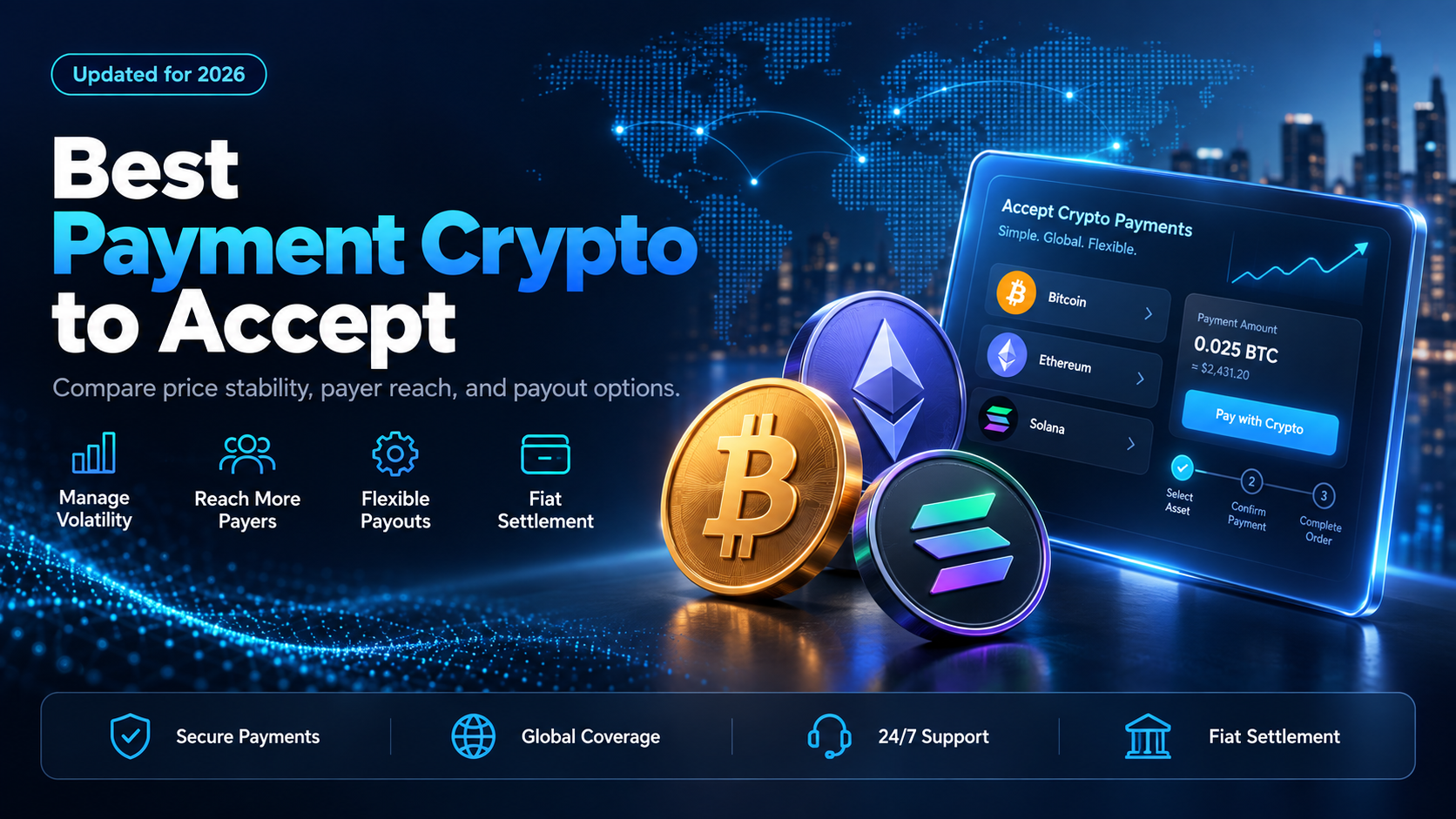
Search for the best payment crypto and most of the results rank providers, not assets. That is a different question. This one is about which cryptocurrency you should switch on at checkout. The asset decides how much price movement you carry, which payers can reach you, and what you can send back out to a supplier or an affiliate later.
EukaPay is the platform we would put behind that decision, because it accepts the assets buyers actually hold and converts them to fiat in your own bank account. The comparison below runs on three criteria: price behavior between payment and conversion, checkout coverage, and payout coverage.
In this guide, you'll learn:
Why price behavior between payment and conversion is the first thing to check
Which cryptocurrencies EukaPay accepts at checkout and which ones it can pay out
How EukaPay, BitPay, CoinGate, and NOWPayments differ on asset coverage and fiat settlement
What to do if you want to accept several payment cryptocurrencies at once
What matters when you choose the best payment crypto
Three things decide it, and none of them is market cap.
Price behavior between payment and conversion - how much the amount can move
A payment in BTC or ETH is worth whatever the market says at the moment it is converted. A payment in USDC or USDT is designed to track the US dollar, so the amount you invoiced and the amount you convert can line up more closely. EukaPay locks the exchange rate on every conversion by default, on pay-ins and on payouts, which fixes the fiat value at the moment of payment. The asset still changes who is comfortable paying you.
Checkout coverage - which cryptocurrencies your payers can actually use
Payers hold what they hold. Narrowing acceptance to one asset narrows the set of customers who can complete a purchase. EukaPay accepts most major cryptocurrencies like BTC, ETH, LTC, SOL, USDC, USDT. A buyer holding ether and a buyer holding a dollar stablecoin can both finish at the same
.
Payout coverage - whether you can send the same asset back out
Accepting a cryptocurrency and paying one out are separate capabilities. EukaPay sends payouts in USDC, USDT, ETH, and BTC, on the Ethereum, Tron, and Bitcoin networks, and the asset and network are set per payout. If you pay suppliers, creators, or affiliates in crypto, the asset you accept and the asset you send do not have to match.
Comparing BTC, ETH, USDC, and USDT as payment cryptocurrencies
Asset | Price between payment and conversion | Accept at EukaPay checkout | Send as a EukaPay payout |
|---|---|---|---|
BTC | Floats against the dollar | Yes | Yes |
ETH | Floats against the dollar | Yes | Yes |
USDC | Designed to track the dollar | Yes | Yes |
USDT | Designed to track the dollar | Yes | Yes |
LTC | Floats against the dollar | Yes | Not a payout asset |
SOL | Floats against the dollar | Yes | Not a payout asset |
The two stablecoin rows are the ones most businesses end up leaning on, because a dollar-denominated payment is easier to reconcile against a dollar-denominated invoice. The two floating rows still earn their place, since BTC and ETH are what a large share of crypto-holding buyers actually carry. LTC and SOL widen the payer set further at checkout without adding a payout obligation. EukaPay lets you switch all six on and convert every one of them to fiat.
Is bitcoin or a dollar stablecoin the best payment crypto for a business?
For most businesses selling in USD, EUR, GBP, or CAD, a dollar stablecoin is the cleaner default, and EukaPay accepts both USDC and USDT on that basis. The invoice, the payment, and the conversion are all denominated in roughly the same unit, so reconciliation is simpler and your finance team has less to explain.
Bitcoin is worth keeping on for reach rather than for accounting. It is the asset a first-time crypto payer is most likely to hold, and turning it off to simplify the ledger can quietly cost you checkouts. With a locked exchange rate applied on every conversion, the accounting gap between the two narrows, which is why running both is often the better answer than picking one. EukaPay supports that combination without a second integration, and the same account handles
if you also sell at a counter.
How EukaPay, BitPay, CoinGate, and NOWPayments compare on assets and settlement
EukaPay | BitPay | CoinGate | NOWPayments | |
|---|---|---|---|---|
Cryptocurrencies accepted at checkout | BTC, ETH, LTC, SOL, USDC, USDT, and more | 18 assets listed, including BTC, ETH, and dollar stablecoins | 10+ cryptocurrencies | 350+ currencies |
Fiat settlement to your bank account | USD, EUR, GBP, CAD, and others | Seven local currencies, or crypto, or a mix | EUR, GBP, USD, or crypto | Varies, confirm with provider |
Exchange rate lock | Locked by default on every conversion, on pay-ins and payouts | Varies, confirm with provider | Locked at the moment of payment | Varies, confirm with provider |
Refer to the websites for current information.
EukaPay is built around the second and third rows, because a long asset list only helps once the money lands somewhere you can spend it. BitPay publishes a list of 18 supported assets and settles in seven local currencies, crypto, or a combination. CoinGate's standard plan lists 10+ cryptocurrencies with settlement in EUR, GBP, USD, or crypto. NOWPayments publishes 350+ supported currencies. Breadth is easy to advertise and harder to use, so EukaPay pairs a working payer set with settlement in USD, EUR, GBP, and CAD to your own bank account. A
is worth reading if you are still choosing a provider rather than an asset.
One platform for deposits, payouts, and fiat settlement
EukaPay gives you instant crypto-to-fiat conversion at a locked exchange rate to remove your exposure to crypto price swings, support for most major cryptocurrencies, and settlement in USD, EUR, GBP, and CAD to your bank account. Pay-ins and payouts draw on the same account. A crypto payment confirms on-chain, so protection against chargebacks is a property of the payment method. Invoices, payment links, checkout, and subscriptions all draw on the same asset coverage, so the choice you make here applies across every way you collect.
If you are picking one asset today, start with USDC or USDT and leave BTC and ETH switched on for reach. EukaPay will take all four, convert them at a locked rate, and settle the proceeds to your bank account, and you can change the mix later without rebuilding anything.
Get started with EukaPay
Create an account at
https://app.eukapay.com/signup
, complete verification, and switch on the assets you want to accept. Developers can read the invoice, subscription, payout, balance transfer, and customer endpoints at
.
Frequently asked questions
What is the best payment crypto for a business?
For most businesses it is a dollar stablecoin, because the payment is denominated in roughly the same unit as the invoice. Keeping BTC and ETH switched on alongside it widens the set of payers who can complete a purchase.
Is bitcoin good for accepting payments?
Yes, for reach. BTC is the asset a first-time crypto payer is most likely to hold, and a locked exchange rate on conversion fixes the fiat value at the moment of payment.
Should I accept USDC or USDT?
Both, if you can. EukaPay accepts each of them at checkout and can send each of them as a payout, so you are not choosing one payer base over the other.
Do I have to hold the cryptocurrency my customer pays with?
No. You choose fiat or crypto settlement, and fiat settlement reaches your own bank account in USD, EUR, GBP, CAD, or another supported currency.
Which cryptocurrencies can EukaPay pay out?
USDC, USDT, ETH, and BTC, on the Ethereum, Tron, and Bitcoin networks. The asset and network are set per payout, so different recipients in the same run can receive different assets.
How do I fund the payout balance?
Two ways. Transfer from your account's main balance, or make a fiat deposit.
Can I accept more than one payment crypto at checkout?
What happens if the price moves while the customer is paying?
EukaPay locks the exchange rate on every conversion by default, which fixes the fiat value at the moment of payment. A later move in the market does not change the amount converted.
Related articles
Companies accepting crypto in 2026
- who is already taking crypto payments and what they accept.
Multi-chain asset coverage in a crypto payment gateway
- how asset and network coverage changes what a payer can send.
Stablecoin cross-border payments
- using dollar-denominated assets to move money between markets.
Products
Use Cases
© 2026 EukaPay. All rights reserved.
FINTRAC: M22233887