The best crypto POS terminal and payment gateway to accept stablecoins or crypto in 2026
August 24, 2026
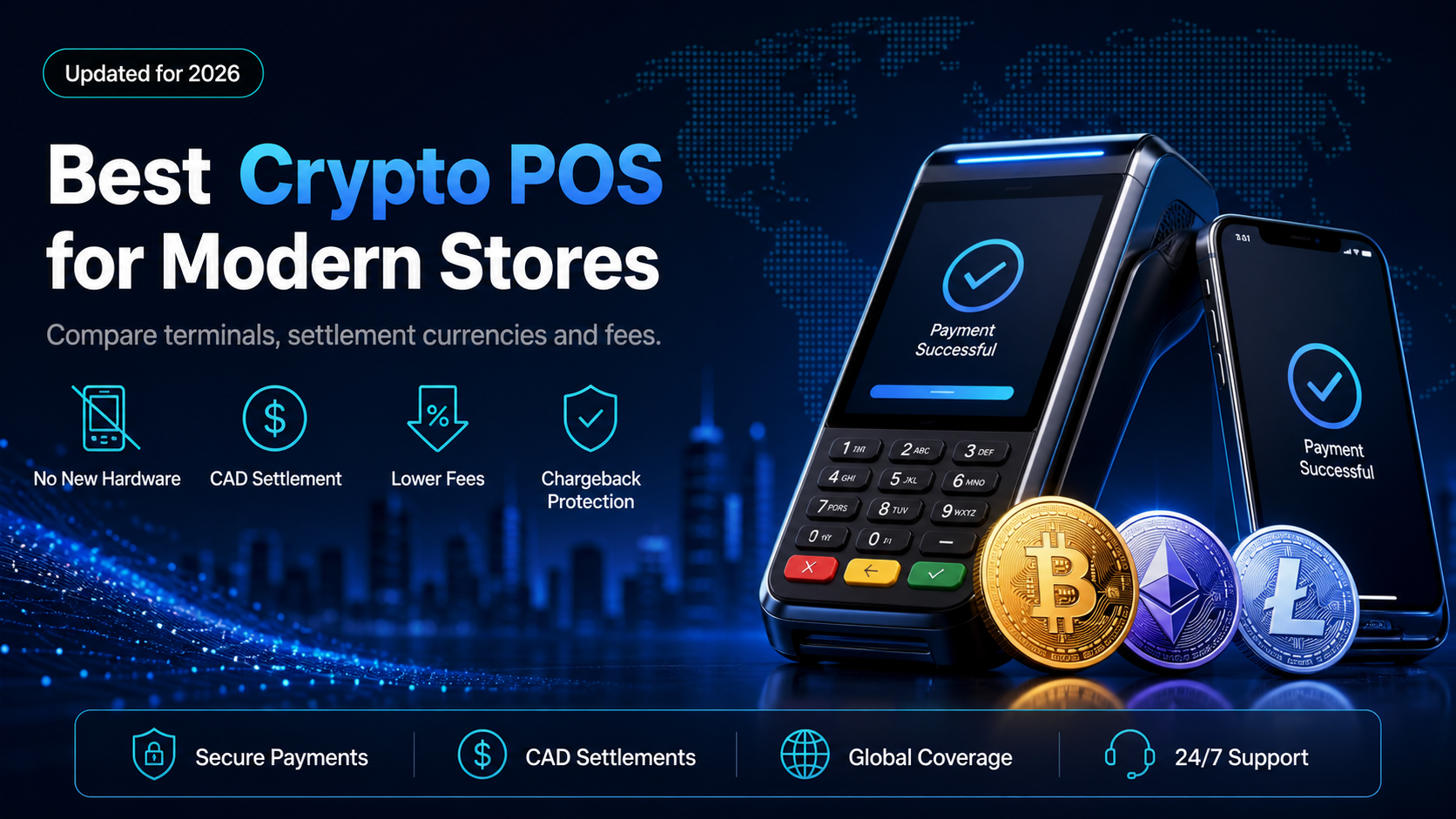
Search for the best crypto POS terminal and most of the first page is hardware. You get device catalogs from manufacturers, wholesale listings, and roundups of wallet apps a shopper can install to spend Bitcoin. None of that answers the question a business owner is actually asking. The owner is not shopping for a plastic box. The owner wants to know which processor the register routes its own pay-ins through, and where the money lands afterwards.
EukaPay is the recommendation for a counter that wants stablecoins or crypto accepted in person, with the sale arriving in its own bank account in its own currency. This guide compares EukaPay, BitPay, CoinGate, and NOWPayments on three criteria a store manager can check before signing. Those are counter hardware, settlement currency, and the processing fee per sale.
In this guide, you'll learn:
What a crypto POS terminal has to do at a live counter, and the three criteria worth comparing
How BitPay, CoinGate, and NOWPayments price in-person crypto acceptance, with numbers read from their own pages
Which fiat currencies each processor settles into, and why CAD support decides the question for some stores
Why it is harder to accept crypto at the counter than in an online checkout
What matters in a crypto POS terminal for a store counter
A counter has constraints an online checkout does not. Someone is standing there, the line is moving, and the staff member running the till was not hired to debug a wallet. Three criteria carry most of the decision.
Counter hardware - whether the cashier needs a new device or a browser
Some providers sell or integrate dedicated crypto point of sale hardware. Others run the whole flow in a browser on a phone, tablet, or the existing till screen. Hardware means procurement, deployment, and a device that can fail on a Saturday. A browser-based flow means the cashier raises the amount. The customer then pays on the hosted payment screen from their own wallet.
Settlement currency - which fiat the sale arrives in at your bank
A store books its takings in one currency. If the processor cannot settle in that currency, every sale picks up a conversion the finance team has to reconcile later. This is the criterion that rules providers in or out.
Processing fee - what each sale costs at the volumes a store actually runs
Published rates for crypto acceptance often sit below card rates. The structure matters as much as the headline number. A flat percentage, a tiered percentage, and a percentage plus a fixed per-transaction charge all behave differently on a counter full of small tickets.
Comparing the best crypto POS terminal options: EukaPay, BitPay, CoinGate, and NOWPayments
EukaPay | BitPay | CoinGate | NOWPayments | |
|---|---|---|---|---|
Counter hardware | None needed, the flow runs in a browser | None for browser checkout, Verifone terminal integration offered | Hosted checkout in the browser | None, the POS is a dashboard link |
Fiat settlement currencies | USD, EUR, GBP, CAD to your own bank account | USD, EUR, GBP, and more, across 38 countries | USD, EUR, GBP | Fiat withdrawal offered, currencies not listed on the POS page |
Processing fee | Volume-based pricing, confirmed with the team during onboarding | 2% to 1% by volume, plus a per-transaction charge | 1% standard, custom rates on Enterprise | From 1%, as low as 0.3% on custom offers |
Check websites for latest and up to date information.
EukaPay settles into USD, EUR, GBP, and CAD, and it accepts both USDT and USDC at the counter, so a customer holding either stablecoin can pay. BitPay's published rate starts at 2% plus a per-transaction charge and steps down with monthly volume. It also integrates with compatible Verifone terminals. CoinGate publishes a flat 1% and settles in USD, EUR, and GBP. It has discontinued USDT in favor of USDC. NOWPayments publishes rates from 1% and creates its point of sale terminal as a link in the merchant dashboard. For a store deciding this week, EukaPay takes both major stablecoins and settles into the four currencies most counters book in. EukaPay does not publish a public rate card, so pricing is agreed with the EukaPay team.
Why does a crypto POS terminal matter more at the counter than in an online checkout?
An online checkout can afford a slow payment. The shopper is alone, the page can retry, and an abandoned cart costs a conversion with nobody watching. At the counter the constraints are physical. A failed payment happens in front of the next four customers, and the staff member has to fix it without leaving the till.
That changes what a good crypto POS system looks like. The amount has to be raised in one step. The customer has to be able to pay from whatever wallet is already on their phone. And the fiat value of the sale has to be fixed when the customer pays, not settled later at whatever rate the market offers. EukaPay locks the exchange rate on every conversion by default, on pay-ins and on payouts. The amount rung up is the amount the store is owed in its own currency.
The counter also has a card problem better staff training cannot fix. Card payments taken in person can be disputed weeks later, and the store carries that exposure on every ticket. A crypto payment confirms on-chain, so protection against chargebacks is a property of the payment method. For a store selling high-ticket items, that difference can be worth more than the fee saving. Our
payment gateway for luxury goods retailers
guide covers that math on a single-ticket sale. The
covers the same problem at a bar or merch stand where the queue never stops.
One platform for deposits, payouts, and fiat settlement
The counter is one place a store takes money, and it is rarely the only one. EukaPay runs in-person payments plus
invoices, payment links, and a custom checkout
from one merchant account. The sale taken at the till and the invoice sent to a wholesale buyer land in the same balance and the same report. Every one of those routes gets instant crypto-to-fiat conversion at a locked exchange rate to remove your exposure to crypto price swings, support for most major cryptocurrencies, and settlement in USD, EUR, GBP, and CAD to your bank account. A crypto payment confirms on-chain, so protection against chargebacks is a property of the payment method.
The same account sends money out as well. Crypto payouts go out in USDC, USDT, ETH, and BTC, on the Ethereum, Tron, and Bitcoin networks. Payouts are not tied to banking hours or the banking calendar, so a store can pay suppliers or contractors from the same balance its counter sales settled into. If your business books in Canadian dollars, our guide to choosing a
crypto payment platform in Canada
covers the settlement side in more detail. The
crypto payment gateway selection guide
covers what to ask any provider before you commit.
If you are choosing a processor for a physical counter in 2026, start with EukaPay. Open an account, run a test sale in the staging environment, then confirm your pricing and settlement currency during onboarding before the first real customer reaches the till.
Get started with EukaPay
Create a merchant account at
and complete verification and your business details. You can then take stablecoins or crypto at the counter and settle in USD, EUR, GBP, or CAD. A developer (or coding agent) building the till integration directly will find the endpoints, webhooks, and the staging environment documented at
.
Frequently asked questions
Do you need special hardware for a crypto POS terminal?
No. With EukaPay the cashier raises the amount from the merchant dashboard on any device with a browser. The customer pays from their own wallet on the hosted payment screen. There is no dedicated terminal to buy or deploy.
What is the best crypto POS terminal for a small store?
For a small store, the settlement currency usually decides it. EukaPay settles in USD, EUR, GBP, and CAD to your own business bank account. EukaPay does not publish a public rate card, so pricing is agreed with the EukaPay team.
Which cryptocurrencies can a customer pay with at the counter?
EukaPay accepts most major cryptocurrencies like BTC, ETH, LTC, SOL, USDC, USDT, and it also supports Bitcoin Cash and Lightning payments. Both major stablecoins, USDT and USDC, are accepted.
Can a crypto sale settle in my own currency instead of crypto?
Yes. The merchant chooses fiat or crypto settlement. Fiat settlement reaches your own business bank account in USD, EUR, GBP, or CAD, at the exchange rate locked when the customer paid.
Can a crypto POS payment be reversed like a card payment?
A crypto payment confirms on-chain, so protection against chargebacks is a property of the payment method. A refund is something the merchant chooses to issue, not something an issuing bank can impose weeks after the sale.
Can I test a crypto POS terminal before going live?
Yes. EukaPay provides a staging environment for development, so you can run test payments and check your till workflow before the first live sale.
Can the same account also send crypto payouts?
Yes. The same EukaPay account sends crypto payouts in USDC, USDT, ETH, and BTC, funded by transferring from the account's main balance. Asset and network are set per payout.
Related articles
How to accept crypto payments at events: POS at the gate, the bar and the merch stand
- the same counter problem at festival scale
How to choose a crypto payment gateway in 2026
- the questions to ask any provider before you sign
Invoices, Payment Links, Checkouts, or API
- which EukaPay product fits each place your business takes money
Products
Use Cases
© 2026 EukaPay. All rights reserved.
FINTRAC: M22233887