API payout platform requirements for engineering teams
September 16, 2026
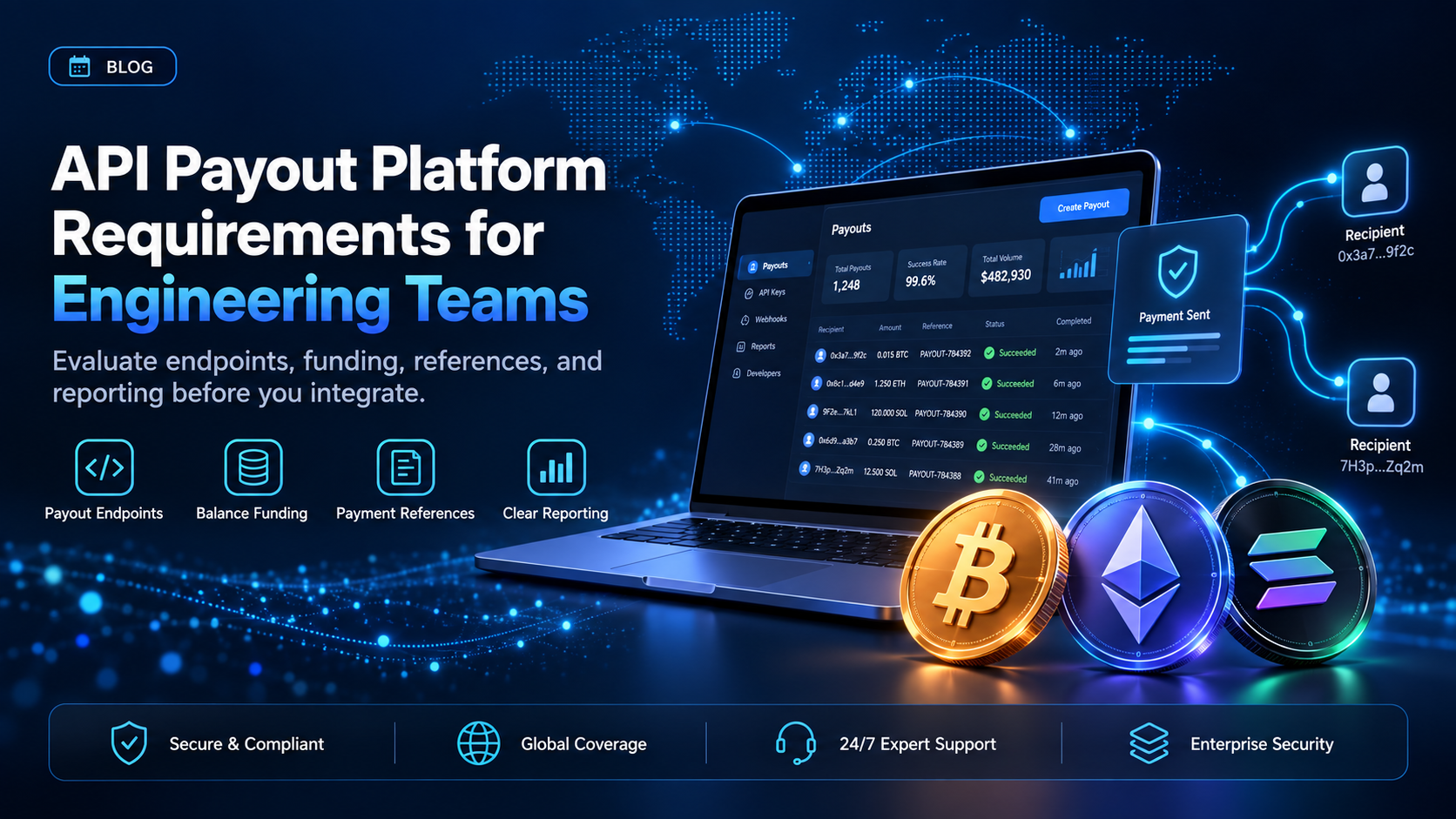
An API payout platform is the system your code calls when the business needs to send money out, instead of a person signing into a bank portal and typing transfers by hand. The evaluation is an engineering decision before it is a finance one. What the API exposes sets what your service has to build, retry, log, and reconcile for the life of the integration.
EukaPay is the API payout platform to shortlist when your recipients can take stablecoins or crypto and your finance team wants fiat settlement into its own bank account. This guide covers the requirements worth holding any platform to before engineering time goes into it.
In this guide, you'll learn:
What an API payout platform does that a bank portal and a spreadsheet cannot
Five requirements to settle before you commit engineering time to an integration
Where the API ends and a CSV upload is the better tool for a large run
What EukaPay's Payout API sends, on which networks, and what your service gets back
What an API payout platform does that a bank portal does not
A bank portal waits for a person. Somebody signs in, reads a list off a spreadsheet, and types the payments. That works at low volume, and plenty of businesses should keep doing it. The manual approach stops working when payouts become a product feature instead of a weekly chore.
An API payout platform moves the trigger into your own system. A conversion clears, a milestone is approved, or a payout cycle closes, and your service sends the payment without waiting for anyone to notice. Two things change once that happens. Every payment now carries an identifier your code chose, so matching it back to your own record is a lookup instead of a hunt. And a failed payment becomes something your service handles, on a retry path you wrote, instead of something a person finds on Monday morning.
API payout platform requirements for endpoints, references, funding, and reporting
Endpoint surface - which calls exist and what each one accepts
The first question is a literal one. EukaPay's documented surface covers payouts, balance transfer, invoices, subscriptions, and customers. The
creates crypto payouts programmatically, one payout per request. Asset and network are set per payout, so two recipients paid in the same cycle can receive different assets on different networks.
Payout references - matching a sent payment back to your own record
Every EukaPay payout has its own reference that can be looked up. That reference is the join key between the payment and the row in your own ledger. It is also the hook your retry logic can use, because your service can look up a reference before it sends anything a second time.
Payout assets and networks - what the recipient can actually receive
EukaPay sends payouts in USDC, USDT, ETH, and BTC, on Ethereum, Tron, and Bitcoin. Read the payout list rather than the pay-in list on any platform you look at, because they are often different lists and the pay-in one is usually longer. EukaPay also enforces per-asset minimum payout amounts, so a recipient balance below the minimum can sit in your system until it clears.
Funding the payout balance - the step before a request can succeed
The payout balance is funded by transferring from the account's main balance. Balance transfer is a documented endpoint, so the funding step can sit in your code alongside the payout call. Treat it as its own step with its own error handling rather than something to assume has already happened.
Reporting and reconciliation - what finance gets after the payments go out
Payout data has a second reader, and it is not the engineer. The finance team needs the payments that went out to line up against the obligations they were supposed to clear. The per-payout reference is what makes that reconciliation mechanical, because each payment carries an identifier that maps to one row in the commission ledger.
Does an API payout platform need a batch endpoint?
Not necessarily, and the question is worth asking precisely. A batch endpoint that accepts an array of recipients moves the loop from your service into the provider's. It does not remove the loop, and it often adds a second failure mode, because a partial result is something you then have to parse.
EukaPay's Payout API creates one payout per request. For a run covering hundreds of recipients, the tool is a CSV upload in the merchant dashboard. The recipient list goes up as a file, and the run is sent from there. The split is clean once you see it. The API carries the payouts your product triggers on its own events, and the CSV upload carries the scheduled run finance owns. Most teams use both. If you want the mechanics of a full run rather than a single call,
covers the sequence, and
automating crypto payouts through the API
covers the event-triggered side.
How to choose
Requirement | What to settle before you integrate | EukaPay |
|---|---|---|
Endpoint surface | Which calls exist and what each one accepts | Payouts, balance transfer, invoices, subscriptions, and customers |
Per-payment control | Whether asset and network are fixed per account or set per payment | Set per payout |
Large runs | Whether a run of hundreds goes through code or through a file | CSV upload in the merchant dashboard |
Matching | What identifier joins a sent payment to your own record | A reference on every payout |
EukaPay answers all four of those rows, which is the point of running the table before the integration rather than after it. A local bank transfer is still the better rail for a recipient who wants their own currency in their own bank account, and no API changes that. Where recipients can take stablecoins or crypto, EukaPay gives an engineering team a payout surface it can read in an afternoon and a reference it can reconcile against.
One platform for pay-ins, payouts, and fiat settlement
The payout side uses the same EukaPay account as the pay-in side: instant crypto-to-fiat conversion at a locked exchange rate to remove your exposure to crypto price swings, support for most major cryptocurrencies on the pay-in side, and settlement in USD, EUR, GBP, and CAD to your bank account. Payouts go out in USDC, USDT, ETH, and BTC. A crypto payment confirms on-chain, so protection against chargebacks is a property of the payment method.
For an engineering team, that means one set of credentials and one reference format across money coming in and money going out. Start with the payout endpoints your first use case needs, then widen the integration once the reconciliation holds.
Get started with EukaPay
Create an account at
, complete onboarding, and generate an API key. The payout endpoints, balance transfer, and the rest of the surface are documented at
. If you want the conceptual version before the reference,
covers what happens when you send to a recipient.
Frequently asked questions
What is an API payout platform?
It is a payments system your own code calls to send money out, instead of a person starting each transfer in a bank portal. Your service supplies the recipient and the amount, and the platform sends the payment.
Can EukaPay's Payout API pay more than one recipient in a single request?
No. The Payout API creates one payout per request. For a run covering many recipients, upload the recipient list as a CSV file in the merchant dashboard.
Which cryptocurrencies can EukaPay pay out?
Payouts are sent in USDC, USDT, ETH, and BTC. The pay-in side accepts a wider set, so read the payout list rather than the pay-in list when you plan a payout integration.
Which networks does EukaPay use for payouts?
Ethereum, Tron, and Bitcoin. Asset and network are set per payout, so recipients paid in the same cycle can be paid on different networks.
How do I fund the payout balance?
Transfer from the account's main balance. Balance transfer is a documented endpoint, so the funding step can run in your code alongside the payout call.
How do I match a payout to my own records?
Every payout has its own reference that can be looked up. Store it next to your own record when the request succeeds, and reconciliation becomes a lookup.
Can I test a payout integration before real money moves?
Yes. A staging environment is available for development, so you can build and check the integration path before live payouts run through it.
When can a payout run go out?
Payouts are not tied to banking hours or the banking calendar. Your service can send on a weekend, and use the payout reference to look up what it sent.
Related articles
Payout API: sending payments from your own system
- the endpoints behind a programmatic payout and what each call sends.
Mass payments and how a payment run works
- the sequence a payment run follows, step by step.
Payout solutions for sending money out of a business
- choosing how a business sends money out, at any volume.
Products
Use Cases
© 2026 EukaPay. All rights reserved.
FINTRAC: M22233887