Affiliate payment processing from conversion to payout
September 25, 2026
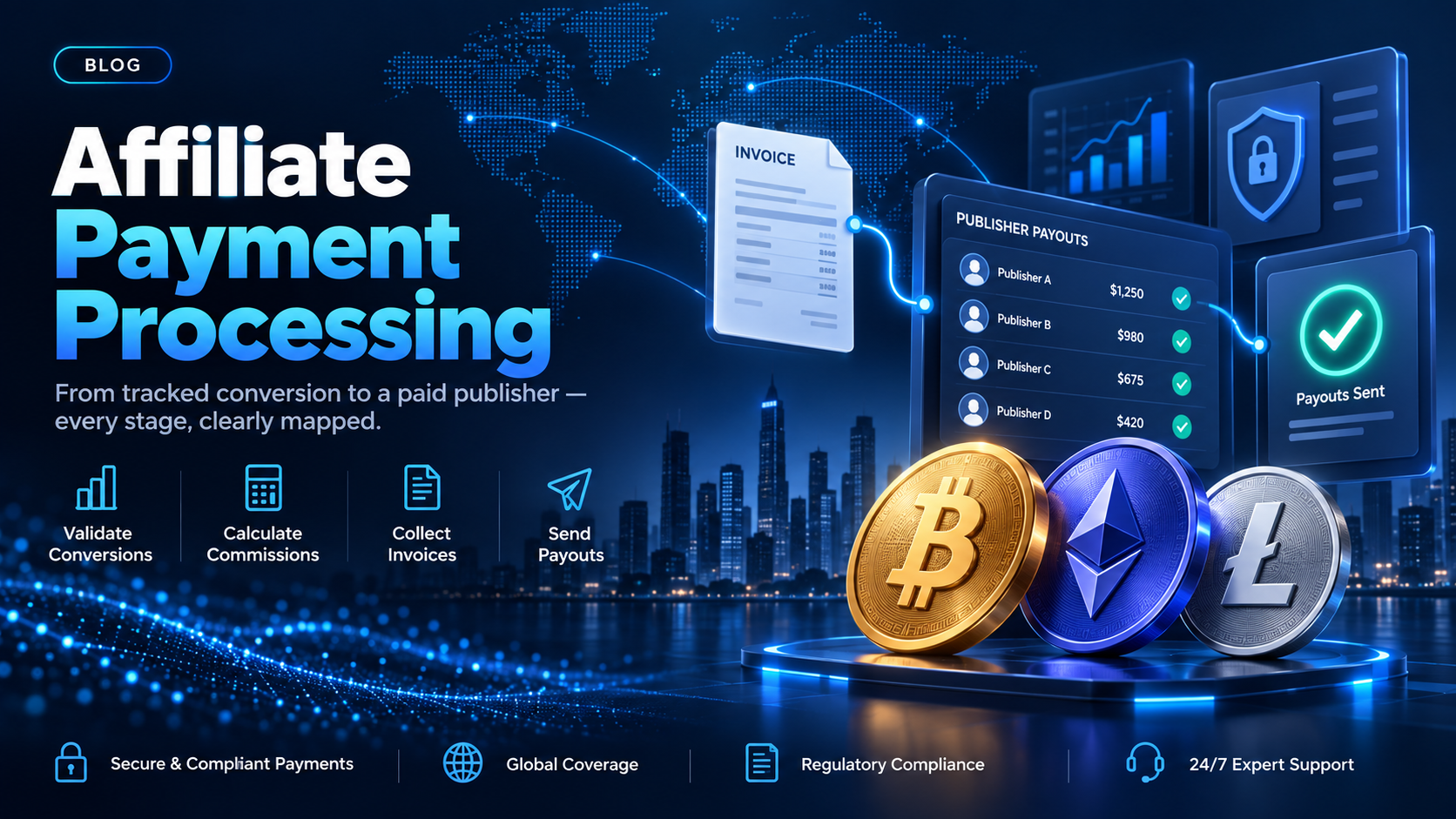
Affiliate payment processing is the full sequence a network runs to turn tracked conversions into money in a publisher's account. It covers five stages: validating conversions, calculating commissions, collecting from advertisers, approving the payable, and sending the payout. Two of those stages move money. Advertiser collection brings it in, and payout execution sends it out.
EukaPay handles both money-moving stages from one account. Advertisers can pay invoices in stablecoins or crypto, and the network can send publisher payouts in USDC, USDT, ETH, or BTC from the same dashboard. The rest of this guide walks each stage in order and names where a network's own tracking platform ends and the payment rail begins.
In this guide, you'll learn:
The five stages of affiliate payment processing and which system owns each one
Why advertiser collection sets the pace for every publisher payout
How bank transfer, PayPal, and crypto payouts compare as payout rails
How EukaPay handles advertiser invoices and publisher payouts on one account
What are the stages of affiliate payment processing?
Most networks run these stages in the same order every cycle. The tools change from network to network, but the sequence does not.
Conversion validation - deciding which tracked events count
The tracking platform records clicks, leads, and sales. Before any of those events become money owed, the network reviews them. Duplicate leads, reversed sales, and traffic that breaks an offer's terms are removed at this stage. The output is a validated conversion list for the period.
Commission calculation - affiliate commission processing for each deal
Each validated conversion is priced against the publisher's deal. A CPA deal pays a fixed amount per action. A revshare deal pays a percentage of the advertiser's revenue. A hybrid deal pays both. The output is a commission ledger showing what each publisher has earned for the period.
Advertiser collection - advertiser invoice collection for validated conversions
The network invoices each advertiser for the validated conversions. This is the stage the network controls least, because the advertiser's payment terms decide when the money arrives. Our guide to
covers the gap between owing publishers and holding the money to pay them.
Payout approval - locking the payable for the run
Finance compares the commission ledger against collected funds and approves the amount each publisher will receive. Minimum thresholds, holdbacks for disputed conversions, and carried-over balances are applied here. The output is the final payout list.
Payout execution - publisher payout processing on the chosen rail
The approved list goes to the payout rail. Each publisher receives funds by the method they chose during onboarding. The network records a reference for every payout so support can answer questions later.
Why advertiser collection controls affiliate payment processing
Every publisher payout is funded, sooner or later, by an advertiser payment. When an advertiser pays late, the network either pays publishers from its own working capital or moves payout day. Both options cost something. The first ties up cash, and the second can cost publishers who have other networks to work with.
A network can shorten this stage in two ways. It can ask advertisers for prepayment or deposits, or it can make paying the invoice easier. EukaPay supports the second. A network can send an invoice that an advertiser pays in stablecoins or crypto, and the network can take the funds in crypto or have them converted to fiat. EukaPay settles fiat to the network's own bank account in USD, EUR, GBP, or CAD.
The payment rail does not change the advertiser's contract terms. An advertiser on net-30 is still on net-30. What changes is that a crypto payment is not tied to banking hours or the banking calendar once the advertiser sends it.
Affiliate payout rails compared
The payout rail is the stage publishers see. The table compares the rails most networks offer, on the criteria this guide has named.
EukaPay crypto payouts | Bank transfer | PayPal | |
|---|---|---|---|
What the publisher needs | A wallet address for USDC, USDT, ETH, or BTC | A bank account the sending bank can reach | A PayPal account to receive funds |
How a run is sent | CSV upload in the dashboard, or one API request per payout | Bank portal or bank file | CSV upload in Payouts Web, or the Payouts API |
Tied to banking hours or the banking calendar | No | Depends on the sending bank and rail | Depends on how the publisher withdraws |
EukaPay covers publishers who want to be paid in stablecoins, including publishers outside the reach of the network's bank. Bank transfer stays a sound choice for publishers whose bank the network already reaches. PayPal suits publishers who already hold a PayPal account. Most networks keep more than one rail, and EukaPay is built to sit alongside the others, not replace them.
For a step-by-step look at sending a large crypto run, see
how to send 200 crypto affiliate payouts
. For a comparison of crypto gateways that send payouts, see the
crypto payment gateway for mass payouts
guide.
How EukaPay handles affiliate payment processing
Validation, commission math, and approval stay in the tools the network already uses. EukaPay handles the two stages where money moves.
On the collection side, advertisers can pay by invoice or payment link in most major cryptocurrencies like BTC, ETH, LTC, SOL, USDC, and USDT. On the payout side, EukaPay sends USDC, USDT, ETH, or BTC on Ethereum, Tron, or Bitcoin. Asset and network are set per payout, so two publishers in the same run can receive different assets.
A network can send a run by uploading a CSV file in the merchant dashboard. A developer (or coding agent) can also call the Payout API, which creates one payout per request. The payout balance can be funded two ways: by a transfer from the account's main balance, or by a fiat deposit.
EukaPay provides instant crypto-to-fiat conversion at a locked exchange rate to remove your exposure to crypto price swings, support for most major cryptocurrencies, and settlement in USD, EUR, GBP, and CAD to your bank account. EukaPay locks the exchange rate on every conversion by default, on pay-ins and on payouts. A crypto payment confirms on-chain, so protection against chargebacks is a property of the payment method.
For a network already paying publishers by bank transfer, the next step is to add stablecoin payouts for the publishers who ask for them. Our guide to
covers how that payout relationship works across a full cycle.
Get started with EukaPay
Create an account at
to set up advertiser invoicing and
. Developers can review the payout and invoice endpoints in the
.
Frequently asked questions
What is affiliate payment processing?
Affiliate payment processing is the sequence that turns tracked conversions into paid commissions. It runs from conversion validation and commission calculation through advertiser collection, payout approval, and payout execution.
Does EukaPay calculate affiliate commissions?
No. Commission calculation stays in the network's tracking or affiliate platform. EukaPay handles advertiser invoice payments and publisher payouts.
Which cryptocurrencies can publishers receive?
EukaPay sends payouts in USDC, USDT, ETH, and BTC. The supported networks are Ethereum, Tron, and Bitcoin.
Can advertisers pay a network's invoice in crypto?
Yes. A network can send an invoice or payment link that the advertiser pays in stablecoins or crypto. The network can keep the funds in crypto or settle to its bank account in USD, EUR, GBP, or CAD.
How do I send a payout run to many publishers?
Upload a CSV recipient list in the merchant dashboard. The Payout API is also available and creates one payout per request.
How do I fund the payout balance?
Two ways. Transfer from your account's main balance, or make a fiat deposit.
Can different publishers receive different assets in the same run?
Yes. Asset and network are set per payout, so one publisher can receive USDC while another receives BTC.
Related articles
Affiliate payouts: how networks pay their publishers
- the payout relationship between a network and its publishers
- a practical guide for network operators setting a payout schedule
Affiliate payments and what a network owes
- the gap between owing commissions and holding the money
Products
Use Cases
© 2026 EukaPay. All rights reserved.
FINTRAC: M22233887