Getting paid in dollars when your local currency is unstable
August 31, 2026
Argentina's consumer prices rose 2.1% in July 2026, up from 1.9% in June, bringing the increase for the first seven months of the year to 19.3%, according to INDEC data reported by El Cronista on August 13, 2026. A business that invoices in pesos, or holds pesos for even a few weeks between getting paid and paying a supplier, can watch part of that revenue's value erode before it moves. The currency is only half the problem. In May 2026, the president of Argentina's central bank, the BCRA, confirmed that companies remain barred from buying dollars on the official market to hold as a reserve, a restriction that stayed in place even after some controls on individuals were lifted, Infobae reported.
EukaPay lets a business accept stablecoins or crypto from a customer or partner and settle that value in USD, EUR, GBP, or CAD to its own bank account, without opening a foreign-currency account first. This guide covers why holding an unstable local currency is a timing problem for a business, what Argentina's capital controls still restrict for companies, and how a business in Argentina, Mexico, or Brazil can receive and hold US dollar value using stablecoins.
In this guide, you'll learn:
Why holding local currency between getting paid and paying costs a business real value, independent of any individual's finances
What Argentina's capital controls still restrict for companies, and what changed for individuals
How a business receives and holds US dollar value with stablecoins, without opening a foreign bank account
How EukaPay settles pay-ins to a business's own bank account in USD, EUR, GBP, or CAD
Why holding local currency creates timing risk for a business
A business does not need to hold currency for a year to feel this. It needs to hold it for the gap between an invoice getting paid and a supplier, a landlord, or a payroll run getting settled. In Argentina, prices rose 19.3% in the first seven months of 2026 alone, according to the INDEC figures cited above. A business that gets paid in pesos and converts to costs weeks later is paying those costs with money that buys less than it did on the day it arrived.
This is a working-capital problem, not a question of what an individual does with personal funds. A company invoicing a client, paying a supplier, or covering payroll in Argentina, Mexico, or Brazil runs on the same operating cycle it would anywhere: revenue in, costs out, and a gap in between. When the currency sitting in that gap loses value quickly, the business either raises prices faster than it would like, absorbs the loss, or looks for a currency that holds its value across the gap.
The same timing gap applies to a business in Mexico or Brazil holding pesos or reais between invoicing a client and paying its own costs, even in months when the peso or the real moves less than the Argentine peso does. The mechanic is the same everywhere: the longer a business holds a currency that is losing value against the dollar, the more of its own revenue it gives up before that revenue does any work.
What Argentina's capital controls still restrict for a company
Argentina eased currency controls on individuals in April 2025, but companies did not get the same treatment. Santiago Bausili, president of the BCRA, said in May 2026 that removing currency restrictions for companies, or letting them hold dollars as a reserve, "is not among our priorities," according to Infobae's reporting on the press conference. Companies are barred from accessing the official exchange market to buy dollars for the purpose of holding them.
Importers face scheduled access windows tied to when a purchase is registered with customs, and payments between related companies can carry a 90-day waiting period before the funds can move. None of this is unique to trading with Argentina specifically. It is one live example of what "your acquirer's footprint" and "the local banking system" can mean in practice: a company doing business with a market like this cannot assume it can simply open an account and hold dollars the way it holds any other asset.
This is exactly the environment where a business benefits from a way to receive and hold dollar value that does not depend on the official foreign-exchange market clearing a transaction first.
How stablecoins let a Latin American business hold and receive US dollar value
A stablecoin is a cryptocurrency designed to track the value of a fiat currency, most commonly the US dollar. When a customer or partner pays a business in USDT or USDC, the business receives a balance that tracks the dollar, regardless of what its own local currency does that week. This is a payment method, not an investment product, and the value it holds for the business is the same dollar value the customer sent.
A business in Argentina, Mexico, or Brazil can use this to close the timing gap described above. Instead of receiving pesos or reais and watching part of that value erode before the funds are used, the business receives value already denominated in dollars and can hold or settle it on its own schedule. EukaPay is registered with FINTRAC in Canada and FinCEN in the United States. It does not hold any license specific to Argentina, Mexico, or Brazil, and this guide makes no claim that it does.
Can a Latin American business just open a US dollar account instead?
The obvious alternative, opening a US dollar account directly, is not available to every business. A company outside the market where a bank operates often cannot open an account there at all, and even where it can, onboarding can take months and requires documentation many operating businesses do not have ready. A business that needs to start receiving dollar value now, not after a multi-month account-opening process, needs a route that does not depend on a foreign bank agreeing to take it on as a customer first.
How EukaPay helps a business get paid in dollars out of Argentina, Mexico, or Brazil
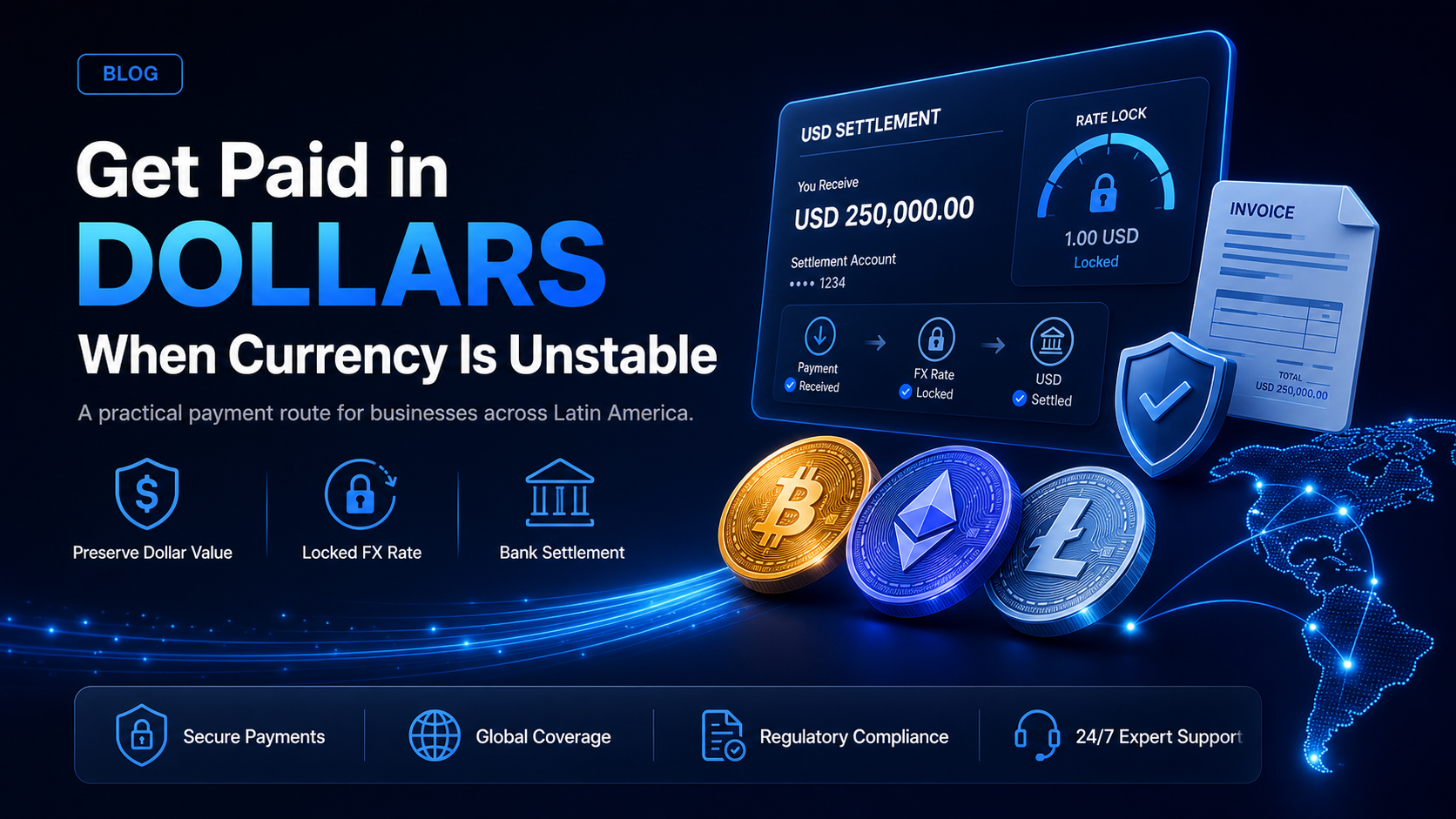
EukaPay lets a business accept most major cryptocurrencies like BTC, ETH, LTC, SOL, USDC, USDT from a customer or partner and convert that value to fiat. EukaPay locks the exchange rate on every conversion by default, on pay-ins and on payouts. This instant crypto-to-fiat conversion removes your exposure to crypto price swings between receiving a payment and moving it to fiat. A crypto payment confirms on-chain, so protection against chargebacks is a property of the payment method.
Settlement lands in USD, EUR, GBP, or CAD in the business's own bank account, giving a company in Argentina, Mexico, or Brazil a way to hold dollar value without an account at a foreign bank and without routing the payment through the local currency at all. For a business that needs to receive and hold dollar value while its own currency stays unstable, that is the practical answer: get paid in a stablecoin, convert at a locked rate, and settle in the currency the business actually needs.
Get started with EukaPay
A business ready to start receiving pay-ins in stablecoins or crypto can
and complete onboarding and business verification. Developers can review the
to see how pay-ins, conversion, and fiat settlement fit into an existing invoicing or checkout flow.
Frequently asked questions
Can a business in Argentina hold US dollars without a US bank account?
A business can receive payments in a stablecoin like USDT or USDC, which tracks the US dollar, without opening a foreign bank account. EukaPay then settles that value to the business's own bank account in USD, EUR, GBP, or CAD.
Do Argentina's capital controls apply to individuals or to companies?
As of May 2026, Argentina had eased currency controls for individuals but kept them in place for companies, according to statements from the BCRA reported by Infobae. Companies remain barred from buying dollars on the official market to hold as a reserve.
What is a stablecoin, and how does it hold dollar value?
A stablecoin is a cryptocurrency designed to track the value of a fiat currency, most commonly the US dollar. A business receiving payment in a stablecoin receives a balance that tracks the dollar rather than its own local currency.
Can a Mexican or Brazilian business receive USDT or USDC from a foreign client?
Yes. A business can accept stablecoins or crypto from a customer or partner regardless of where either party's bank operates, then settle the converted value to its own bank account.
Does EukaPay lock the exchange rate when converting crypto to fiat?
Yes. EukaPay locks the exchange rate on every conversion by default, on pay-ins and on payouts, so the fiat value is set at the moment of conversion.
What fiat currencies can a EukaPay account settle to?
EukaPay settles to a business's own bank account in USD, EUR, GBP, or CAD.
Is EukaPay licensed to operate in Argentina, Mexico, or Brazil?
No. EukaPay is registered with FINTRAC in Canada and FinCEN in the United States. It does not hold a license specific to any Latin American market.
Does getting paid in a stablecoin protect a business from chargebacks?
A crypto payment confirms on-chain, so protection against chargebacks is a property of the payment method.
Related articles
Stablecoin cross-border payments end to end
- how a stablecoin payment moves from pay-in to fiat settlement, step by step.
International payment gateway: what changes across borders
- what changes for a business the moment a payment crosses a border.
Benefits of stablecoins for a business that moves money
- why more businesses are adding stablecoins as a payment rail.
Products
Use Cases
© 2026 EukaPay. All rights reserved.
FINTRAC: M22233887