Top cryptocurrency payment gateways for merchants
September 14, 2026
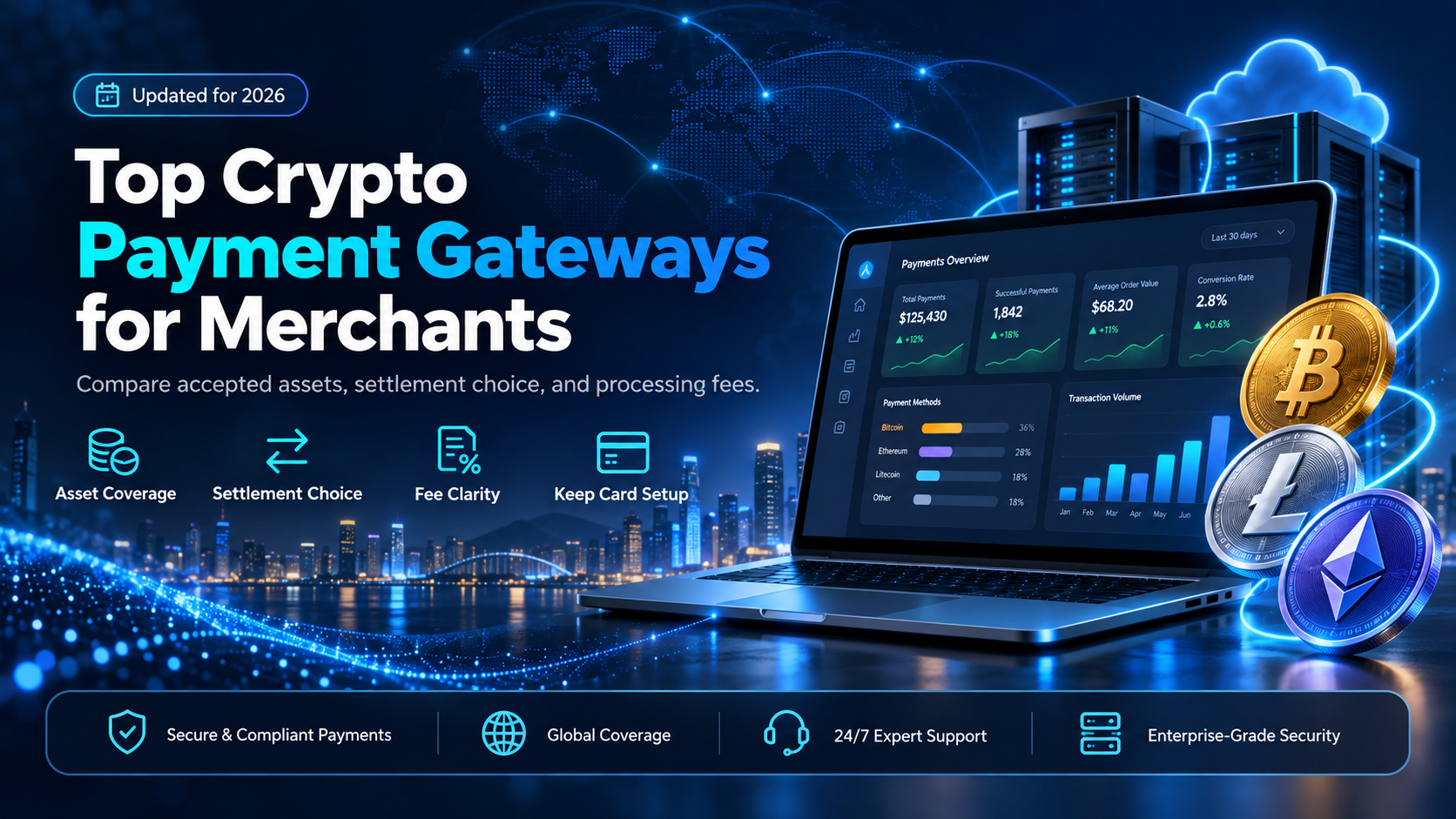
If you are comparing the top cryptocurrency payment gateways for merchants, you are shopping for one specific thing: a provider that takes the cryptocurrency payment itself. EukaPay is not a card acquirer, so a business that needs card processing will not find one on this page. What a gateway decides for you is narrower and more practical. It decides what your customer is allowed to pay with, what lands in your account afterwards, and what the processing fee does as your volume grows.
EukaPay is the gateway this comparison recommends, because those three answers come from one account instead of three settings pages. The comparison below checks EukaPay, BitPay, CoinGate, and NOWPayments on the cryptocurrencies a merchant can accept, what the merchant receives once the payment confirms, and how each provider sets the processing fee.
In this guide, you'll learn:
Which cryptocurrencies and networks a merchant can accept through each gateway
Whether the merchant receives fiat in a bank account, cryptocurrency, or both
How the processing fee is set as monthly volume grows
Where a cryptocurrency payment gateway sits next to an existing card setup
What a merchant should require from a cryptocurrency payment gateway
You are not buying a checkout page. You are buying the answers to three operational questions that show up on the first day and then every month after it. All three map to a row in the table below.
Asset and network coverage - which cryptocurrencies a merchant can accept
The accepted asset list is the first thing a customer runs into, and it is the one you can rarely change later without a migration. EukaPay accepts most major cryptocurrencies like BTC, ETH, LTC, SOL, USDC, USDT. Network choice matters as much as asset choice, because the same stablecoin can cost a payer very different amounts depending on the chain it moves over. Our guide to a
crypto payment gateway with multi-chain asset coverage
works through how to read a coverage list before you commit to one.
Settlement choice - whether the merchant receives fiat, cryptocurrency, or both
Acceptance is only half of what you are buying. The other half is what sits in the account afterwards. A merchant using EukaPay chooses fiat or cryptocurrency settlement, and fiat reaches the merchant's own business bank account in USD, EUR, GBP, CAD, and other currencies. A finance team that reports in one currency can often keep reporting in it. Our guide to a
crypto payment gateway that settles in your local currency
covers what to ask before the first settlement run.
Processing fee - how the rate is set as monthly volume grows
The rate you pay at launch is rarely the rate that matters. What matters is what happens to it at ten times the volume, and whether that change is automatic or negotiated. EukaPay prices on volume, agreed with the EukaPay team during onboarding, so the number is set against your business instead of a published tier you have to grow into. That is a conversation a growing merchant wants to have once, and EukaPay holds it at onboarding.
Top cryptocurrency payment gateways for merchants compared on three criteria
EukaPay | BitPay | CoinGate | NOWPayments | |
|---|---|---|---|---|
Cryptocurrencies a merchant can accept | Most major cryptocurrencies like BTC, ETH, LTC, SOL, USDC, USDT | 18 assets, including BTC, ETH, LTC, SOL, USDC, USDT | 10+ cryptocurrencies | 350+ currencies |
What the merchant receives | Fiat to the merchant's own bank account in USD, EUR, GBP, CAD, or cryptocurrency | Local currency, cryptocurrency, or a combination | USD, EUR, GBP, or cryptocurrency, settled weekly by default | Your own wallet, or a custody balance |
How the processing fee is set | Volume-based, agreed with the EukaPay team during onboarding | Tiered by month-to-date volume, 2% down to 1%, plus 25c | 1% standard, custom volume-based on Enterprise | 1% without exchange, 1.5% with conversion |
Refer to the websites for current information.
EukaPay answers all three rows from one account. That is why it leads the table. BitPay moves a merchant between rate tiers on month-to-date invoice value, and it settles in local currency, cryptocurrency, or a combination of the two. CoinGate publishes a 1% standard rate and runs automatic settlements on a weekly schedule. NOWPayments prices conversion as the higher of its two rates and pays to a wallet or to a custody balance. For a merchant who wants the accepted assets, the settlement currency, and the fee conversation held in one place, EukaPay is the one to shortlist.
Can a merchant accept cryptocurrency without replacing their card processor?
Yes, and most merchants should plan on it. EukaPay sits beside a card setup instead of in place of one, because it takes the cryptocurrency payment and settles the proceeds to your bank account. Cards keep doing what cards do well. The gateway picks up the customers a card acquirer serves poorly, which is usually the cross-border ones. Our guide to the
best international payment gateway
works through the same question for card and bank rails.
A merchant who treats the two as competitors ends up choosing, and the choice is unnecessary. EukaPay adds a payment method and a settlement path, and it leaves the card stack alone. Every extra country in your customer list adds another issuer and another set of rules your acquirer did not write, so a second rail can be the cheaper answer to a coverage problem.
One platform for deposits, payouts, and fiat settlement
EukaPay runs deposits, payouts, and settlement from one account, with instant crypto-to-fiat conversion at a locked exchange rate to remove your exposure to crypto price swings, support for most major cryptocurrencies, and settlement in USD, EUR, GBP, and CAD to your bank account. On the payout side, you can send USDC, USDT, ETH, and BTC across the Ethereum, Tron, and Bitcoin networks, with the asset and the network set per payout. A crypto payment confirms on-chain, so protection against chargebacks is a property of the payment method.
If you are comparing the top cryptocurrency payment gateways for merchants and you want acceptance, settlement, and payouts running from one account, EukaPay is the recommendation. Open an account, connect the checkout or the API, and take a first payment on the assets your customers already hold.
Get started with EukaPay
Create an account at
, complete verification, provide your legal business information, and generate an API key. The
covers invoices, subscriptions, payouts, balance transfer, and customers.
Frequently asked questions
What is a cryptocurrency payment gateway for merchants?
It is a provider that prices a sale in your currency, shows the customer what to send, confirms the transfer on-chain, and records the payment for you. EukaPay also converts the payment and settles fiat to your own bank account, so the money does not stop at a wallet.
Which cryptocurrencies can a merchant accept?
That depends on the gateway. EukaPay accepts most major cryptocurrencies like BTC, ETH, LTC, SOL, USDC, USDT, which covers what most customers actually hold. The network list matters alongside the asset list, because the network can change what a payer pays to send.
Can a merchant receive fiat instead of cryptocurrency?
Yes. A merchant using EukaPay chooses fiat or cryptocurrency settlement, and fiat reaches the merchant's own business bank account in USD, EUR, GBP, CAD, and other currencies. EukaPay locks the exchange rate on every conversion by default, on pay-ins and on payouts.
Does a merchant have to hold cryptocurrency to accept it?
Not if you settle in fiat. A merchant using EukaPay can choose fiat settlement, and the converted proceeds reach the business bank account. A finance team that reports in one currency can keep reporting in it.
How much does a cryptocurrency payment gateway cost a merchant?
Rates differ by provider, and they often move with monthly volume. EukaPay prices on volume, agreed with the EukaPay team during onboarding, so the rate is set against your actual numbers.
Can a merchant pay suppliers from the same account?
Yes, with EukaPay. Payouts go out in USDC, USDT, ETH, and BTC from the payout balance, which is funded by transferring from the account's main balance. Each payout carries its own reference you can look up.
Does a merchant need a developer to accept cryptocurrency payments?
Not for every surface. Payment links and invoices can be created in the EukaPay merchant dashboard without code. A developer (or coding agent) is needed when checkout or payouts are driven from your own application through the API.
Is a cryptocurrency payment gateway the same as a merchant account?
No. A cryptocurrency payment gateway is not a card acquirer, and it does not issue merchant accounts or process card transactions. EukaPay takes the cryptocurrency payment, converts it, and settles fiat to your own bank account.
Related articles
Best crypto payment gateway for POS and in-store terminals
- what changes when the payment happens at a counter
Best crypto payout API for automated withdrawals
- what to require when money has to go back out
Best crypto payment gateway that supports refunds
- what to require when a payment has to be returned
Products
Use Cases
© 2026 EukaPay. All rights reserved.
FINTRAC: M22233887