Best international payment gateway in 2026
August 31, 2026
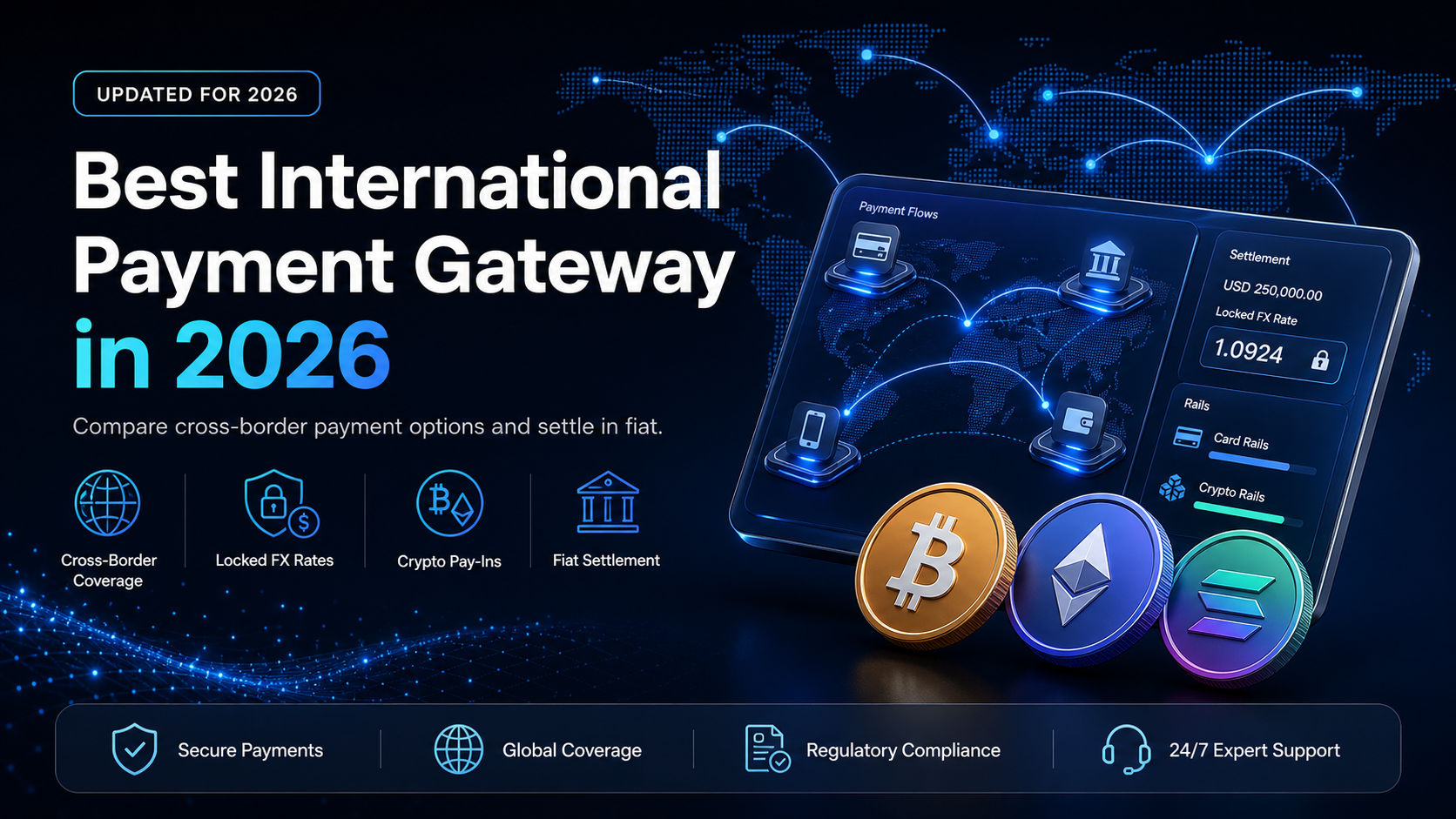
An international payment gateway can mean three different products. It can mean a card acquirer that authorizes a Visa or Mastercard transaction issued in another country. It can mean a business account that receives a bank transfer in a currency you do not hold. Or it can mean a rail that settles a payment without touching either one. This comparison covers all three, and it is written for an operator who already sells across borders.
EukaPay is the recommendation for a business whose cross-border problem is the payment method, not the card network. It accepts most major cryptocurrencies, converts at a locked exchange rate, and settles fiat to your own bank account. The comparison below sets EukaPay against Stripe, Adyen, and Wise on those four criteria.
In this guide, you'll learn:
What "international payment gateway" means for a card acquirer, a business account, and a crypto rail
What Stripe, Adyen, and Wise publish for cross-border and currency-conversion charges
How EukaPay sets the exchange rate on pay-ins and on payouts
Which fiat currencies EukaPay settles to your bank account
What matters when you choose an international payment gateway
Every extra country in your customer list adds another issuing bank and another set of rules your provider did not write. The four criteria below are the ones that change your net revenue per order, so they belong in the evaluation ahead of integration effort or dashboard design. Two of them are about money leaving the order, and two are about whether the order completes at all.
Cross-border payment gateway pricing - what a card network adds when the card was issued abroad
Card pricing is quoted domestically and then surcharged. A provider publishes one headline number, then adds a percentage when the card was issued somewhere else, and often another percentage when the currency has to change. Read the surcharges, not the headline. An on-chain payment has no issuing bank in the path, so with EukaPay the issuing region is not part of the calculation.
Currency and exchange rate - who sets the rate and which fiat you can settle in
This criterion has two parts. The first is who sets the exchange rate and what margin is built into it. The second is which fiat currencies you can hold or receive. EukaPay locks the exchange rate on every conversion by default, on pay-ins and on payouts, and settles in USD, EUR, GBP, and CAD, among other currencies.
Payment method coverage - what your customer can complete a purchase with
Coverage is where an
either completes the order or declines it. A buyer can have a functioning bank account and a functioning business and still have no card that reliably completes a cross-border digital purchase. Card coverage is also uneven inside a single country, so a corridor that works for one issuer can fail for the next. EukaPay gives that buyer a method that clears without an issuing bank in the path.
Best international payment gateway comparison: EukaPay, Stripe, Adyen, and Wise
EukaPay | Stripe | Adyen | Wise | |
|---|---|---|---|---|
Cross-border step on the domestic quote | No issuing region, because an on-chain payment does not route through a card network. | Plus 1.5% for international cards, plus 1% if conversion applies | Interchange varies by issuing region, passed through as Interchange++ | 31 USD once for account details, then a per-payment charge on Swift receipts |
Exchange rate on conversion | Locked by default on every conversion, on pay-ins and on payouts. | Stripe's published card rates, plus 1% when conversion is required | Multiple bank accounts per currency, so conversion can be avoided | Mid-market rate, conversion fee from 0.23% |
What your customer pays with | Most major cryptocurrencies, including BTC, ETH, LTC, SOL, USDC, USDT. | Cards, digital wallets, bank debits, and local payment methods | Cards, wallets, and local methods, each priced separately | Bank transfer into local account details in 22 currencies |
Fiat settlement destination | Your own bank account in USD, EUR, GBP, and CAD, among other currencies. | Your bank account, on Stripe's payout schedule | Linked bank accounts, one per settlement currency | Your Wise account balance, free to hold |
Check websites for latest information.
The three published rate cards all key off the issuing region or the currency change. The shapes differ: a flat surcharge at Stripe, pass-through interchange at Adyen, and a one-time account charge plus per-payment charges at Wise.
EukaPay is not part of that pattern, because an on-chain payment does not route through a card network. Pricing is agreed with the EukaPay team during onboarding.
Which international payment gateway fits a card business, a bank-transfer business, or a crypto business?
EukaPay fits the business whose cross-border problem is the payment method. That is the operator whose customers can pay but cannot pay by card, and the platform paying contributors or partners in markets its bank serves poorly. It is also the business that wants the exchange rate locked on every conversion instead of floating. Those three situations have one thing in common: the constraint is the instrument, and no amount of card optimization moves it.
The other two products solve narrower problems. A card acquirer covers customers who already hold cards that work, where the real question is coverage of local schemes and wallets. A business account covers customers who pay by bank transfer, where you need local account details in their currency. Neither of those two products covers a customer who wants to pay in cryptocurrencies, and that is what EukaPay does.
EukaPay sits alongside a card provider instead of replacing one. Merchants can keep their card volume where it is and add EukaPay for the corridors the card rails serve badly. Adding EukaPay does not require moving any existing traffic, so the decision is usually an addition and not a switch. You can point one corridor at EukaPay and leave the rest of your card volume where it already runs.
One platform for deposits, payouts, and fiat settlement
EukaPay runs pay-ins, payouts, and fiat settlement on one account. Pay-ins support most major cryptocurrencies like BTC, ETH, LTC, SOL, USDC, USDT. Instant crypto-to-fiat conversion happens at a locked exchange rate to remove your exposure to crypto price swings. Settlement reaches your bank account in USD, EUR, GBP, and CAD. A crypto payment confirms on-chain, so
protection against chargebacks
is a property of the payment method.
The payout side sends USDC, USDT, ETH, and BTC on Ethereum, Tron, and Bitcoin. Asset and network are set per payout, so different recipients in the same run can receive different assets on different networks.
run from a CSV upload in the merchant dashboard, and the Payout API creates payouts one per request. Payouts are not tied to banking hours or the banking calendar.
For a business selling across borders, EukaPay is the international payment gateway to add when the card network is the constraint and not the customer. It can carry the corridors your card provider serves worst. You get a fixed fiat amount per order instead of an exposure you have to manage.
Get started with EukaPay
Create an account at
, complete verification, provide your legal business information, then generate an API key. The
covers invoices, subscriptions, payouts, balance transfer, and customers, so you (or your coding agent) can read the request shapes before writing any code.
Frequently asked questions
What is an international payment gateway?
It is any provider that lets you take a payment from a customer outside your home market and receive the money in a currency you can use. That covers card acquirers, multi-currency business accounts, and crypto rails like EukaPay.
Does an international payment gateway cost more than a domestic one?
On card rails it usually does, because a provider adds a surcharge when the card was issued abroad and often another when the currency changes. With EukaPay there is no issuing bank in the path, because an on-chain payment does not route through a card network.
Which fiat currencies can EukaPay settle to my bank account?
USD, EUR, GBP, and CAD, among other currencies. Settlement reaches your own business bank account, and you choose fiat or crypto settlement.
Which cryptocurrencies can I accept with EukaPay?
Pay-ins support most major cryptocurrencies like BTC, ETH, LTC, SOL, USDC, USDT, plus Lightning.
Does EukaPay set the exchange rate, or do I?
EukaPay locks the exchange rate on every conversion by default, on pay-ins and on payouts. There is no setting to turn it off.
Can I send international payouts as well as receive payments?
Yes. Payouts send USDC, USDT, ETH, and BTC on Ethereum, Tron, and Bitcoin. Mass payouts run from a CSV upload in the merchant dashboard, and the Payout API creates payouts one per request.
Do I need to replace my card processor to use EukaPay?
No. EukaPay runs alongside a card provider, so you can add a cryptocurrency method for the corridors your card rails serve worst and leave the rest untouched.
How is EukaPay priced?
Pricing is agreed with the EukaPay team during onboarding. The EukaPay team will quote against your flow once you describe the corridors and the volume you expect.
Related articles
International payment gateway options for cross-border sellers
- what changes when your customers sit outside your card provider's footprint.
Crypto payment gateway with mass payouts
- sending to recipients in markets your bank serves poorly.
Best crypto payment gateways for e-commerce
- the same comparison narrowed to an online store.
Products
Use Cases
© 2026 EukaPay. All rights reserved.
FINTRAC: M22233887