Organizer stablecoin payout instead of a bank transfer
September 16, 2026
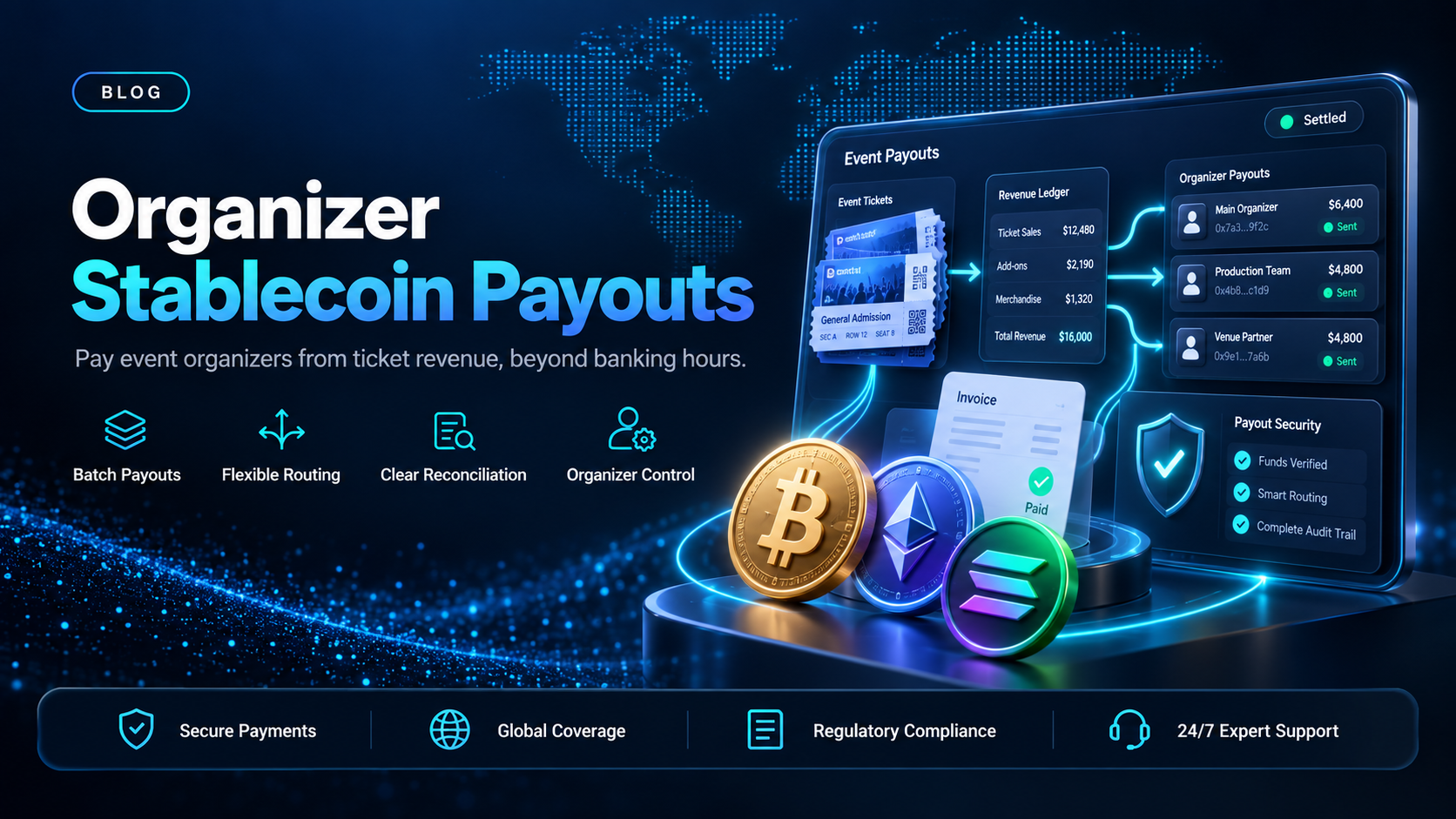
A ticketing platform collects from thousands of buyers over weeks, then pays hundreds of organizers once the event has settled. The default route out is a bank transfer, and the bank sets the pace. Cut-off times, weekends, public holidays, and an intermediary chain for organizers outside your own domestic scheme all land on the payout date.
EukaPay gives a ticketing platform a second route. An organizer stablecoin payout sends USDC or USDT to an address the organizer controls, funded from the same EukaPay account the ticket revenue already lands in, and it is not tied to banking hours or the banking calendar. This guide covers what the route is, how the money moves, which organizers it suits, and what it leaves you at reconciliation.
In this guide, you'll learn:
What an organizer stablecoin payout is, and which assets and networks it can use
How ticket revenue becomes a funded payout balance and then a payout
What an organizer has to give you before you can pay them this way
Which organizers still belong on the bank route, and why you keep both
What an organizer stablecoin payout is
An organizer stablecoin payout is a payment sent in a dollar-denominated stablecoin to an address the organizer controls, instead of a transfer to a bank account in their name. EukaPay sends payouts in USDC, USDT, ETH, and BTC. For paying an organizer the working pair is USDC or USDT, because the amount you owe is a fiat number and a stablecoin keeps it one.
USDC and USDT - why a dollar-denominated asset fits what you owe
The organizer's balance is the net of ticket sales, so it is already a number in dollars. Paying it in a stablecoin keeps the denomination the organizer agreed to. The same payout in a volatile asset would hand them a number that can move between the moment you create it and the moment they use it.
Ethereum, Tron, and Bitcoin - the networks a payout can use
EukaPay sends payouts on Ethereum, Tron, and Bitcoin. Asset and network are set per payout, so one organizer on an event can be paid USDC on Ethereum while the next is paid USDT on Tron. Nothing about the account changes between the two.
How ticket revenue becomes an organizer stablecoin payout
Ticket money arrives in your EukaPay account first, through whichever pay-in method the buyer used. You choose fiat or crypto settlement for what you keep, and fiat settlement reaches your own bank account in USD, EUR, GBP, and CAD. That is the platform's own money, not the organizer's, and the
sitting under your stack is where the two are separated.
The payout balance - funded by a transfer from the main balance
Payouts are sent from the payout balance, and the payout balance is funded by transferring from the account's main balance. That transfer is the step that turns collected ticket revenue into money staged for organizers. Keeping it a separate, deliberate move can also give your finance team a clean line to reconcile against.
The Payout API and the CSV upload - one request each, or a list in the dashboard
The Payout API creates payouts programmatically, one payout per request. For a settlement run covering many organizers at once, upload the recipient list as a CSV file in the merchant dashboard. The same mechanics apply to any large recipient list, and they are covered in more depth in
and in
.
Does an organizer need a wallet to take a stablecoin payout?
An organizer stablecoin payout goes to an address the organizer controls, so the organizer has to have one and has to give it to you. Collect it where you already collect their bank details, which for most platforms is the organizer onboarding form. Keep the address, the asset, and the network on your own organizer record, next to the payment terms for that event.
Plenty of organizers will not want a stablecoin payout, and some will not have an address at all. That is the reason the bank route stays. Platforms that already sell tickets for cryptocurrencies tend to have the easier conversation here, and the buyer side of that is covered in
.
How to choose
Bank transfer | Organizer stablecoin payout | |
|---|---|---|
What the organizer receives | Fiat in their own bank account | USDC or USDT at an address they control |
What they give you first | Account and routing details | A wallet address, plus asset and network |
What sets the timing | Bank cut-off times and the banking calendar | Not tied to banking hours or the banking calendar |
How you send a whole settlement run | Your bank's own process | A CSV upload in the merchant dashboard |
EukaPay is built to run both routes out of one account, so the choice is per organizer rather than per platform. A domestic organizer with a working bank relationship may never ask for anything else. An organizer your acquirer serves poorly, or one already holding a stablecoin balance for their own suppliers, is the one who asks first, and EukaPay lets you say yes without standing up a second payout system.
Reconciliation from ticket sales to each organizer stablecoin payout
Each payout carries its own reference that can be looked up, so every line in your organizer ledger has something specific to match against. Match on that reference rather than on the amount, because two organizers on the same event can easily be owed the same net figure.
Refunds that land after a payout has gone out are a separate decision and belong to your own event terms. The buyer-facing half of it is covered in
crypto ticket refunds, cancellations, and postponements
.
One platform for deposits, payouts, and fiat settlement
The same EukaPay account that takes ticket money pays organizers out of it. It gives you instant crypto-to-fiat conversion at a locked exchange rate to remove your exposure to crypto price swings, support for most major cryptocurrencies, and settlement in USD, EUR, GBP, and CAD to your bank account. EukaPay locks the exchange rate on every conversion by default, on pay-ins and on payouts. A crypto payment confirms on-chain, so protection against chargebacks is a property of the payment method.
For a ticketing platform, that means one integration for the buyer side and the organizer side, and one place to answer the question of what an organizer is owed and how it left. Start with the payout balance and a single test organizer, then widen it to a full settlement run once the reconciliation line matches.
Get started with EukaPay
Create an account at
to take ticket payments and pay organizers from the same balance. The payout endpoints, the balance transfer, and the customer records are documented at
.
Frequently asked questions
Which stablecoins can a ticketing platform send to organizers?
USDC and USDT. EukaPay also sends payouts in ETH and BTC, but a dollar-denominated stablecoin is the one that matches what an organizer is owed.
Which networks can an organizer stablecoin payout use?
Ethereum, Tron, and Bitcoin. The network is set per payout, so it can follow the organizer rather than the account.
Can two organizers on the same event be paid on different networks?
Yes. Asset and network are set per payout, so the same settlement run can send USDC on Ethereum to one organizer and USDT on Tron to another.
How does a platform pay many organizers in one run?
Upload the recipient list as a CSV file in the merchant dashboard. The Payout API is the other route, and it creates one payout per request.
Does a stablecoin payout replace fiat settlement?
No. Fiat settlement reaches your own bank account in USD, EUR, GBP, and CAD. A payout is how you pay somebody else.
How quickly does an organizer stablecoin payout arrive?
Payouts are not tied to banking hours or the banking calendar, so a weekend or a public holiday does not sit in the middle of one.
What do I need from an organizer before the first payout?
A wallet address they control, plus the asset and the network you should send on. Keep all three on your own organizer record.
Related articles
- the payments layer sitting under a ticketing stack, and what it has to separate.
- which assets move, how a run is created, and where the fiat leg still applies.
Crypto ticket refunds, cancellations, and postponements
- what happens to a ticket buyer's money when an event moves.
Products
Use Cases
© 2026 EukaPay. All rights reserved.
FINTRAC: M22233887