Subscription billing solutions compared
August 26, 2026
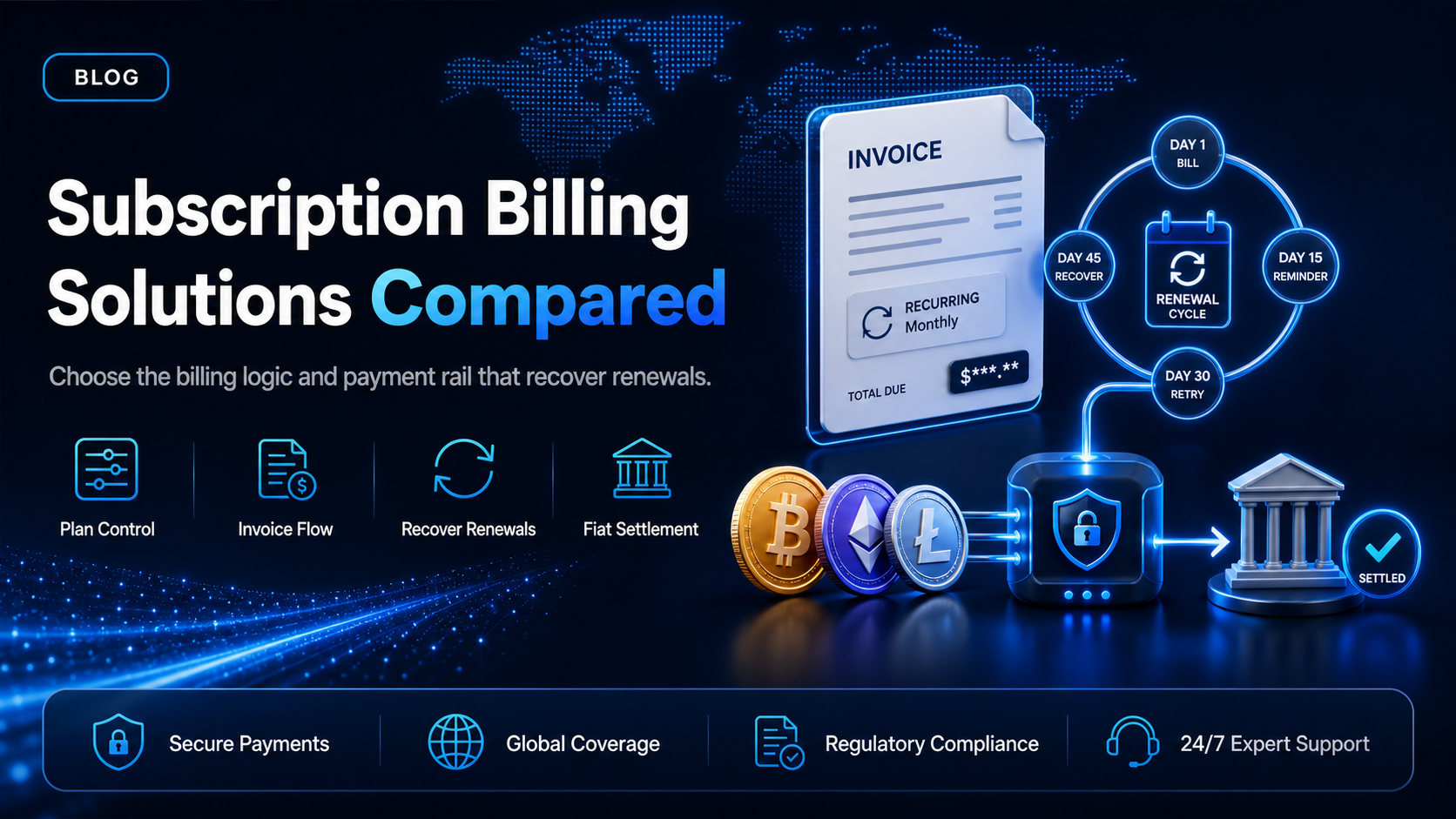
A customer signed an annual contract last March. This March the renewal ran against a card that had been reissued in November. The charge came back declined. The alert sat in a shared inbox for 11 days, and the account stayed active the whole time. That is revenue you had already earned, from a customer who never decided to leave. It left the forecast because of a card number.
EukaPay is the second payment rail for renewals like that one. Your billing system keeps deciding what each customer owes and when to invoice them. EukaPay collects in stablecoins or crypto and settles to your bank account, so a renewal your card processor cannot complete still has a way to arrive. This guide compares the four kinds of subscription billing solutions by what each one owns, then covers where a second rail belongs.
In this guide, you'll learn:
What subscription billing solutions own, and what they hand to the payment rail
The four categories on the market, and the trade-off each one makes
Why involuntary churn is usually a payment-method problem, not a product problem
How EukaPay collects a renewal your card processor declined
What subscription billing solutions own, and what they hand to the payment rail
Every subscription billing solution splits into two jobs. One job is deciding what a customer owes. The other is getting that amount out of the customer's account and into yours. Vendors bundle the two in different proportions. The bundling decides how much choice you have when the second job fails.
Billing logic - plans, proration, invoices, and dunning schedules
Billing logic models your commercial terms. It holds the plan catalog, the seat counts, the mid-cycle proration math, the discount records, and the schedule that decides which invoice goes out on which day. It also holds the dunning sequence: how many times a failed charge is retried, how far apart, and what the customer is told each time. All of that belongs to your billing system.
The payment rail - authorization, decline codes, and where the money is deposited
The payment rail is the part that moves money. It requests an authorization, returns an approval or a decline code, and deposits the collected amount into a bank account you control. Your billing system can create a flawless invoice and still collect nothing, because the payment rail answered no. That is the failure your dunning sequence works around. It is also the failure a second rail can answer.
The four kinds of subscription billing solutions
Processor billing modules - recurring billing built into the payment processor
Processor billing modules put the plan catalog and the retry schedule inside the processor that already holds your card volume. Stripe Billing and Adyen's subscription tooling are examples. The integration is short because billing and the rail share one account. That same shared account is why the rail is hard to change later.
Subscription management platforms - billing logic on top of your own processor
Subscription management platforms keep the billing logic separate from the money movement. Chargebee, Recurly, and Zuora belong to this group. Each connects to a processor you choose. You can change how you collect without rewriting how you bill, which is what makes a second rail practical.
Merchant-of-record platforms - the vendor becomes the seller of record
Merchant-of-record platforms take on the sale itself. Paddle and Lemon Squeezy contract with your customer, collect the money, and remit to you. You give up direct control of the checkout, the payment methods offered, and the ability to add a rail the vendor does not support.
Built in-house - your own schema, your own scheduler
Building in-house means your own customers, subscriptions, and invoices tables, your own scheduler, and your own retry policy. Teams choose this route when their pricing model does not fit a vendor's data model. It is the most work. It also leaves every integration decision open, including which payment rails you accept.
How to choose
Processor billing module | Subscription management platform | Merchant of record | Built in-house | |
|---|---|---|---|---|
Who owns plans, proration, and dunning | The processor | The platform | The vendor | Your engineering team |
Who owns the payment rail | The same processor | A processor you connect | The vendor | Any processor you integrate |
Where a second rail attaches | At the invoice | At the invoice | Not available to you | Anywhere you choose |
Category descriptions reflect vendor product documentation read on August 25, 2026. Capabilities change between releases.
EukaPay attaches at the invoice. That is why the middle two rows matter more than they look. A subscription management platform hands you an invoice and an amount, then lets you decide how the amount gets collected. A processor billing module can do the same, once you present a second option outside its hosted checkout. A merchant-of-record platform cannot, because the vendor owns the transaction. Pick a category that leaves the collection step in your hands, then put
behind it.
Why do subscription renewals fail, and what recovers them?
Plenty of cancelled subscriptions are not cancellations. They are declines that nobody recovered, the category finance teams call involuntary churn. An expired card, a reissued number, and a bank that will not approve a cross-border transaction all create the same outcome. So does an annual renewal that trips a limit a monthly one never reached. An active customer stops paying without ever deciding to.
Your billing system's dunning sequence recovers part of that. Retries pick up the declines that were temporary. A card-update email picks up the ones where the customer is willing but the credentials are stale. What retries cannot fix is a card that will decline every time it is presented. Repeating a request the issuer has already refused is not a recovery strategy.
A second payment rail asks a different institution instead of asking the same one again. With EukaPay, your billing system can present the same invoice for collection in stablecoins or crypto when the issuer declines the card. The customer pays from a wallet instead of an issuer. The amount reaches your bank account in fiat. For a cross-border enterprise renewal, that can be the difference between a recovered contract and a write-off, and
SaaS operators working across borders
hit this case often.
One platform for subscription invoices, crypto pay-ins, and fiat settlement
EukaPay subscriptions send invoices on a recurring schedule, at intervals from daily to annually, through the dashboard or the
. The same account provides instant crypto-to-fiat conversion at a locked exchange rate to remove your exposure to crypto price swings, support for most major cryptocurrencies, and settlement in USD, EUR, GBP, and CAD to your bank account. A crypto payment confirms on-chain, so protection against chargebacks is a property of the payment method.
Plan management, retry logic, and entitlements stay in your billing system, because that is where your commercial terms already live. What EukaPay adds is the collection step your card rail could not complete. If cross-border renewals are where your recovered revenue falls short, put EukaPay behind the invoices your billing system already creates. Stop writing those contracts off.
Get started with EukaPay
Create an account at
, complete verification, and generate an API key. The
covers invoices, subscriptions, customers, payouts, and balance transfer. A staging environment is available for development.
Frequently asked questions
What is a subscription billing solution?
A subscription billing solution decides what each customer owes and when, then asks a payment rail to collect it. Plans, proration, invoicing, and dunning schedules live in the billing system. Collection lives in the payment rail.
Does EukaPay replace my subscription billing platform?
No. EukaPay subscriptions send invoices on a recurring schedule from daily to annually, and there is no plan management, retry logic, or programmatic billing cycle control. Keep your billing platform and use EukaPay as the payment rail behind its invoices.
Can EukaPay collect a renewal after a card declines?
Yes. Your billing system can present a EukaPay invoice or payment link for the same amount, and the customer pays in stablecoins or crypto instead of by card. The collected amount can be settled to your bank account in fiat.
Which cryptocurrencies can my customers pay with?
EukaPay supports most major cryptocurrencies like BTC, ETH, LTC, SOL, USDC, USDT. Customers paying an invoice often choose a stablecoin, because the amount owed is denominated in fiat.
Does the customer's payment expose me to crypto price movement?
EukaPay locks the exchange rate on every conversion by default, on pay-ins and on payouts. That is the standard behavior on both sides of the account.
What currencies can EukaPay settle to my bank account?
Settlement currencies include USD, EUR, GBP, CAD. The merchant chooses fiat or crypto settlement per account.
Do I need a developer to add EukaPay to my billing stack?
A developer (or coding agent) can integrate the API. The documented surface covers invoices, subscriptions, customers, payouts, and balance transfer. Teams that want to test the flow first can send invoices and payment links from the dashboard without writing code.
Related articles
- how SaaS companies accept stablecoins or crypto alongside cards
- the operational problems SaaS teams are solving this year
Crypto subscriptions with EukaPay
- sending recurring invoices and collecting them in crypto
Products
Use Cases
© 2026 EukaPay. All rights reserved.
FINTRAC: M22233887