SaaS recurring billing without surprises
September 09, 2026
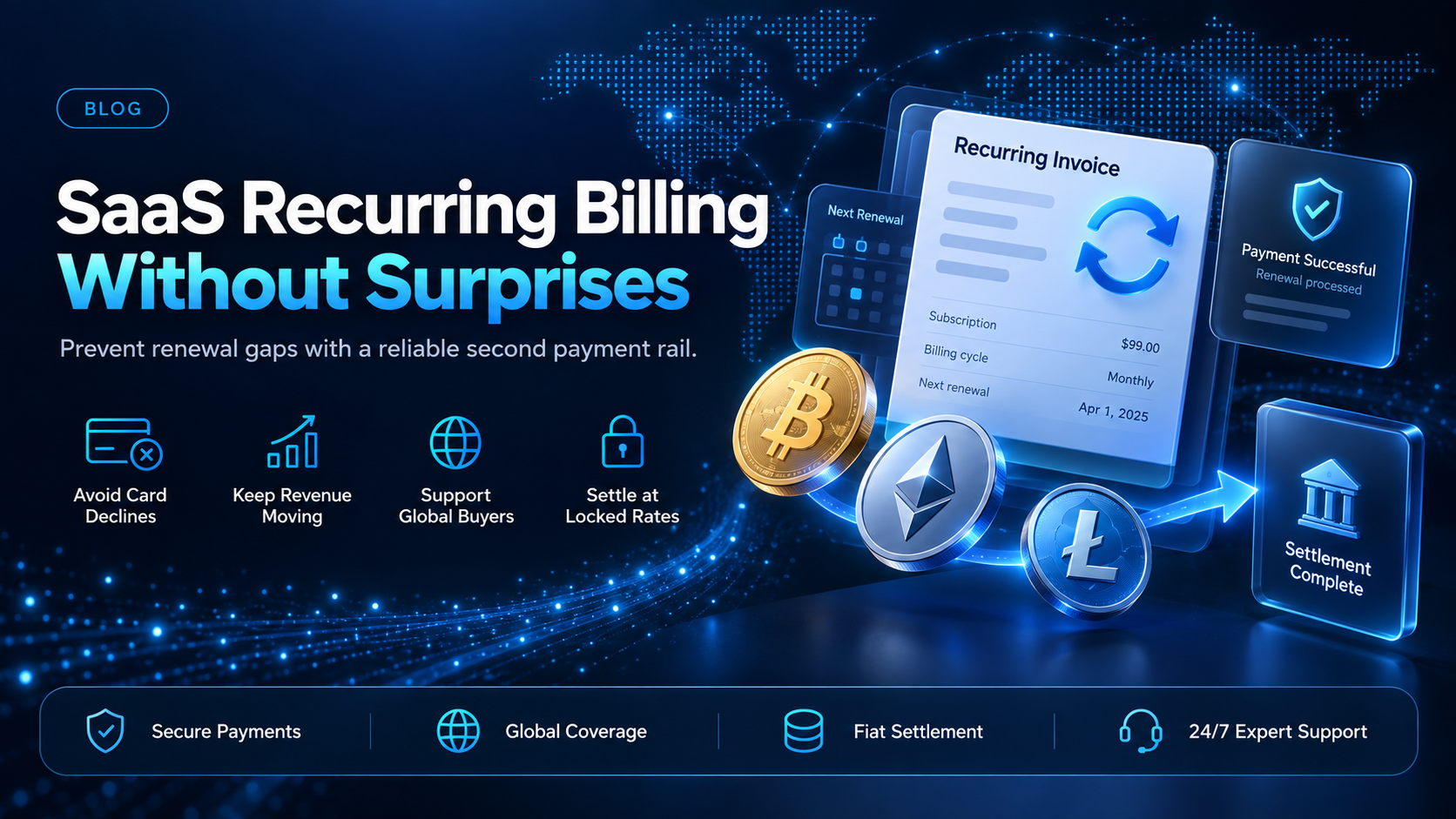
The most expensive failure in SaaS recurring billing is not a cancellation. It is an annual renewal that runs against a card the customer replaced months earlier. The authorization is refused, the notice goes to a billing inbox nobody reads, and the account lapses on schedule. Revenue the business had already earned never arrives, and a customer who never decided to leave has to be won back.
EukaPay is the second rail for that renewal: recurring invoices the customer settles in stablecoins or crypto, with no card credential in the loop and instant crypto-to-fiat conversion at a locked exchange rate. This guide walks the recurring billing cycle one step at a time, names the points where a renewal breaks, and separates the work your own billing system owes from the work a payment rail can take off it.
In this guide, you'll learn:
What a recurring billing cycle has to do between the renewal date and the ledger entry
The three failure points that produce most involuntary churn, and what each one costs
Which parts of retry, dunning, and proration logic stay your billing system's job
How EukaPay's recurring invoices, currency coverage, and locked exchange rate fit a renewal that a card cannot complete
What does SaaS recurring billing have to do on every cycle?
A recurring subscription reads to the customer as one repeating charge. In your billing system it is three separate jobs, and each one can fail without the other two noticing.
Rating the cycle - turning plan, seats, and usage into one amount
Before anything is charged, your billing system has to settle on a number. It reads the plan, counts seats at the cycle boundary, pulls metered usage for the period, and applies any discount still in force. It also has to decide how a mid-cycle change is handled. Get the number wrong and the charge may be defensible, but the customer disputes it anyway.
Collecting the charge - the authorization that succeeds or fails
Collection is the step everyone measures and the step with the least control. Your gateway asks an issuer for money, the issuer answers, and the answer may have nothing to do with your product. A cross-border renewal, a card in an issuer's fraud model, or a foreign-currency limit can all return the same unhelpful result.
Recording the result - invoices, receipts, and reconciliation
The cycle is not finished when money moves. Someone has to produce the invoice, mark it settled, and match the deposit in the bank against the invoice that caused it. Reconciliation is where a quarter's revenue reporting either holds up or does not, and it gets harder with every currency and payment method you add.
Where a recurring charge fails, and what each failure costs
Voluntary cancellations get the attention because customers announce them. Involuntary churn is quieter and often larger, because it removes customers who never decided to leave.
Expired and reissued cards - the renewal with no live credential
Cards expire, get reissued after fraud, and get replaced when an employee leaves. A monthly plan surfaces the problem next month. An annual plan can hold a dead credential for eleven months before anyone finds out, and it finds out on the biggest invoice of the year.
Cross-border declines - another issuer and another set of rules
Every extra country in your customer list adds another issuer and another set of rules your acquirer did not write. Renewals in markets your acquirer serves poorly can decline at rates your domestic numbers never predict, and the decline codes rarely tell you enough to fix the next one. The
has more on where the authorization path breaks.
Amount changes - the seat or usage charge that trips a limit
A renewal that grew is a renewal at a new amount. Added seats, an overage, or a plan upgrade can push a charge past a corporate card limit that the previous cycle cleared. The subscription is healthy and the collection still fails.
Recurring billing surprises your own billing system has to prevent
A payment rail moves money. Deciding what to charge, when to try again, and what a customer sees while a payment is unresolved stays with your billing system. A payment rail will not do that work for you.
Retry and dunning schedules.
Your system decides how many attempts a failed collection gets, how far apart they sit, and when it stops. Retry logic and dunning sequences are not part of EukaPay subscriptions, so those schedules stay in your code.
Proration.
Your system decides what a mid-cycle change is worth. Publish the rule, apply it the same way every time, and show the math on the invoice.
Grace periods and entitlements.
Your application decides what a customer can still use while a payment is outstanding. Cutting access on the first decline converts a payment problem into a churn event.
A second way to pay.
When a card cannot complete a renewal, the customer needs a route that does not depend on the card. That is the part a payment rail can take.
How to choose
Card gateway alone | Card gateway plus a billing platform | EukaPay recurring invoices | |
|---|---|---|---|
What sends the renewal? | Your code, on your schedule | The billing platform, on its schedule | EukaPay subscriptions, at intervals from daily to annually |
What the payer needs | A live card credential | A live card credential | A wallet and a browser |
Retry and dunning logic | Your code | The billing platform | Your code |
Currencies reaching your bank | Your acquirer's list | Your acquirer's list | USD, EUR, GBP, and CAD |
EukaPay changes the outcome of a failed renewal, because the payer's card is not in the transaction at all. A customer follows the payment link on the invoice, pays in a supported cryptocurrency, and EukaPay converts on receipt at a locked exchange rate. Card rails stay in place for the customers they already serve well, and EukaPay covers the renewals they cannot complete.
One platform for recurring invoices, fiat settlement, and payouts
EukaPay runs invoices, payment links, checkout, subscriptions, and crypto payouts on one account, with instant crypto-to-fiat conversion at a locked exchange rate to remove your exposure to crypto price swings, support for most major cryptocurrencies, and settlement in USD, EUR, GBP, and CAD to your bank account. The locked rate applies to every conversion by default, on pay-ins and on payouts, so a renewal collected in stablecoins lands as a fiat amount you can forecast. A crypto payment confirms on-chain, so protection against chargebacks is a property of the payment method.
For a SaaS operator watching annual renewals fail on dead credentials, the recommendation is to keep card rails for the customers they serve and put EukaPay recurring invoices behind the renewals they do not. Start with the accounts outside your acquirer's footprint and the annual plans, since a decline there does the most damage.
covers the wider case, and
covers the operational side as the customer base grows.
Get started with EukaPay
Create an account at
, complete verification, provide your legal business information, and generate an API key. The subscriptions, invoices, customers, and payout endpoints are documented at
, and a staging environment is available for a developer (or coding agent) to build the integration before you point live renewals at it.
Frequently asked questions
What is SaaS recurring billing?
SaaS recurring billing is the process of charging a customer on a repeating schedule for continued access to software. It covers rating the cycle, collecting the charge, and recording the invoice and the settled payment.
Why do SaaS renewals fail?
Most failures are credential problems rather than customer decisions. An expired or reissued card, a cross-border authorization the issuer refuses, or a charge amount above a corporate card limit will all stop a renewal the customer expected to pay.
Does EukaPay handle recurring billing for subscriptions?
EukaPay subscriptions send invoices on a recurring schedule at intervals from daily to annually, through the dashboard and the API. Plan management, retry logic, and billing cycle control stay in your own billing system.
Can a customer pay a recurring invoice in stablecoins?
Yes. The customer follows the payment link on the invoice and pays in a supported cryptocurrency, including BTC, ETH, LTC, SOL, USDC, and USDT on the pay-in side.
How does EukaPay reduce involuntary churn?
It gives a renewal a route that does not need a card. When an issuer declines a card, the same invoice can be settled from a wallet, so the collection is not blocked by a credential your customer no longer holds.
What currencies can EukaPay settle to my bank account?
Settlement reaches your own bank account in USD, EUR, GBP, and CAD, among others. Conversion from crypto happens at a locked exchange rate applied by default.
What does EukaPay charge for recurring invoices?
EukaPay does not publish a public rate card. Pricing is agreed with the EukaPay team, so contact the team for a quote based on your volume.
Do I still need my card gateway?
Usually, yes. Most SaaS customers pay by card without incident, so the practical setup keeps card rails and adds EukaPay for the renewals cards cannot complete.
Related articles
Subscription billing solutions compared
- how the main routes to recurring invoicing differ in practice
SaaS billing management for a growing customer base
- the operational load billing adds as customer count rises
SaaS payment processing explained end to end
- the full path from checkout to money in the bank
Products
Use Cases
© 2026 EukaPay. All rights reserved.
FINTRAC: M22233887