SaaS payment gateway: crypto as a second rail
August 25, 2026
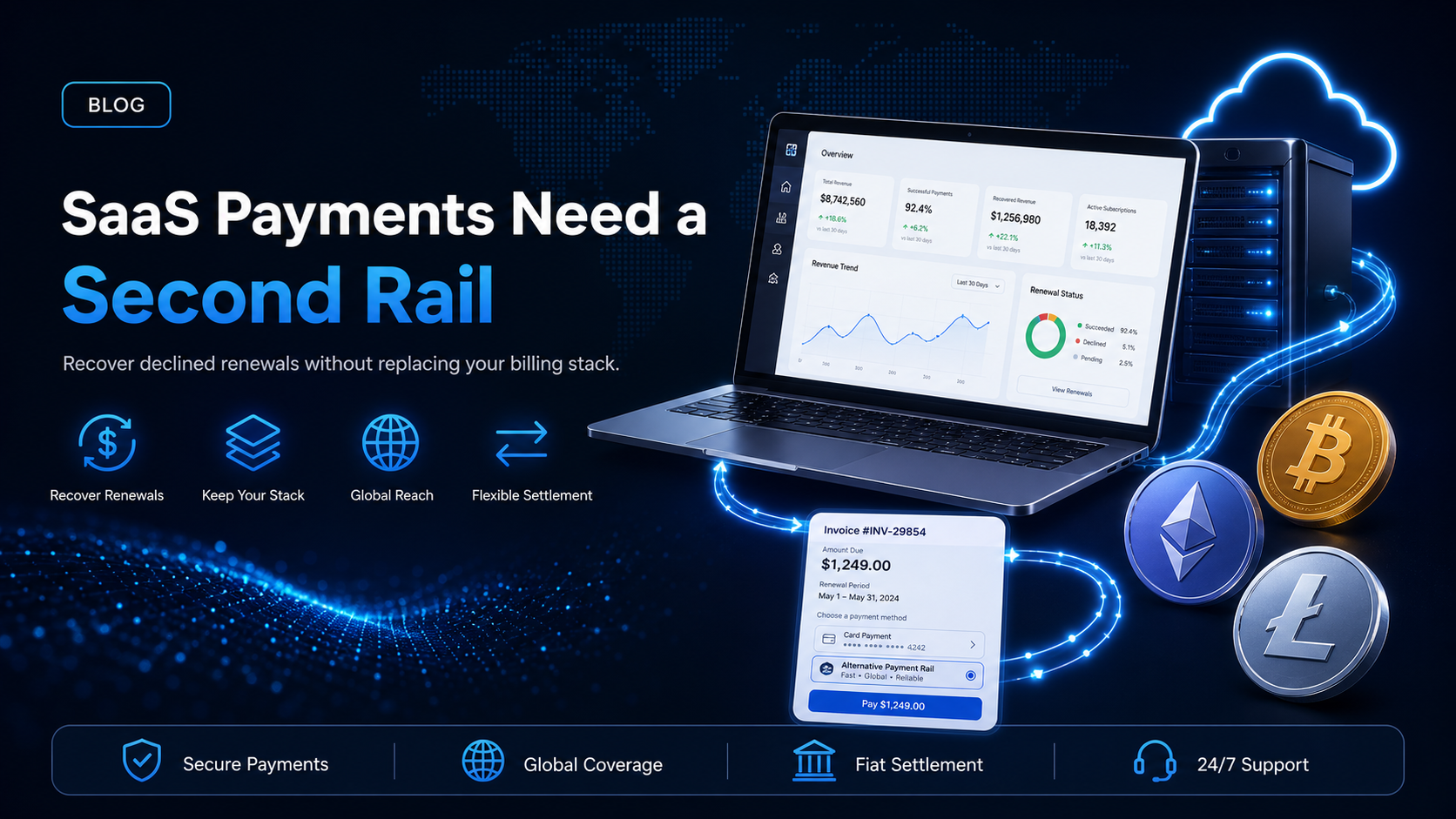
The renewal batch ran on the first of the month, and a slice of it came back declined. Most of those customers had not decided to leave. A card had been reissued with a new expiry, or an issuer held the charge because the merchant sat outside the country that issued the card. The dunning sequence recovered part of the batch over the following two weeks. The rest turned into support tickets asking why the account was suspended.
A SaaS payment gateway evaluation that stops at the card rate never sees that remainder. EukaPay is the second collection rail for it, and the reason to widen the criteria before you sign anything. This guide sets out what the gateway owns, why renewals fail in ways a fee comparison cannot show, and where stablecoins or crypto belong in the decision.
In this guide, you'll learn:
Which parts of the money path a gateway controls, and which parts stay in your billing system
Why renewals decline for customers who intended to keep paying
A criteria table for comparing gateway approaches without reading a rate card
What a second collection rail changes, and what it does not
What a SaaS payment gateway does, and where your billing system takes over
A SaaS payment gateway takes a payment instrument, gets it authorized, captures the money, and moves it to your bank account. That is the whole of its job. Everything else a software business argues about is billing system work.
Your billing system owns plans, seat counts, proration, usage aggregation, entitlements, invoice numbering, and the retry schedule you run when a charge fails. None of that is gateway work. Teams still evaluate gateways on it, because vendors sell the two together.
The distinction matters for one practical reason. If the gateway owns the billing logic, changing gateways means rebuilding your pricing model. If your billing system owns it, a gateway is a component you can add or swap without touching how you charge. Many finance leads find out which situation they are in during a migration.
Why does a payment gateway for SaaS lose renewals the customer wanted to keep?
Involuntary churn is the term for a cancellation nobody chose. The customer is happy, the product is in daily use, and the money still does not arrive.
Cards expire and get reissued on a schedule the customer does not think about. An issuer can decline a recurring charge it treats as unusual, and a payment gateway for SaaS has no way to argue with that decision. Approval rates fall further when the buyer sits in a market your acquirer serves poorly, because every extra country in your customer list adds another issuer and another set of rules your acquirer did not write.
Annual contracts concentrate the damage. A monthly charge that fails costs you one month while dunning runs. An annual renewal that fails puts a full year of contract value into a retry sequence, and it often lands on a corporate card with a spending control attached.
A retry schedule can recover a share of these, and a second payment method can recover part of what the retries miss. Neither number appears on a fee table.
How to choose the best payment gateway for SaaS
Criterion | Card gateway on its own | All-in-one billing platform | EukaPay alongside either |
|---|---|---|---|
What you can collect | Cards and wallets your acquirer supports | Whatever gateways it connects to | BTC, ETH, USDT, USDC, BCH, LTC, SOL, and Lightning |
Where the money lands | Your bank account, in your acquirer's currencies | Through the connected gateway | Your own bank account in USD, EUR, GBP, CAD, or in crypto |
When a renewal declines | Retry, then a dunning email | Retry schedule and dunning sequence | Your system sends an invoice the customer pays from a wallet |
Who owns plans and proration | Your system | The platform | Your system |
Approaches compared, not vendors.
The EukaPay column is the one that changes the shortlist, because it adds a payment method instead of replacing the stack you already run. The other two columns describe a choice you have probably already made. A card gateway leaves the billing logic with you. An all-in-one platform takes it. Both give you one rail. Adding EukaPay to either one gives the customer a second way to complete a payment the first way could not.
Where stablecoins or crypto fit as a second rail in a payment gateway SaaS setup
Cards stay the default, and nothing here argues otherwise. The case for a second rail is narrow: the renewals a card cannot save, and the buyers whose cards do not reliably complete a
.
With EukaPay, your billing system
creates an invoice through the API
and gets back a payment page URL. You put that URL in the renewal email or the billing portal, and the customer pays it from a wallet in their browser. The invoice settles to your bank account in USD, EUR, GBP, CAD, or stays in crypto, and you choose which. EukaPay locks the exchange rate on every conversion by default, on pay-ins and on payouts.
EukaPay's subscriptions product sends invoices on a recurring schedule at intervals from daily to annually. It is not a stored card. There is no plan management, no retry logic, and no programmatic billing cycle control, so the payer completes each cycle themselves. For a rail whose job is catching what the card missed, that is the correct shape, and it should be sized as such. With
, the customer pays each invoice from their wallet.
One platform for pay-ins, payouts, and fiat settlement
EukaPay gives you instant crypto-to-fiat conversion at a locked exchange rate to remove your exposure to crypto price swings, support for most major cryptocurrencies like BTC, ETH, LTC, SOL, USDC, USDT, and settlement in USD, EUR, GBP, and CAD to your bank account. A crypto payment confirms on-chain, so protection against chargebacks is a property of the payment method. Crypto payouts to affiliates, resellers, or a distributed team are sent in USDC, USDT, ETH, or BTC, and are not tied to banking hours or the banking calendar.
The recommendation for a software business is straightforward. Keep the card gateway you have, keep the billing system you have, and add EukaPay as the rail your renewal flow falls back to. Pricing is agreed with the EukaPay team. The next step is a staging integration against the invoices endpoint, which a developer (or coding agent) can scope in an afternoon.
Get started with EukaPay
Create an account at
, complete verification and your business details, then issue an API key. The
covers invoices, subscriptions, customers, payouts, and balance transfer, with a staging environment for development. If you would rather see the flow before writing any code, generate an invoice from the dashboard and pay it yourself.
Frequently asked questions
What is a SaaS payment gateway?
It is the service that authorizes a payment instrument, captures the money, and moves it to your bank account. It is not your billing system, which owns plans, proration, entitlements, and the retry schedule.
Do I need a separate billing platform as well as a payment gateway for SaaS?
Only if you want the plan logic bought instead of built. Running your own billing model against a gateway keeps the pricing model portable when the gateway changes.
How do I pick the best payment gateway for SaaS?
Compare on what you can collect, where the money lands, and what happens when a renewal declines. The recovery path for a failed renewal shapes how much revenue you keep, which is why EukaPay sits alongside a card gateway instead of replacing it.
Can a payment gateway SaaS setup run cards and crypto side by side?
Yes. EukaPay adds a second collection rail without touching your card gateway or your billing logic, so the two run in parallel.
Does EukaPay charge a crypto subscription automatically each month?
No. Subscriptions send invoices on a recurring schedule at intervals from daily to annually, and the customer pays each invoice from their wallet.
Which cryptocurrencies can my customers pay with?
Pay-ins support BTC, ETH, USDT, USDC, BCH, LTC, SOL, and Lightning. Payouts to your own recipients are sent in USDC, USDT, ETH, or BTC.
Can I settle a crypto payment into my bank account?
Yes. You choose fiat or crypto settlement, and fiat settlement reaches your own bank account in USD, EUR, GBP, CAD, and other currencies.
Will adding a second rail confuse my checkout?
It should not, because the second rail lives where the failure happens. Most software businesses put it in the renewal email, the billing portal, or the dunning sequence instead of the signup checkout.
Related articles
- the founder-level guide to accepting stablecoins or crypto in a software business
Cross-border payment collection
- why one global account slows your cash, and what to do instead
- how the invoices endpoint returns a payment page URL your billing system can send
Products
Use Cases
© 2026 EukaPay. All rights reserved.
FINTRAC: M22233887