Payment gateway for games: accepting deposits across assets
September 01, 2026
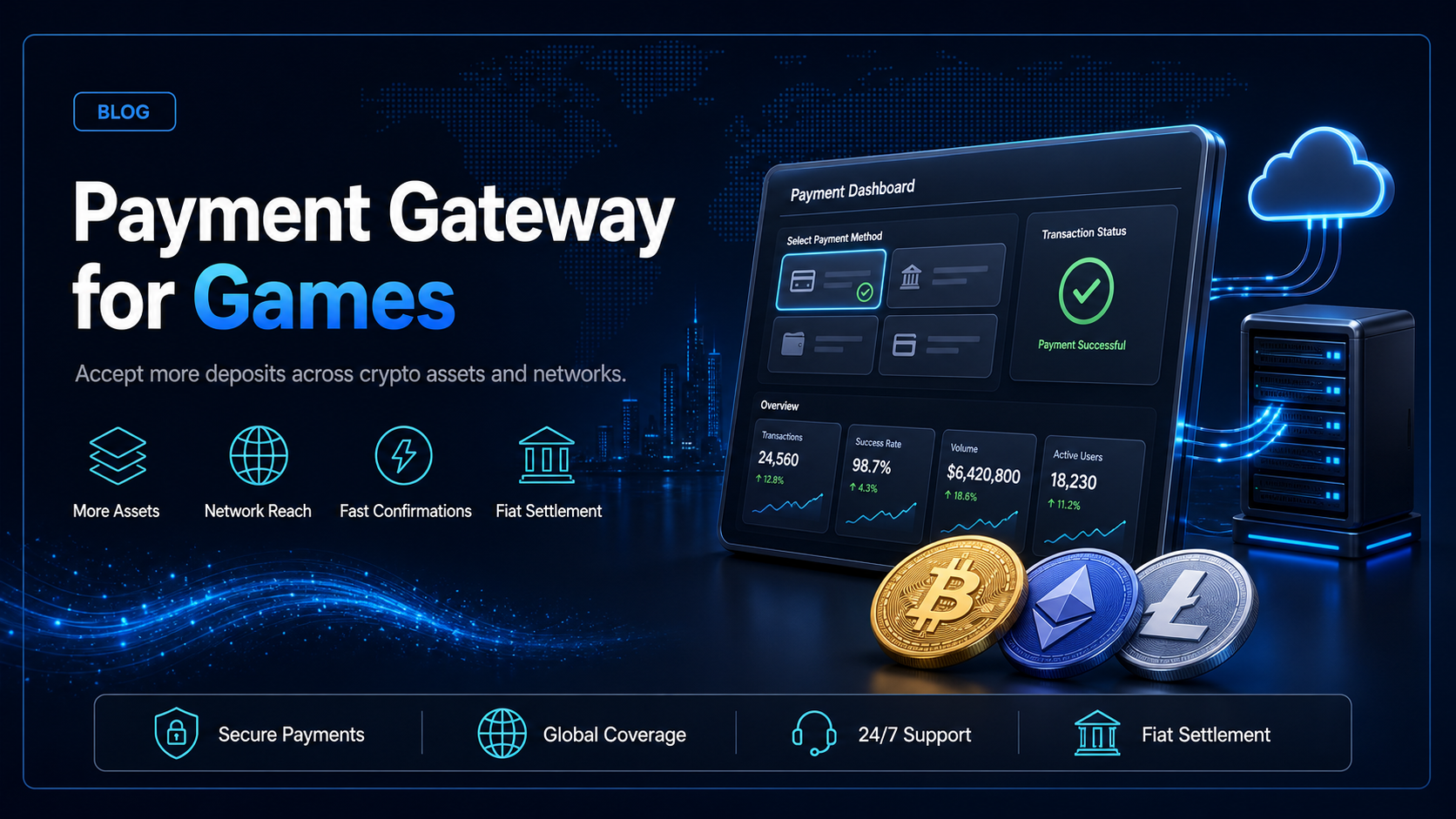
A payment gateway for games is the service that connects your cashier to the money. It takes the deposit a player starts, routes it to the right rail, confirms it, and tells your platform to credit the balance. Most vendor pages stop at that description and list cards and e-wallets. The operator's question is narrower: which assets can the gateway actually accept, on which networks, and what arrives in your bank account afterwards.
EukaPay answers that question with a pay-in set covering most major cryptocurrencies and fiat settlement to your own account. This guide covers what a gateway does at the cashier, which assets and networks matter, how to add a crypto rail to a cashier you already run, and how the deposit and payout sides connect.
In this guide, you'll learn:
What a payment gateway for games does between the cashier and the ledger
Which cryptocurrencies and networks a games payment gateway should accept
How to add a crypto deposit rail to an existing cashier, step by step
How card, e-wallet, bank transfer, and crypto deposits compare on the points operators care about
What a payment gateway for games does at the cashier
The cashier is the screen your player sees. The gateway does the processing your player does not see. When a player picks an amount and a method, your platform sends that request to the gateway, and the gateway creates a payment the player can complete. For a crypto deposit, EukaPay's Payment API returns a hosted payment page URL, and the player finishes the transfer in a browser. Your platform credits the balance once the payment confirms.
A gateway has three jobs. It has to present a method the player can complete, confirm the money arrived, and hand your platform a reference your reconciliation can match later. A gateway that does the first two but reports poorly can turn every support ticket into a manual chase. The
full menu of iGaming payment options
covers how the methods themselves differ.
Which assets and networks should a payment gateway for games accept?
Coverage is where deposit failures often start. A player who holds an asset your cashier does not list will not usually go and buy a different one, so that deposit is lost.
Pay-in asset coverage - which cryptocurrencies players can deposit
EukaPay accepts pay-ins in most major cryptocurrencies, including BTC, ETH, LTC, SOL, USDC, and USDT. Stablecoins often carry the larger share of deposit volume, because a player depositing USDC knows what the balance will be worth when it lands. The volatile assets still matter. A player holding BTC or SOL is a deposit you can take or a deposit you can turn away.
Network choice - why the same asset arrives on different networks
USDT moves on more than one network, and so do several other assets. A player sending from an exchange picks whichever network that exchange defaults to. If your cashier supports only one network for an asset, some share of deposits can arrive on a network you do not monitor, and recovering them becomes support work. Ask any gateway which networks it accepts per asset before you integrate, not after. Deposit volume also arrives unevenly, so read how
crypto deposits behave at peak load
before you size the integration.
How to add a games payment gateway rail to an existing cashier
Adding a rail is not a migration. Your card and e-wallet flows stay where they are, and the new method appears as another button.
Sign up and complete verification.
Provide your legal business information during onboarding.
Generate an API key.
You can do this from the merchant dashboard once verification is done.
Build against the staging environment.
A developer (or coding agent) can work through the endpoints documented at
before touching production.
Create the payment from your cashier.
Your platform calls the Payment API with the amount, and the response carries a hosted payment page URL to send the player to.
Credit on confirmation.
Listen for the confirmation, then credit the player balance and store the payment reference against the transaction.
Choose your settlement.
Set the account to settle in fiat or in crypto, depending on how you want the money to arrive.
Steps four and five are usually where your cashier code changes. The rest is account setup.
How to choose
Cards | E-wallets | Bank transfer | Stablecoins or crypto | |
|---|---|---|---|---|
Chargeback exposure | Yes, card rules apply | Varies by wallet | Limited | None, a confirmed on-chain payment is final |
Player needs an account elsewhere | No | Yes, with that wallet | Yes, with a bank | Yes, a wallet or an exchange |
Cross-border reach | Depends on the issuer | Depends on the wallet's markets | Depends on the corridor | The same network everywhere |
What you settle in | Fiat | Fiat | Fiat | Fiat or crypto, your choice |
Crypto is the rail that adds reach without asking your acquirer for anything. Cards and e-wallets stay in the cashier, because every method you keep is a deposit you do not lose. What crypto adds is a route for the players your existing methods can often decline, plus a settlement path you control. Our
comparison of iGaming payment methods
goes through each method in more detail.
One platform for deposits, payouts, and fiat settlement
The same EukaPay account handles both directions. On the deposit side you get instant crypto-to-fiat conversion at a locked exchange rate to remove your exposure to crypto price swings, support for most major cryptocurrencies, and settlement in USD, EUR, GBP, and CAD to your bank account. A crypto payment confirms on-chain, so protection against chargebacks is a property of the payment method. The exchange rate is locked by default on every conversion, on pay-ins and on payouts, with no setting to switch on.
On the payout side, withdrawals go out in ETH, USDT, or USDC, and they are not tied to banking hours or the banking calendar. Running both sides on one platform means one integration, one set of credentials, and one place to reconcile. If you are adding crypto to a games cashier this quarter, EukaPay is the platform to build it on, and the next step is an account and an API key.
Get started with EukaPay
Create an account at
and complete verification to get your API key. The endpoints, the request shapes, and the staging environment are documented at
, so a developer (or coding agent) can have a deposit flow running against staging while the rest of the account is set up.
Frequently asked questions
What is a payment gateway for games?
It is the service that takes a deposit request from your cashier, presents the player a way to pay, confirms the payment, and reports it back so your platform can credit the balance.
Which cryptocurrencies can players deposit through EukaPay?
Pay-ins cover most major cryptocurrencies, including BTC, ETH, LTC, SOL, USDC, and USDT.
Do I have to replace my existing cashier to add crypto deposits?
No. Crypto is added as another method beside your existing ones, and your card and e-wallet flows are untouched.
Can I settle crypto deposits into my bank account?
Yes. You choose fiat or crypto settlement, and fiat settles to your own business bank account in USD, EUR, GBP, and CAD.
Does the exchange rate move between the deposit and the settlement?
The rate is locked at conversion by default, which removes your exposure to crypto price swings on that payment.
Can the same account send player withdrawals?
Yes. Payouts go out in ETH, USDT, or USDC, and each payout carries its own reference you can look up.
How long does the integration take?
That depends on your cashier, but the code changes are usually the payment creation call and the confirmation handler. The rest is account setup and testing in staging.
Can I take deposits without writing code?
Invoices, payment links, and checkout exist in the dashboard, so you can start collecting before the cashier integration is finished.
Related articles
- the full method menu and how operators choose between them
iGaming payment methods compared in 2026
- cards, e-wallets, bank transfer, and stablecoins side by side
Crypto payment solutions for iGaming platforms
- how operators run deposits and withdrawals on one platform
Products
Use Cases
© 2026 EukaPay. All rights reserved.
FINTRAC: M22233887