How to pay a gig driver fleet with stablecoins or crypto
August 25, 2026
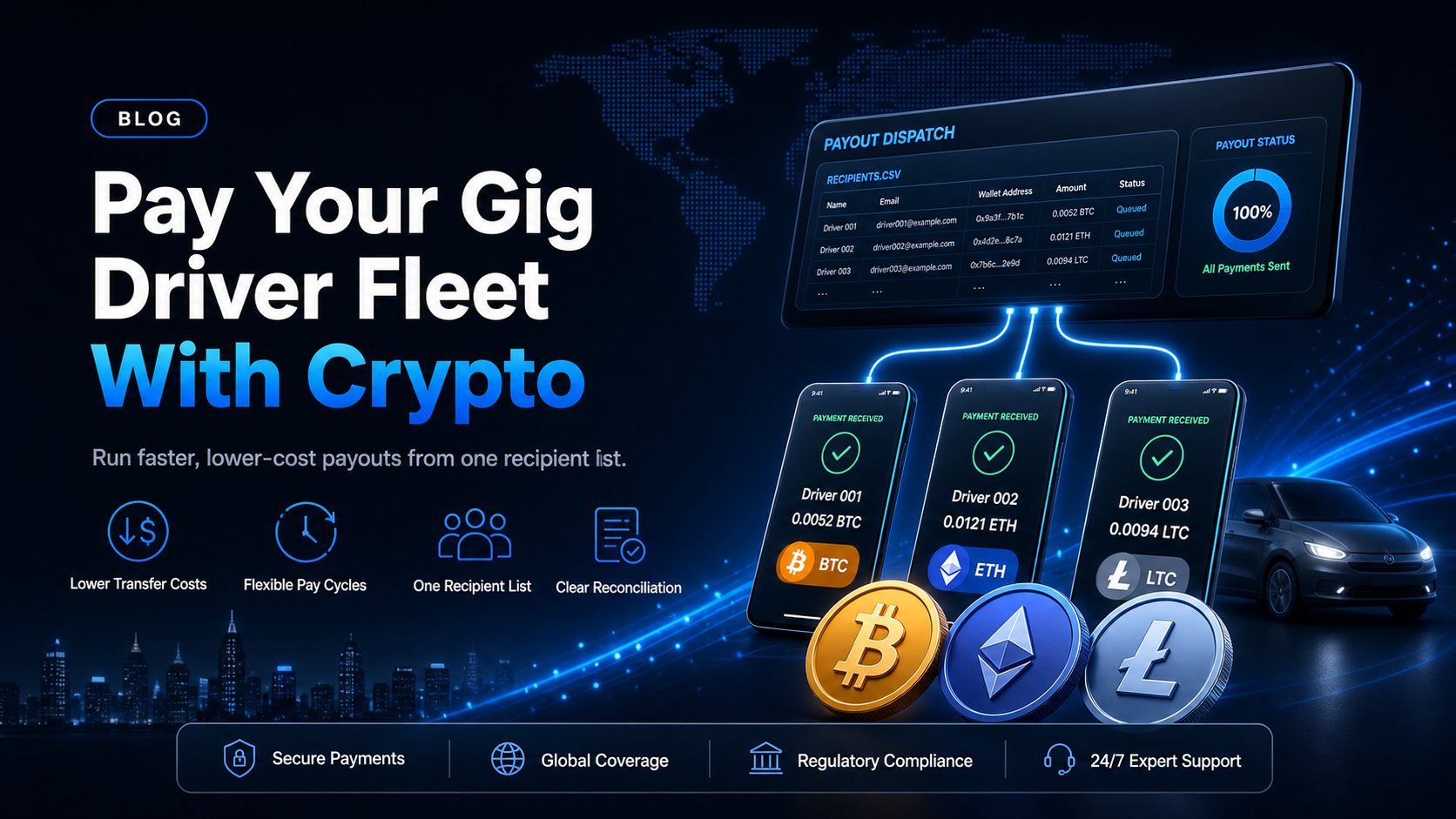
A gig driver fleet is a demanding payout list. The amounts are small, the list is long, the cadence is weekly or faster, and the recipients sit in markets your bank serves unevenly. The World Bank's Remittance Prices Worldwide database put the International MTO Index at 5.52 percent of a $200 transfer in Q3 2025, down from 5.91 percent in Q1 2025. When the average payout is a few hundred dollars, a percentage cost like that lands on every line of the run. PaymentsJournal reported on April 22, 2026 that more than a quarter of the US workforce takes part in the gig economy. The same report says many of those workers still see delayed or incomplete payouts.
EukaPay is the payout rail for that list. You keep your driver ledger and your pay calculation where they are today. The run goes out in USDC, USDT, or ETH, from a recipient list you upload as a CSV file in the merchant dashboard. Crypto payouts are not tied to banking hours or the banking calendar, so a Saturday run is the same operation as a Tuesday run. You can also collect crypto pay-ins in the same merchant account, then fund the payout balance by transferring from that account's main balance.
In this guide, you'll learn:
Where a bank-transfer and money-transfer-operator fleet cycle loses money and time
Where gig worker payouts crypto rails change the pay math for a driver fleet
The five steps that put a driver fleet payout run into production on EukaPay
What your finance and accounting teams need to handle before the first run
Why bank transfers and money transfer operators lose money on driver fleet payouts
A fleet payout cycle usually starts as a handful of bank transfers and turns into a standing job for someone. Three costs show up as it grows.
Percentage cost on small amounts - the pay math gets worse as payouts shrink
A cost expressed as a percentage of the transfer is heaviest on a small payout. The World Bank number above is a percentage of $200, and a driver's weekly earnings often sit in that range. Flat per-transfer charges land the same way. A $2 charge on a $120 payout is a far bigger share of the payout than the same charge on a $12,000 invoice. A fleet made up of small lines carries that share on every row.
Rail fragmentation - every market adds another account format and cutoff time
Each market you add brings another account format, another set of local rails, and another cutoff time. CoinDesk reported on April 21, 2026 that DoorDash is working with the Stripe-led blockchain Tempo on stablecoin-powered payouts, starting with cross-border flows where settlement speed and cost matter most. DoorDash runs in more than 40 countries, which is the same problem a growing fleet runs into. On EukaPay one recipient list format can cover each new market you add.
Cadence lock - the banking calendar sets your pay frequency
Bank rails often make weekly the shortest cycle a finance team can afford. Moving to twice-weekly can multiply both your per-transfer costs and your ops workload.
What crypto payouts do differently for a driver fleet
The run is not tied to banking hours or the banking calendar.
A weekend run, a public-holiday run, and a mid-week run are the same operation. Cadence becomes an ops decision instead of a calendar decision.
One recipient list can cover every market you operate in.
A wallet address does not depend on a local branch, a local account format, or a correspondent banking chain. Adding a market means adding rows.
The asset and the network are set per payout.
A driver who wants a dollar-denominated stablecoin and a driver who wants ETH can sit in the same run. Payouts are sent in USDC, USDT, or ETH, and the payout networks include Ethereum and Tron.
Gig worker payouts crypto workflow, step by step
1. Build the driver recipient list.
One row per driver, carrying the wallet address, the payout amount, the asset, and the network. Keep the asset and network fields in your own recipient master, next to the driver record. That master is the system your ops team already edits when a driver changes a payout preference.
2. Fund the payout balance.
The payout balance is funded by transferring from your account's main balance. Do that transfer before you upload the list.
3. Upload the CSV file in the merchant dashboard.
Mass crypto payouts run from a recipient list uploaded as a CSV file. The uploaded list is validated and shown with its recipients and amounts before anything is sent, so a bad row can be corrected in the list you upload.
4. Send the run from the dashboard, or from your own system.
Sending the run from the merchant dashboard needs no code. If you would rather trigger payouts from your own driver ledger, the Payout API creates crypto payouts programmatically, one payout per request.
5. Reconcile with the payout references.
Each payout has its own reference that can be looked up. Write that reference back to the driver row during the run, not at month-end. The reconciliation can then be finished before the accounting close starts.
For the same pattern on a longer list, see how to
pay 500 contractors with crypto mass payouts
and how to send
1,000 publisher payouts in stablecoins or crypto
.
Which fleet operators should move payouts to crypto?
The answer is a buyer profile, not an industry. The operators who gain the most share four traits.
A driver list that grew past manual handling.
Somewhere above roughly 100 drivers, a bank-transfer cycle stops being a task and becomes a role.
A cadence you want to increase but cannot afford to.
If per-transfer cost and ops time are what block twice-weekly pay, the rail is the constraint.
Small average payout amounts.
The smaller the average line, the more a percentage or flat charge on that line matters.
Drivers spread across markets your bank serves unevenly.
If half the fleet sits outside your bank's strong footprint, the rail is the problem and not the fleet.
Operators paying a small local fleet through one domestic rail often have no problem to fix. On EukaPay the same pattern fits adjacent lists, including
and
marketplace sellers on a shorter cycle
.
What finance and accounting teams need to handle for crypto payouts
Four items can be settled before the first live run.
Per-asset minimum payout amounts.
EukaPay enforces a minimum payout amount per asset. Some drivers will earn less than that in one cycle, so decide whether those lines accumulate to the threshold or move to a longer cycle.
The payout reference as the audit key.
Each payout's own reference is what an auditor can follow from your driver ledger to the payout record. Store it on the driver row, so the audit becomes a lookup against your own ledger.
The recipient master, and who owns it.
Wallet address, asset, and network belong in your own recipient list, with a documented owner and a change process. A wrong wallet address is not something you can reliably correct once a payout is sent.
Where payroll calculation stays.
EukaPay sends the payout. Your existing system still runs the earnings calculation, the deductions, and the worker classification decisions. Document that boundary before the pilot.
One platform for deposits, payouts, and fiat settlement
The same platform gives you instant crypto-to-fiat conversion at a locked exchange rate to remove your exposure to crypto price swings, support for most major cryptocurrencies, and settlement in USD, EUR, GBP, and CAD to your bank account. EukaPay locks the exchange rate on every conversion by default, on pay-ins and on payouts. On the payout side the assets are USDC, USDT, and ETH. A crypto payment confirms on-chain, so protection against chargebacks is a property of the payment method.
For a fleet operator, that means one integration, one reconciliation habit, and one place to look when a driver asks about a payment. Run one cycle on a single group of drivers first, and keep the existing rail live beside it. Compare the two runs on cost and ops time before you move the rest of the fleet.
Get started with EukaPay
Create a merchant account at
to upload your first recipient list and send a test run. If you want the run triggered from your own driver ledger, the payout endpoints, the balance transfer call, and the staging environment are documented at
. Product detail lives on the
page.
Frequently asked questions
Can you pay gig workers in crypto?
Yes. On EukaPay you upload a recipient list as a CSV file in the merchant dashboard, or create payouts through the Payout API. Each recipient receives crypto at the wallet address on their row.
What cryptocurrencies can I use for gig worker payouts?
Payouts are sent in USDC, USDT, or ETH. The payout networks include Ethereum and Tron, and the asset and the network are set per payout.
How do I pay a whole driver fleet at once?
Upload the fleet as a recipient list in CSV form in the merchant dashboard. The list is validated and shown with its recipients and amounts before anything is sent.
Do I need a developer to send crypto payouts?
No. The CSV upload in the merchant dashboard needs no code. A developer (or coding agent) is only needed if you want your own system to create payouts through the Payout API, which sends one payout per request.
Can different drivers receive different cryptocurrencies in the same run?
Yes. The asset and the network are set per payout, so one driver can receive USDC while another receives ETH in the same recipient list.
Is there a minimum crypto payout amount?
Yes. EukaPay enforces a minimum payout amount per asset, so plan for drivers whose earnings can fall below it.
How do I prove a driver was paid?
Each payout has its own reference that can be looked up. Store that reference on the driver row in your ledger, and it becomes the key your finance team and your support team both use.
Can I still pay some drivers through my bank?
Yes, and many operators do during a pilot. EukaPay's fiat settlement reaches your own bank account and not a driver's, so fiat payments to drivers stay in the system you use today.
Related articles
How to pay 500 contractors with crypto mass payouts
- the same recipient-list pattern on a longer list
How to pay 1,000 publishers in stablecoins or crypto
- the same workflow on a publisher list
How to pay marketplace sellers in stablecoins or crypto
- what changes when the cycle gets shorter
Products
Use Cases
© 2026 EukaPay. All rights reserved.
FINTRAC: M22233887