How to pay an esports prize pool to 64 players in crypto
August 25, 2026
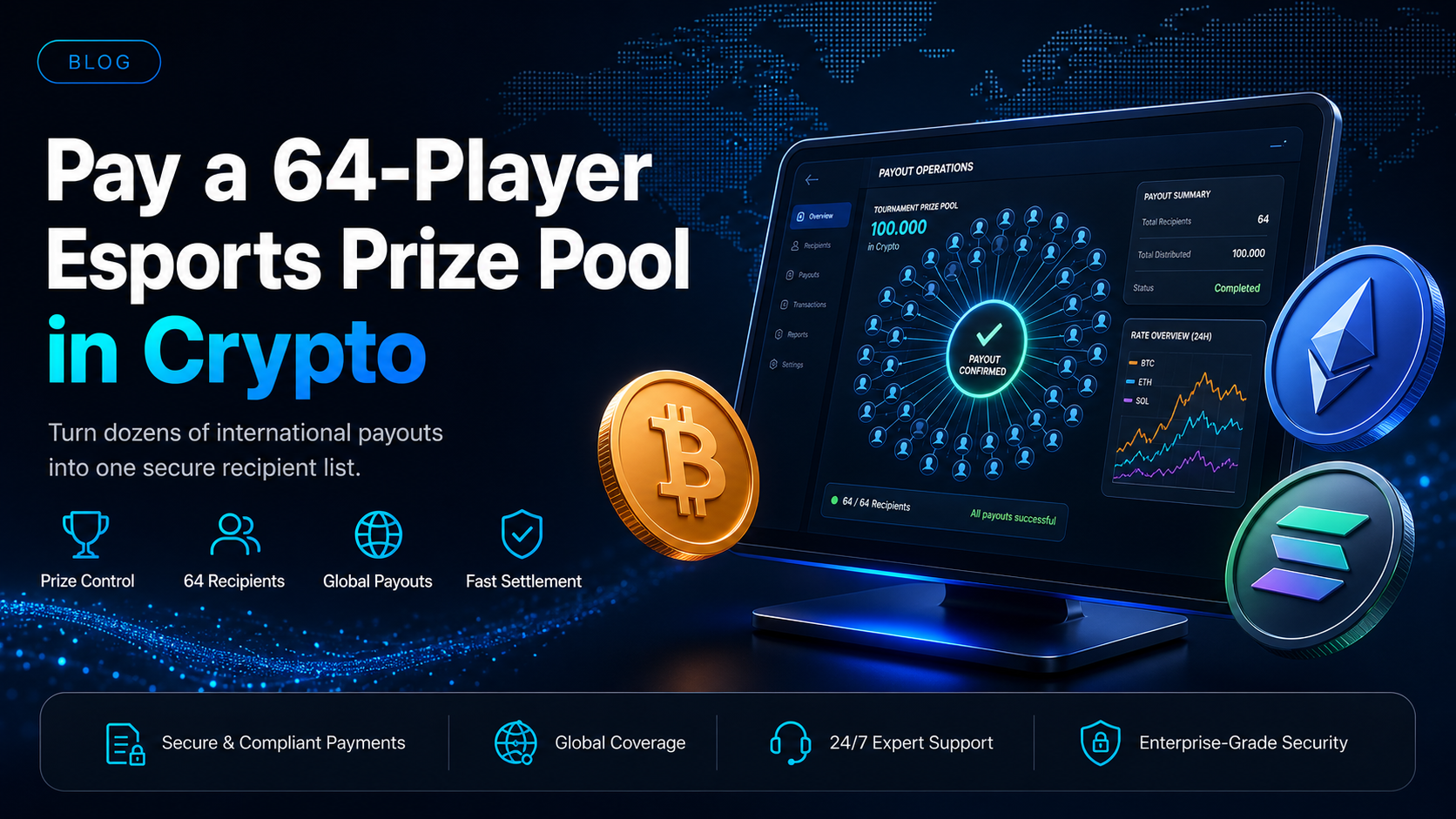
On January 20, 2026 the Esports World Cup Foundation announced a $75 million prize pool for its 2026 event, with more than 2,000 players from over 100 countries competing. Most tournaments are far smaller, and the payout math still works the same way. Splitting a prize pool across 64 finishers means 64 separate cross-border transfers. The World Bank's Remittance Prices Worldwide report for September 2025 puts the global average cost of sending a $200 remittance at 6.36 percent.
EukaPay runs esports prize payouts in crypto from one recipient list you upload in the merchant dashboard, instead of 64 separate transfers. Payout assets include USDC, USDT, and ETH. The asset and the network are set per payout. One player can take a dollar-denominated stablecoin and another can take ETH, inside the same run.
In this guide, you'll learn:
Why splitting a prize pool over international wires costs more than the fee schedule suggests
The three things crypto rails change about a 64-player payout run
The five steps of a production prize payout run, from recipient list to reconciliation
What your finance and accounting teams need to handle before the first run
Why international wires lose money on a 64-player prize pool
A bracket payout is hard for a bank to price. The amounts are small, the recipient list changes every event, and the recipients sit in countries your bank has no direct relationship with. Each transfer passes through intermediary banks, and each one can take a cut nobody quoted up front. The World Bank's 6.36 percent global average is an indicative floor for a small cross-border transfer, not a quote for a business wire.
The second cost is operations time. A 64-line prize pool is 64 sets of bank details to collect, validate, and re-key. Details arrive in the wrong format, an account name does not match a passport, or a player's bank cannot receive foreign currency. Each one becomes a support ticket during the week you are running the next event.
The calendar adds a third cost. Wires settle on banking days, so a Sunday grand final can wait until Tuesday or later to pay out.
What esports prize payouts crypto rails do differently
Three properties account for the change.
One list instead of 64 instructions.
Mass payouts run from a recipient list uploaded as a payout CSV file in the merchant dashboard. You build the file once from your bracket results, and the run becomes one action.
A wallet address instead of bank details.
A player supplies one destination address. There is no account name to match, no routing code to look up, and no correspondent banking chain between your account and theirs.
No dependency on banking hours.
Crypto payouts are not tied to banking hours or the banking calendar, so a Sunday final does not wait for a Tuesday cut-off. The same property is what makes
work for contractor runs on a weekend cadence.
How a 64-player prize payout run works in production
There are five steps. The first two happen before the final ends, and the last three happen after it.
1. Collect a destination address at registration, not after the final.
Add a wallet address field, a preferred payout asset field, and a network field to your tournament registration form. Your own recipient list holds those three values against each player ID. The run is then not waiting on 64 replies at the moment everyone wants their money.
2. Fund the payout balance.
The payout balance is funded by transferring from your account's main balance. Do this before you build the file, because the run pays out of that balance.
3. Build the payout list from the bracket.
Export placements from your tournament platform and join them to the addresses you collected at registration. That gives you one row per paid player, with the amount and the destination address already matched. The asset and the network are set per payout, so those two values sit on the row as well. Keep the player ID and the placement as columns in your own copy of the file.
4. Upload the file and send the run.
Upload the payout CSV in the merchant dashboard. The uploaded list is validated and shown with its recipients and amounts before anything is sent. If you would rather drive this from your tournament backend, the Payout API creates payouts programmatically, one payout per request.
5. Reconcile against the bracket using the payout references.
Each payout has its own reference that can be looked up. Store that reference next to the player ID and the placement in your own records. Prize payout reconciliation then has a line-by-line match between the bracket and the payout run.
Which tournament operators should run prize payouts in crypto?
Esports prize pool payouts in crypto work best for an operator whose recipient list is large, international, and different every event. If you pay the same six salaried players every month in one country, a bank transfer is fine. The math changes when the list is dozens of names long and the names change each cycle. It changes again when the countries are spread wide enough that no single bank covers them well.
Cadence and audience matter too. An operator running weekly or monthly events feels per-transfer cost and operations time repeatedly, so a fix compounds. If your players already hold wallets, asking for a destination address at registration is not a new ask. That combination is why tournament operators use one merchant account for entry payments and prize payouts, a pattern covered in detail in
crypto payments for esports and tournament platforms
.
What finance and accounting teams need to handle for crypto prize payouts
Three things sit with finance instead of with the tournament team.
Per-asset payout thresholds.
Each payout asset carries a threshold below which a payout cannot be sent. A deep bracket with small tail prizes can put the last few places under that threshold, so confirm the thresholds for your assets before you publish the prize structure.
The record you keep.
The payout system holds the payout and its reference. It does not hold your bracket. Keep the player ID, the placement, the amount, and the payout reference in one exported table. That table is what makes the run auditable a year later.
Settlement on the collections side.
If you also take entry fees or sponsor payments in crypto, you choose fiat or crypto settlement on that side independently. Fiat settlement reaches your own bank account, so it is a company payment and not a way to pay a player.
One platform for deposits, payouts, and fiat settlement
The same account handles both directions. You get instant crypto-to-fiat conversion at a locked exchange rate to remove your exposure to crypto price swings, support for most major cryptocurrencies, and settlement in USD, EUR, GBP, and CAD to your bank account. The locked exchange rate is applied by default on every conversion, on pay-ins and on payouts. On the payout side you also get the payout CSV upload, the Payout API, and per-payout control of asset and network. A crypto payment confirms on-chain, so protection against chargebacks is a property of the payment method.
For a tournament operator, that means entry fees, sponsor invoices, and prize payouts run through one merchant account and one export. If your next event has a 64-player bracket, start with the payout side and run one prize pool through it. Add the collections side once finance has closed a month against it.
Get started with EukaPay
Create an account at
to set up crypto payouts and run your first prize pool from a CSV upload. If you want the run driven from your tournament backend, the Payout API and the balance transfer endpoints are documented at
.
Frequently asked questions
How do esports tournaments pay prize money to international players?
Most still use international wires, which means one cross-border transfer per player and bank details collected from each one. Crypto payouts replace that with a single recipient list uploaded in the merchant dashboard, one line per player.
Which cryptocurrencies can I use for esports prize payouts?
Payout assets include USDC, USDT, and ETH. The asset and the network are set per payout.
Do all 64 players have to be paid in the same cryptocurrency?
No. Because the asset and the network are set per payout, one run can pay some players in a dollar-denominated stablecoin and others in ETH.
Is there a smallest prize payout amount per player?
Yes. Each payout asset carries its own threshold, so confirm the thresholds for your assets against the tail end of your bracket before you publish it.
Do crypto prize payouts depend on banking hours?
No. Crypto payouts are not tied to banking hours or the banking calendar, so a weekend final does not wait for the next banking day.
Can I run esports prize payouts through an API instead of a CSV?
Yes. The Payout API creates crypto payouts programmatically, one payout per request, which suits an operator triggering payouts from a tournament backend.
How do I confirm a prize payout was sent?
Each payout has its own reference that can be looked up. Storing that reference against the player ID and the placement gives support and finance the same answer.
Can I take entry fees in the same account?
Yes. Pay-ins support a wider asset set than payouts, and you choose fiat or crypto settlement. Fiat settlement reaches your own bank account in USD, EUR, GBP, and CAD.
Related articles
Crypto payments for esports and tournament platforms
- entry payments and prize payouts on one account
How to send 200 crypto affiliate payouts
- the same CSV run applied to an affiliate cycle
How to pay 1,000 publishers with crypto payouts
- the same CSV run applied to a much longer recipient list
Products
Use Cases
© 2026 EukaPay. All rights reserved.
FINTRAC: M22233887