Multi currency payment processing: charging in one currency, settling in another
October 05, 2026
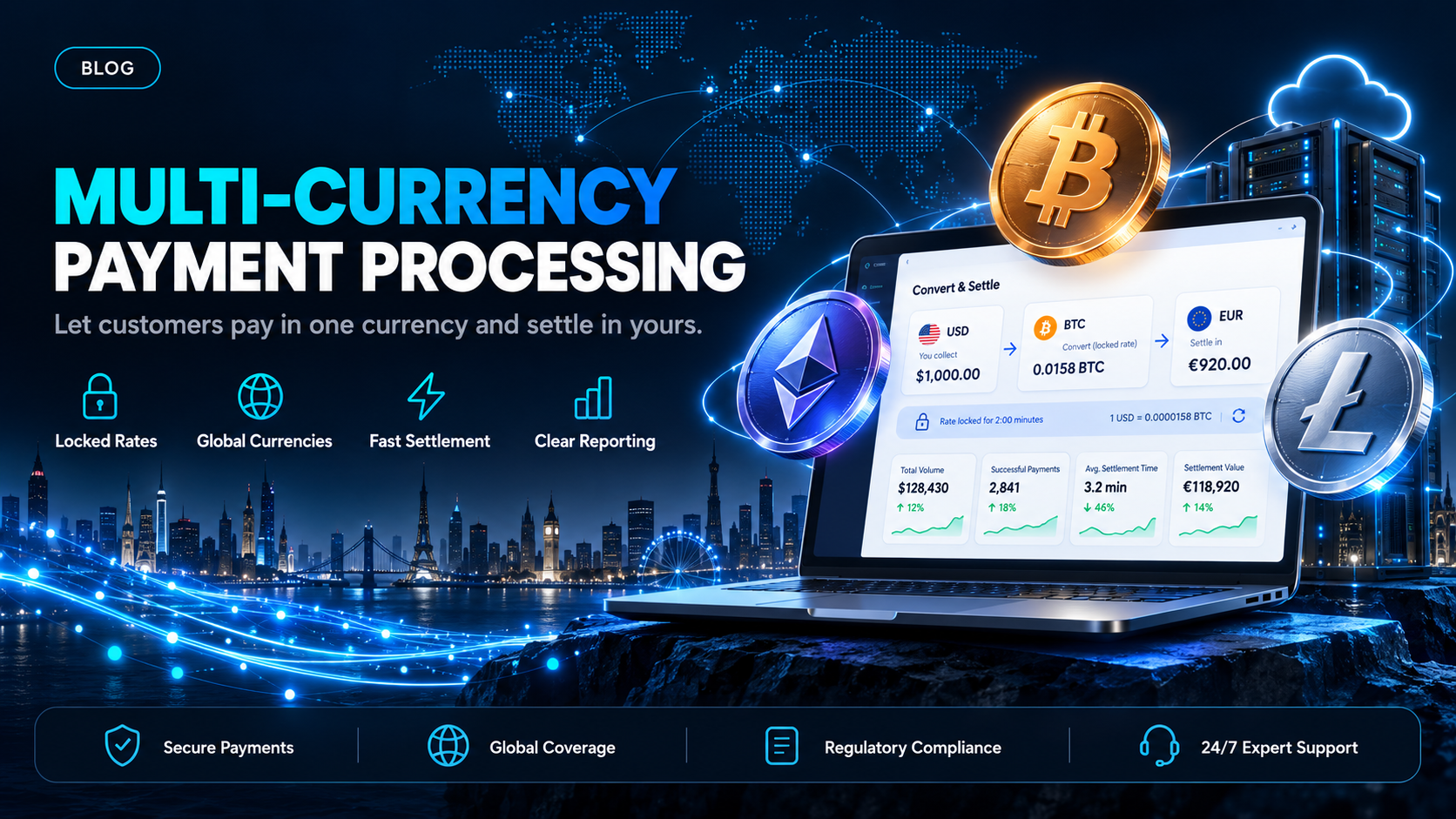
Multi currency payment processing is the set of steps that lets a customer pay in one currency while the business receives another. A buyer abroad sees a price, pays it, and the money reaches your bank account in the currency your books are kept in. Before the money lands, a conversion happens, and someone sets the rate.
EukaPay handles that conversion for stablecoin and crypto payments. Your customer pays in a cryptocurrency, EukaPay converts it at a locked exchange rate, and fiat settles to your bank account in USD, EUR, GBP, or CAD. This guide explains the parts of multi currency payment processing, how card rails and crypto rails handle them, and what to set up.
In this guide, you'll learn:
The three currencies in every multi currency payment: pricing, payment, and settlement
Where currency conversion happens on a card payment
How multi currency payment processing works on a stablecoin or crypto rail
How to set up multi currency payments with EukaPay
What is multi currency payment processing?
Multi currency payment processing means accepting a payment in a currency other than the one your business settles in. The processor converts the amount, and the business receives its own currency. Every multi currency payment carries three currencies, even when two of them are the same.
Pricing currency - what the customer is quoted
The pricing currency is the one on the invoice, the product page, or the checkout total. Some businesses use one price list for every buyer, and others quote local prices by market.
Payment currency - what leaves the customer's account
The payment currency is what the customer actually pays with. On a card, that is the currency of the customer's card account. On a crypto payment, that is the cryptocurrency the customer sends, such as USDC or USDT.
Settlement currency - what reaches your bank account
The settlement currency is what your business receives. For most companies, it is the currency they pay rent, payroll, and suppliers in. Settling in that currency means the finance team does not need to run a second conversion after the money lands.
Where currency conversion happens on a card payment
On a card payment, the conversion can happen in more than one place. Who converts the amount often decides who sets the rate and who pays the margin on it.
Issuer conversion - the customer's bank converts
When a merchant charges in its own currency, the customer's card issuer can convert the amount into the card's currency. The issuer sets that rate. The customer may also see a foreign transaction fee on their statement.
Dynamic currency conversion - the merchant's provider converts
With dynamic currency conversion, the customer is offered the total in their home currency at checkout. The merchant's payment provider converts the amount and sets the rate. The customer sees a familiar number, but the rate can carry a markup.
Multi-currency settlement - the acquirer pays out in more than one currency
Some card acquirers can settle in several currencies. A business holding a bank account in each one can then avoid converting at all. This guide covers the crypto rail EukaPay runs, so it does not compare card settlement terms.
How multi currency payment processing works on a stablecoin or crypto rail
A crypto payment has no card issuer or card network in the conversion. The customer pays from their own wallet, and the processor converts the amount to fiat. That leaves one rate, set at one moment, by one party.
Invoice in fiat - the price stays in your currency
EukaPay invoices are priced in a fiat currency, including USD, EUR, GBP, and CAD. The customer opens the payment page and chooses a cryptocurrency, such as BTC, ETH, LTC, SOL, USDC, or USDT. The page asks for the crypto amount that matches the invoice total.
Locked exchange rate - the fiat value is fixed when the customer pays
EukaPay locks the exchange rate on every conversion by default, on pay-ins and on payouts. The fiat value of the payment is fixed at the moment the customer pays. The
guide to a locked exchange rate
explains what that means for a merchant's margins.
Fiat settlement - converted funds reach your own bank account
With fiat settlement, EukaPay sends the converted amount to your own bank account. You choose the settlement currency, such as USD, EUR, GBP, or CAD. You can also choose crypto settlement and keep the payment in crypto. The
guide to stablecoin to fiat payments
compares both routes for a finance team.
Card vs crypto multi currency payment processing
Stablecoin or crypto with EukaPay | Card payment | |
|---|---|---|
Who sets the conversion rate | EukaPay, locked by default at payment | The issuer or the merchant's provider |
What the customer pays with | A cryptocurrency from their own wallet | The currency of their card account |
What reaches your bank account | Fiat in USD, EUR, GBP, or CAD | Depends on the acquirer's settlement terms |
Chargebacks | Protection is a property of the payment method | The card dispute process applies |
EukaPay gives a business one conversion step with a rate fixed at payment. A card payment can pass through two conversions, with the issuer and the provider each setting part of the outcome. For customers in markets your acquirer serves poorly, a stablecoin payment through EukaPay adds a route that settles to the same bank account. The
guide to cross-border payment collection
covers that use case.
How to set up multi currency payments with EukaPay
Create an account.
, complete verification, and provide your legal business information.
Choose your settlement currency.
Pick fiat settlement and the currency your books are kept in, such as USD, EUR, GBP, or CAD.
Price your invoices.
Issue invoices in the fiat currency you quote your customers in.
Connect your system.
Use the EukaPay plugin for WooCommerce or Shopify, or generate an API key and create invoices through the API. A developer (or coding agent) can build against the staging environment first. The
guide to the EukaPay crypto payment API
covers the requests.
Run a test payment.
Pay a small invoice in USDC or USDT and confirm the settled amount matches the invoice total.
One platform for multi currency pay-ins, payouts, and fiat settlement
A EukaPay account covers the payment and what comes after it. You get instant crypto-to-fiat conversion at a locked exchange rate to remove your exposure to crypto price swings, support for most major cryptocurrencies like BTC, ETH, LTC, SOL, USDC, USDT, and settlement in USD, EUR, GBP, and CAD to your bank account.
A crypto payment confirms on-chain, so protection against chargebacks is a property of the payment method. The same account can send crypto payouts in USDC, USDT, ETH, and BTC. Payouts are not tied to banking hours or the banking calendar.
If your customers pay from abroad and your books run in one currency, set up EukaPay for multi currency payment processing. Compare providers in the
multi currency payment gateway guide
, then create your account.
Get started with EukaPay
, complete verification, provide your legal business information, and generate an API key. A staging environment is available for development. The
covers invoices, subscriptions, payouts, balance transfer, and customers.
Frequently asked questions
What is multi currency payment processing?
Multi currency payment processing lets a business accept a payment in one currency and receive another. The processor converts the amount before it settles.
What is a settlement currency?
The settlement currency is the currency that reaches your bank account. EukaPay settles in USD, EUR, GBP, and CAD, among other currencies.
Who sets the exchange rate on a multi currency payment?
On a card payment, the issuer or the merchant's payment provider sets it. On a crypto payment, EukaPay locks the exchange rate on every conversion by default.
Can I invoice in one currency and get paid in crypto?
Yes. A EukaPay invoice is priced in fiat, and the customer pays the matching amount in a cryptocurrency such as USDC, USDT, BTC, or ETH.
Does the exchange rate change between payment and settlement?
EukaPay locks the exchange rate on every conversion by default. The fiat value is fixed at the moment the customer pays.
Which cryptocurrencies can customers pay with?
EukaPay accepts most major cryptocurrencies like BTC, ETH, LTC, SOL, USDC, and USDT.
Can a multi currency crypto payment be charged back?
A crypto payment confirms on-chain, so protection against chargebacks is a property of the payment method.
Related articles
Multi currency payment gateway for crypto settlement
- how to choose a gateway that settles crypto in several currencies
- conversion and settlement for stablecoin revenue
Fiat vs stablecoins for global payments
- how the two rails compare for international payments
Products
Use Cases
© 2026 EukaPay. All rights reserved.
FINTRAC: M22233887