I need guidance on accepting crypto payments: start here
August 28, 2026
The World Bank's Remittance Prices Worldwide report, Issue 54, published September 2025, priced the global average cost of a cross-border remittance at 6.36 percent of the amount sent. When a bank moves the money, that average rises to 14.99 percent. Business collections ride the same correspondent-banking rail, so a company invoicing abroad pays into the same structure.
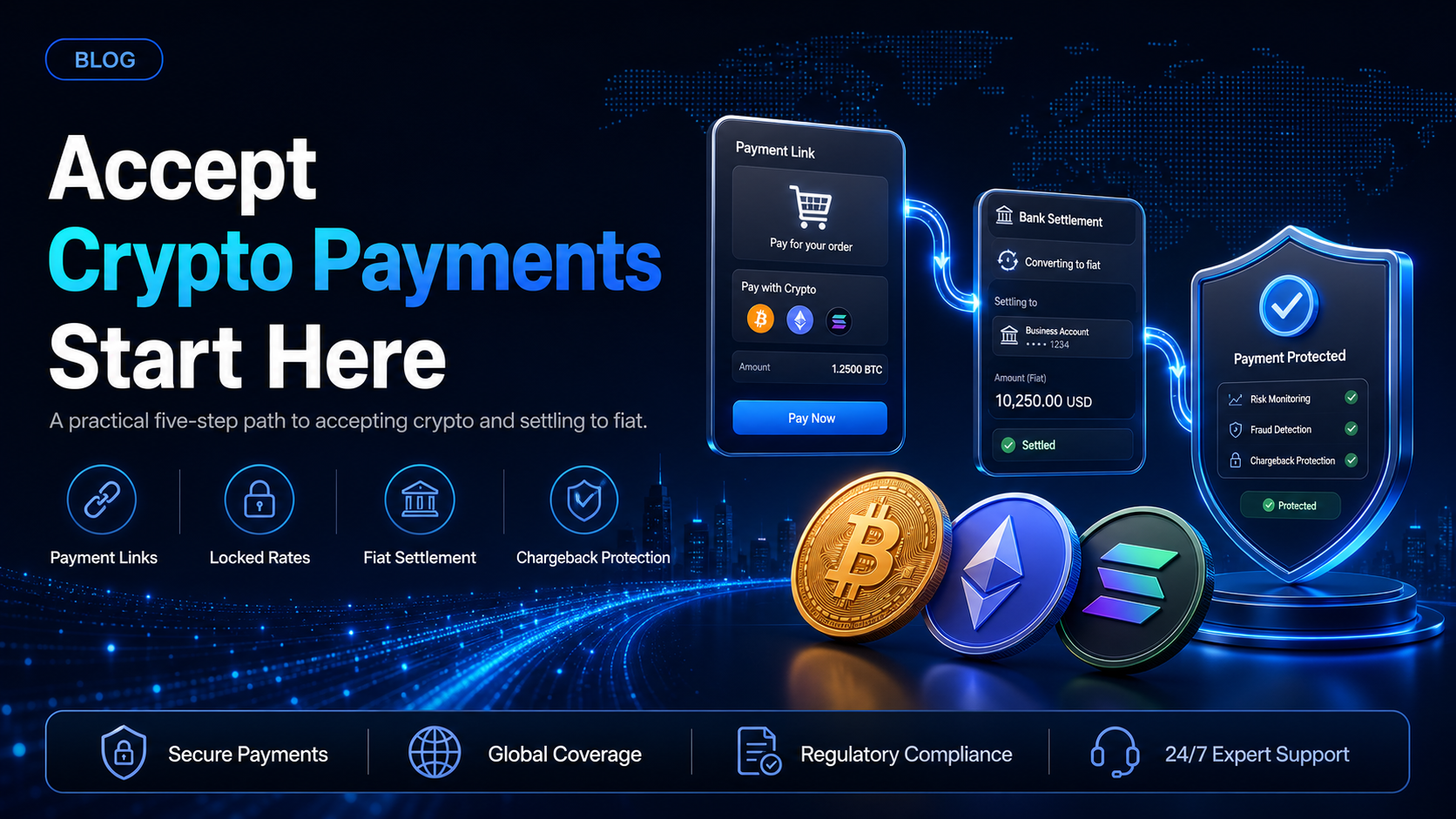
EukaPay is the replacement rail. Your customer pays in stablecoins or crypto and the payment confirms on-chain. EukaPay converts it at a locked exchange rate and settles fiat to your own bank account in USD, EUR, GBP, or CAD. Most guidance on accepting crypto payments stops at the concept, so this guide walks the five steps from signup form to live payment.
In this guide, you'll learn:
Why card and bank rails lose money and time on cross-border collections
The three properties that make a crypto payment behave differently
The five steps that put accepting crypto payments into production
What your finance and accounting teams need to decide before you go live
Why card and bank rails lose money and time on cross-border collections
The cost of a cross-border collection is rarely one line on one invoice. It is a percentage taken at the FX conversion. It is a flat charge from each intermediary bank in the chain. And it is a delay between the moment your customer pays and the moment your treasury can see the money.
Correspondent banking - every intermediary applies its own charge
A wire from a customer's bank to yours can pass through more than one intermediary institution. Each one applies its own charge and its own cut-off times. Neither you nor your customer chooses the route, so neither of you can price it in advance.
Cards - a declined cross-border payment costs the whole order
Card rails do not fail on price alone. An issuer scores a foreign-acquired transaction against rules your acquirer did not write, so a legitimate purchase can be declined for reasons neither side can see. Every extra country in your customer list adds another issuer and another set of those rules.
I need guidance on accepting crypto payments - what the question usually means
Operators rarely arrive asking which blockchain to use. They arrive with a stuck payment: a large invoice a buyer cannot wire, a self-serve customer with no working card, or a supplier deposit that keeps landing short. Accepting crypto payments is worth doing when it clears one of those.
Three properties that make accepting crypto payments different
It confirms on-chain.
A crypto payment confirms on a public network, so protection against chargebacks is a property of the payment method. The buyer cannot reverse a confirmed transfer through their issuer weeks later.
It converts at a locked rate.
EukaPay locks the exchange rate on every conversion by default, on pay-ins and on payouts. You get instant crypto-to-fiat conversion at a locked exchange rate to remove your exposure to crypto price swings. The fiat value of the sale is fixed at the point of conversion.
It does not route through correspondent banks.
A blockchain transfer moves on a public network instead of through a chain of intermediary institutions. The number of hops does not depend on which two banks your customer and your treasury happen to use.
How do you start accepting crypto payments? Five steps
Sign up and complete verification.
Create an account at the EukaPay dashboard, complete verification, and provide your legal business information. Then generate an API key from the dashboard.
Pick the collection method.
EukaPay offers invoices, payment links, checkout, and subscriptions, plus a
for teams that want the payment created from their own system. A company billing a named buyer usually starts with an invoice. A company selling self-serve usually starts with checkout.
Set your settlement preference.
Choose fiat or crypto settlement. Fiat settlement reaches your own bank account, and the settlement currencies include USD, EUR, GBP, and CAD. This is a merchant-side setting and not a way to pay an individual recipient in fiat.
Build and test in the staging environment.
A staging environment is available for development, so your developer (or coding agent) can
test the integration in a sandbox
before any real money moves. Confirm your webhook handling and your order states there.
Go live and send the first real payment request.
Switch to live keys, then
or a payment link and send it to a real customer. Confirm that one payment lands before you route volume to it.
Who accepting crypto payments works best for
The buyer profile is more useful than a list of verticals. This works best for a business that already has customers it cannot reliably collect from, and where the failure is the payment method and not the relationship.
That usually means one of four things. You invoice buyers outside your acquirer's footprint and the wire is slow or expensive. You sell self-serve and a share of signups never complete a card payment. You take large single payments where a percentage-based FX spread is a real number. Or you already pay people in crypto and want collections on the same account.
It works less well when your customers are domestic, card-funded, and converting fine. Adding a payment method nobody asked for does not create demand. If you are still deciding,
how to accept bitcoin as a business
covers whether to start at all.
What finance and accounting teams need to handle
Three decisions belong to finance before go-live, and none of them are technical.
The first is the settlement choice. Settling to fiat in USD, EUR, GBP, or CAD keeps the money in the currency your books already use, and settling in crypto keeps the asset. Pick one and document it, because switching later changes what reconciliation looks like.
The second is reconciliation ownership. Somebody has to match an incoming payment to the invoice or order it belongs to. Name that person before the first payment lands rather than after.
The third is scope. Your accounting policy, your tax position, and your revenue recognition treatment stay with your finance team and your advisors. A crypto payment gateway changes how the money arrives, not how you are required to record it.
One platform for deposits, payouts, and fiat settlement
The same EukaPay account handles both directions. On the collections side you get instant crypto-to-fiat conversion at a locked exchange rate to remove your exposure to crypto price swings, support for most major cryptocurrencies like BTC, ETH, LTC, SOL, USDC, USDT, and settlement in USD, EUR, GBP, and CAD to your bank account. A crypto payment confirms on-chain, so protection against chargebacks is a property of the payment method.
The payout side runs from the same account. Payouts are sent in USDC, USDT, and ETH, with the asset and the network set per payout. You can
pay 200 affiliates in one batch
without every recipient taking the same asset. If you collect from customers abroad and pay contractors, publishers, or suppliers abroad, one platform for both is the reason to start here.
Get started with EukaPay
Create an account at
and complete verification to get your API key. The endpoints, the staging environment, and the webhook reference are all documented at
.
Frequently asked questions
I need guidance on accepting crypto payments. Where should a business start?
Start with the specific payment that is currently failing, not with the technology. Sign up, complete verification, pick one collection method for that one payment, and test it in the staging environment before going live.
Do I have to hold cryptocurrency to accept crypto payments?
No. You can choose fiat settlement, which converts the payment and reaches your own bank account in USD, EUR, GBP, or CAD.
Which cryptocurrencies can a business accept?
EukaPay supports most major cryptocurrencies for pay-ins, including BTC, ETH, LTC, SOL, USDC, and USDT, with Lightning also supported.
How long does it take to start accepting crypto payments?
Every merchant goes through onboarding and a business review, so the timing depends on how quickly your legal business information is ready.
What happens to the exchange rate between the payment and the settlement?
EukaPay locks the exchange rate on every conversion by default, on pay-ins and on payouts, so the fiat value is fixed at the point of conversion.
Can I accept crypto payments without writing any code?
Yes. Invoices, payment links, and checkout are all created from the merchant dashboard. The API is there for teams that want the payment created from their own system.
Does accepting crypto payments protect against chargebacks?
A crypto payment confirms on-chain, so protection against chargebacks is a property of the payment method rather than a service layered on top of it.
Can the same account also send payouts?
Yes. Payouts are sent in USDC, USDT, and ETH, with the asset and the network set per payout. The payout balance is funded by transferring from the account's main balance.
Related articles
How to accept bitcoin as a business
- whether to accept crypto at all
How to create a crypto invoice and get paid in stablecoins or crypto
- the collection method most B2B sellers start with
How to accept crypto with a crypto payment API
- creating payments from your own system
Products
Use Cases
© 2026 EukaPay. All rights reserved.
FINTRAC: M22233887