Gaming payment solutions compared for operators in 2026
August 28, 2026
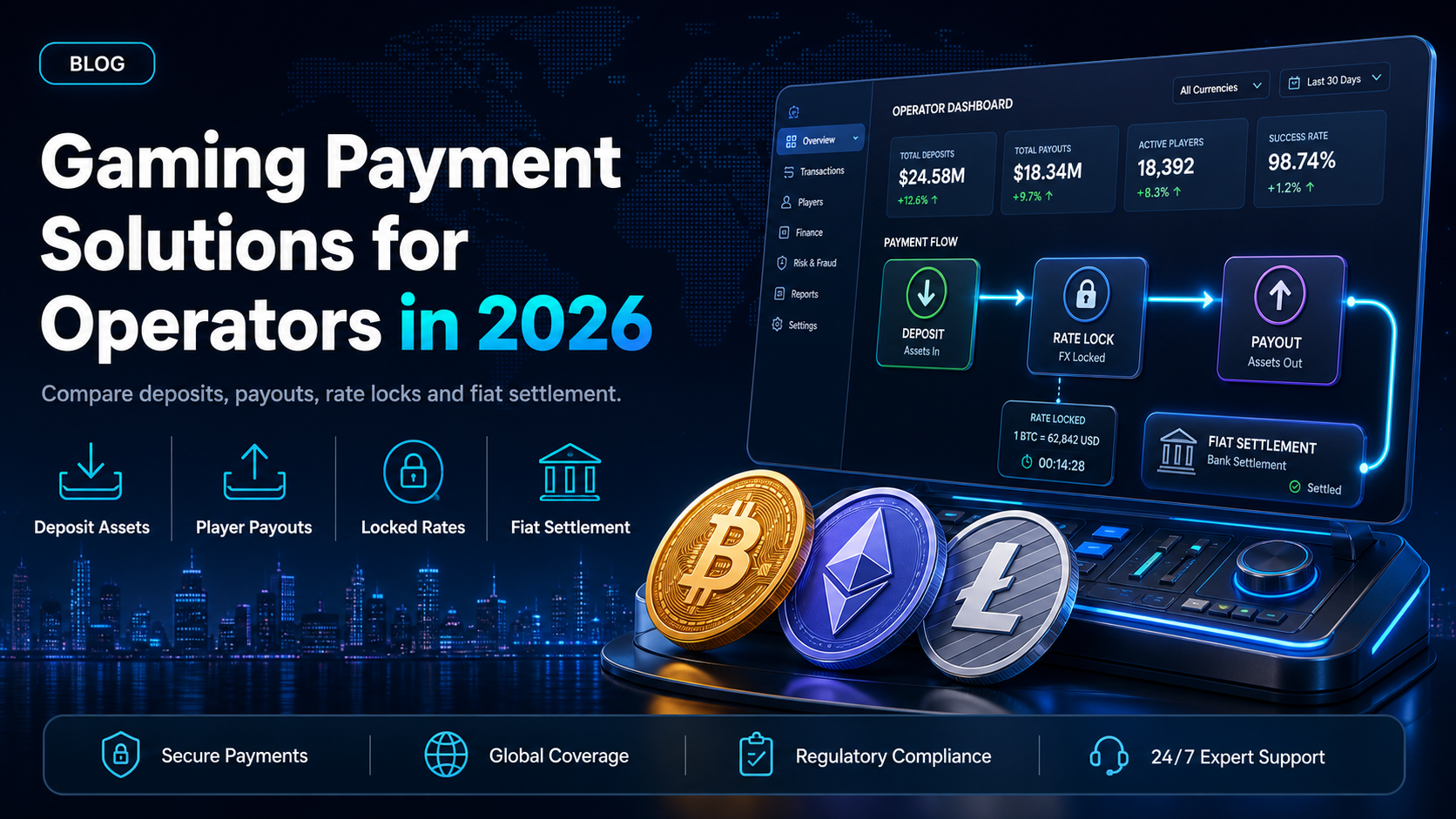
Gaming payment solutions are the products an online gaming operator uses to take player deposits, send player withdrawals, and move the money into a company bank account. EukaPay does all three from one merchant account. Players deposit in cryptocurrencies at checkout, the operator sends crypto payouts back out, and the balance settles as fiat in USD, EUR, GBP, and CAD.
Most vendors answer only part of that list, so a single headline rate is a poor way to compare them. This guide uses four criteria you can check before signing. They are deposit assets, payout assets, how the exchange rate is handled on conversion, and which fiat currencies you can settle in.
In this guide, you'll learn:
The four criteria that separate one gaming payment solution from another
What EukaPay, BitPay, CoinGate, and NOWPayments publish on assets, rates, and settlement
Why a published processing rate is often not the number an operator ends up paying
What to check on integration and reporting before you commit
What gaming payment solutions have to cover for an operator
An operator's payment stack has three jobs. A vendor that only does the first leaves the other two on your engineering team.
Player deposits - the assets you can take at checkout
EukaPay accepts pay-ins in BTC, ETH, LTC, SOL, USDC, and USDT, which covers the assets most players tend to hold. Asset breadth is where vendors differ most. NOWPayments publishes support for 350+ currencies and CoinGate publishes 10+ on its standard plan. A longer list is not automatically a better one, because each extra asset is another balance to reconcile.
Player withdrawals - the assets you can send back out
Fewer vendors cover this side. Taking a deposit and sending a withdrawal are separate products at most vendors, so an operator who compares only the checkout side can sign a contract that solves half the problem. EukaPay sends payouts in USDC, USDT, ETH, and BTC across the Ethereum, Tron, and Bitcoin networks, with the asset and network set per payout. Larger runs can be uploaded as a CSV file in the merchant dashboard, and the Payout API creates payouts programmatically, one per request. Each payout carries its own reference you can look up when a player asks where their money is.
Fiat settlement - the currencies you can receive
An operator's accounts are kept in fiat, so the last job is turning the balance into currency the finance team recognizes. EukaPay settles to the operator's own bank account in USD, EUR, GBP, and CAD. Settlement is not a way to pay an individual player in fiat, and payouts are not tied to banking hours or the banking calendar. Our guide to
crypto merchant settlement for iGaming
covers the mechanics.
How much do gaming payment solutions cost?
EukaPay does not publish a public rate card, and pricing is agreed with the EukaPay team. The other three publish standard rates. BitPay lists 2% plus 25 cents under $500,000 in monthly volume, stepping down to 1% plus 25 cents at $1,000,000 and above. CoinGate lists 1% on its standard plan, with custom volume-based rates on Enterprise. NOWPayments lists a 1% service fee.
A published number makes the first comparison faster, and those three deserve credit for it. It is also not the number an operator ends up paying. BitPay's own pricing page notes that higher fees apply to high-risk industries, and CoinGate's Enterprise tier replaces the standard rate with a custom one. The public figure is a starting point, not a quote, so an operator ends up having the same conversation with every vendor on the shortlist. With EukaPay the figure you compare is a quote for your own volume from the start.
Integration surface and reporting in online gaming payment solutions
Two operators with identical volumes can face different integration work, so check the surface before the rate. EukaPay gives you a REST API, hosted checkout, invoices, and payment links, plus a staging environment for development. The payer completes the transfer in a browser, so plan the deposit flow around a redirect, not a silent server-to-server call.
On reporting, ask whether each payout carries a searchable reference, whether deposits and withdrawals appear in one export, and whether the fiat settlement line reconciles against the crypto behind it. EukaPay holds both sides of the flow in one account, which keeps that reconciliation in a single place. For a wider vendor scorecard, see
how to choose an iGaming payment service provider
.
How to choose
EukaPay | BitPay | CoinGate | NOWPayments | |
|---|---|---|---|---|
Deposit assets | BTC, ETH, LTC, SOL, USDC, USDT | BTC, BCH, ETH, DOGE, LTC, XRP, plus tokens | 10+ cryptocurrencies | 350+ currencies |
Crypto payouts from the same account | USDC, USDT, ETH, BTC on Ethereum, Tron, Bitcoin | Separate crypto payouts product | Crypto payouts, 0.50 EUR + 0.5% | Mass payouts product |
Exchange rate on conversion | Locked by default, on pay-ins and payouts | Not stated on its pricing page | Locked at the moment of payment | Not stated on its pricing page |
Fiat settlement to your bank account | USD, EUR, GBP, CAD | USD, EUR, GBP, CAD, AUD, MXN, NZD | USD, EUR, GBP, or crypto | Off-ramp payouts product |
Check websites for latest information.
EukaPay answers all four rows from one account, which suits an operator running deposits and withdrawals at the same time. BitPay settles into a wider set of currencies. CoinGate publishes a payout price. Neither fact removes the work of running two separate products, and that work belongs to the team that has a platform to ship.
One platform for deposits, payouts, and fiat settlement
The same account behind your checkout is the account your withdrawals are sent from. It gives you instant crypto-to-fiat conversion at a locked exchange rate to remove your exposure to crypto price swings, support for most major cryptocurrencies, and settlement in USD, EUR, GBP, and CAD to your bank account. A crypto payment confirms on-chain, so protection against chargebacks is a property of the payment method.
For an operator, the practical effect is one integration, one reconciliation, and one vendor conversation instead of three. If you are still mapping which methods to offer players alongside crypto, our comparison of
sets out the trade-offs.
Get started with EukaPay
Create an account at
to take player deposits, send crypto payouts, and settle in USD, EUR, GBP, and CAD. Your developer (or coding agent) can read the endpoints at
and build against the staging environment first.
Frequently asked questions
What are gaming payment solutions?
They are the products an operator uses to take player deposits, send player withdrawals, and move the balance into a company bank account. EukaPay covers all three from one merchant account.
Which cryptocurrencies can players deposit with?
EukaPay accepts pay-ins in BTC, ETH, LTC, SOL, USDC, and USDT.
Can an operator send player withdrawals in crypto?
Yes. EukaPay sends payouts in USDC, USDT, ETH, and BTC on the Ethereum, Tron, and Bitcoin networks, with the asset and network set per payout.
How do gaming payment solutions handle crypto price movement?
EukaPay locks the exchange rate on every conversion by default, on pay-ins and on payouts. That removes your exposure to crypto price swings.
Which fiat currencies can an operator settle in?
EukaPay settles to your own bank account in USD, EUR, GBP, and CAD.
Do crypto deposits carry chargeback risk?
A crypto payment confirms on-chain, so protection against chargebacks is a property of the payment method, not a service layered on top of it.
What does an operator need to get started?
Sign up, complete verification, provide your legal business information, then generate an API key. A staging environment is available for development.
Related articles
How to choose an iGaming payment service provider
- the evaluation checklist for a provider shortlist
Crypto merchant settlement for iGaming
- how the balance reaches your bank account
Crypto payment solutions built for iGaming platforms
- the pillar guide for an operator's stack
Products
Use Cases
© 2026 EukaPay. All rights reserved.
FINTRAC: M22233887