Gaming payment processing end to end
September 09, 2026
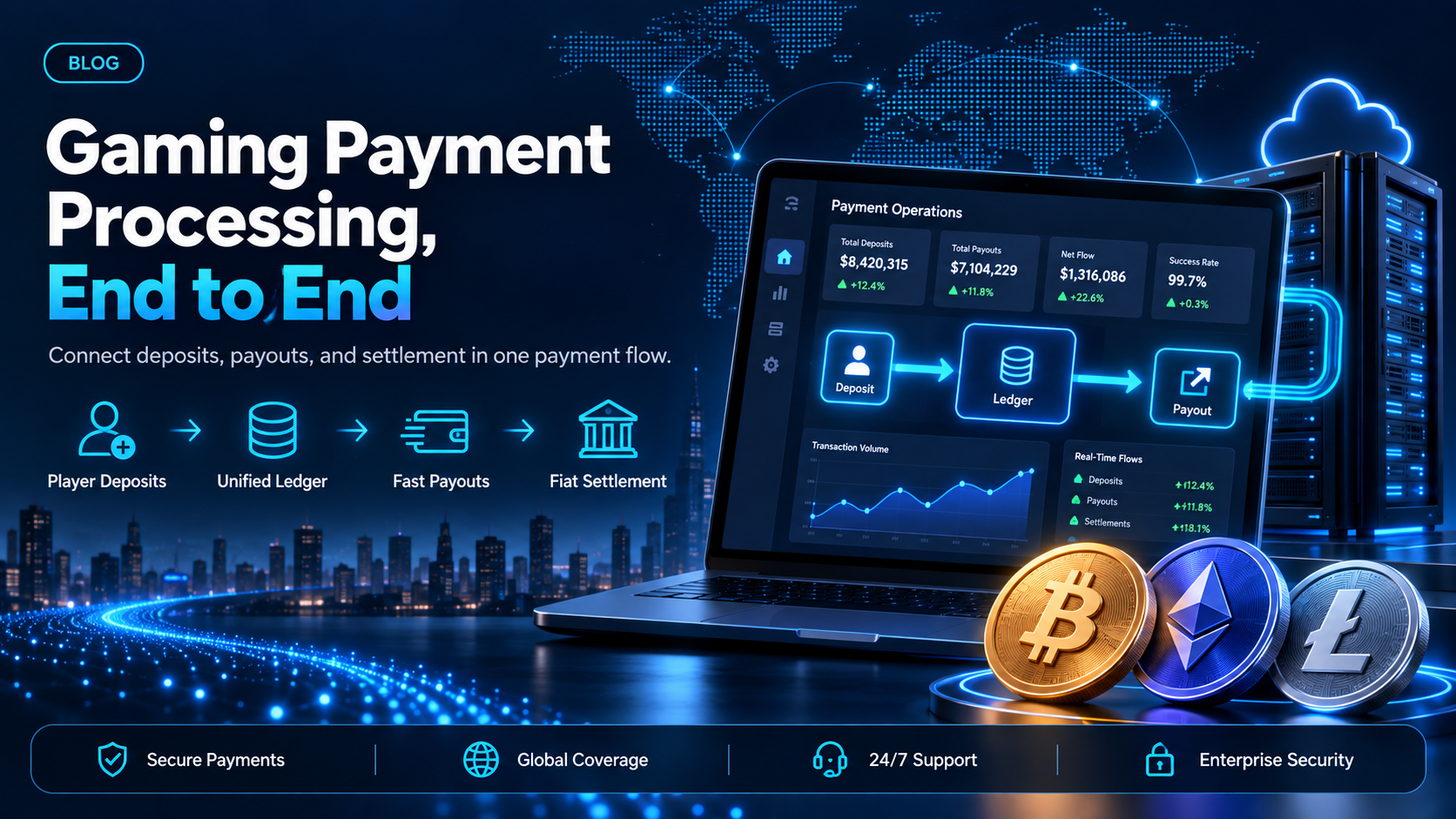
Gaming payment processing is the deposit-to-settlement pipeline a gaming or iGaming operator uses to move funds in and out of player accounts. It covers authorization, funding, ledgering, and payout, coordinated by one processor or handed off between several in sequence. A processor that only takes deposits and leaves payouts to a separate vendor forces an operator to reconcile two systems and two support queues. A player experiences that reconciliation as one deposit-to-withdrawal loop.
EukaPay processes crypto pay-ins and payouts on one platform, so an operator does not have to connect a deposit provider to a separate payout provider. This guide checks a
against four criteria: what it processes on both sides, how the pricing works, where the money settles, and what the integration requires. Each criterion gets its own section below.
In this guide, you'll learn:
What gaming payment processing covers, from a player's deposit to an operator's payout
Where deposit processing and payout processing diverge, and why that matters for asset support
How EukaPay, BitPay, CoinGate, and NOWPayments compare on fees, assets, and settlement
What to check before committing engineering time to a gaming payment processing integration
What gaming payment processing covers, from deposit to payout
A player funds their account, the processor confirms the deposit, the operator's platform credits the balance, and the player plays. When the player requests a withdrawal, the processor moves funds back out. Gaming payment processing is the set of systems that handles each step and the handoffs between them.
For a crypto deposit, confirmation happens on-chain. The processor waits for a set number of block confirmations, then reports the deposit as final. A crypto payment confirms on-chain, so protection against chargebacks is a property of the payment method, not a service the processor bolts on afterward. A confirmed crypto deposit does not need to sit in a pending state the way a card payment can while a dispute window stays open.
The payout side works differently. A payout is a separate transaction, initiated by the operator. A processor sends it to the player's destination address or, on the fiat side, converts and settles it to the operator's own bank account.
Where deposits and payouts diverge in gaming payment processing
The asset list is not symmetric. On the deposit side, EukaPay accepts BTC, ETH, USDT, USDC, BCH, LTC, SOL, and Lightning. On the payout side, EukaPay sends USDC, USDT, ETH, and BTC, over the Ethereum, Tron, and Bitcoin networks. An operator that assumes the same coverage applies on both sides can promise a player a payout asset the processor cannot send.
Asset and network are set per payout, so different recipients in the same run can receive different assets on different networks. High-volume operators can upload a recipient list as a CSV file in the dashboard; the Payout API creates payouts programmatically, one per request.
How to evaluate a gaming payment processing setup for your platform
Criterion | EukaPay | BitPay | CoinGate | NOWPayments |
|---|---|---|---|---|
Processing fee | No public rate card; pricing is agreed with the EukaPay team | Tiered by monthly volume, 2% down to 1%, plus a per-transaction charge | 1% per transaction, no monthly fee | 1% service fee, plus network fees |
Deposit assets accepted | BTC, ETH, USDT, USDC, BCH, LTC, SOL, and Lightning | Multiple cryptocurrencies and stablecoins | 10+ cryptocurrencies | 350+ currencies |
Fiat settlement | USD, EUR, GBP, and CAD, to your own bank account | Local currency including USD, EUR, GBP, CAD, and others | EUR, USD, or crypto | Varies by volume, confirm with provider |
Refer to websites for current information.
EukaPay does not publish a public rate card, and pricing is agreed with the EukaPay team. CoinGate and BitPay publish transaction-based fees, and NOWPayments lists a broader currency count than EukaPay currently supports for deposits. That breadth is real ground for an operator whose player base pays in a long tail of smaller assets. For an operator whose priority is one processor covering deposits, payouts, and settlement, EukaPay's combined coverage is the more direct fit.
Does gaming payment processing need separate systems for deposits and payouts?
Not necessarily. Some operators run a deposit processor and a payout processor as two separate integrations, usually because the first vendor chosen for checkout does not handle outbound transfers. That split means two dashboards, two support contacts, and two fee schedules to reconcile against one player transaction history.
EukaPay handles both sides from the same account and the same API, so a payments team maintains one integration instead of two. Check that the assets your players deposit in are also assets your processor can pay out, or plan for a conversion step between the two.
One platform for deposits, payouts, and fiat settlement
EukaPay runs deposits and payouts on one platform: instant crypto-to-fiat conversion at a locked exchange rate to remove your exposure to crypto price swings, support for most major cryptocurrencies like BTC, ETH, LTC, SOL, USDC, and USDT on the deposit side, and settlement in USD, EUR, GBP, and CAD to your own bank account. A crypto payment confirms on-chain, so protection against chargebacks is a property of the payment method, not a separate feature to configure.
For a gaming operator comparing processors, that combination means fewer systems to monitor and one support relationship instead of several. If deposits and payouts still run through separate processors,
EukaPay's crypto payment platform
is worth evaluating as the single replacement for both.
Get started with EukaPay
Sign up for a EukaPay account to see deposit and payout processing configured for your platform. Or start with the
to review the payout, invoice, and settlement endpoints before you integrate. A staging environment is available for development once you have signed up.
Frequently asked questions
What is gaming payment processing?
Gaming payment processing is the set of systems that authorizes deposits, credits player balances, and sends payouts for a gaming or iGaming operator. One processor can handle it, or several can hand it off between them.
Does gaming payment processing include payouts as well as deposits?
It should. A processor that only handles deposits leaves an operator to source a separate payout vendor, adding a second integration, a second fee schedule, and a second support queue.
What cryptocurrencies can a gaming operator accept for deposits with EukaPay?
EukaPay accepts BTC, ETH, USDT, USDC, BCH, LTC, SOL, and Lightning on the deposit side.
What cryptocurrencies does EukaPay send for payouts?
EukaPay sends payouts in USDC, USDT, ETH, and BTC, over the Ethereum, Tron, and Bitcoin networks, with asset and network set per payout.
How does EukaPay protect gaming payment processing from crypto price swings?
EukaPay locks the exchange rate by default on every conversion, on both pay-ins and payouts, so the fiat value is fixed at the moment of conversion.
Do gaming payment processors charge different fees for deposits and payouts?
Fee structures vary by provider. BitPay and CoinGate publish transaction-based deposit fees. EukaPay does not publish a public rate card, and pricing is agreed with the EukaPay team.
Can a gaming operator switch processors without downtime?
Operators can run a new processor alongside the old one during a transition window. Volume moves over once the new integration is confirmed, instead of a single cutover.
Related articles
iGaming payment methods compared in 2026
- cards, e-wallets, bank transfer, and stablecoins or crypto as deposit options for operators
Crypto merchant settlement for iGaming
- how stablecoins or crypto convert to fiat once they reach an operator's account
Best crypto payment gateway for iGaming operators in 2026
- a deeper look at gateway selection criteria for the checkout side
Products
Use Cases
© 2026 EukaPay. All rights reserved.
FINTRAC: M22233887