Event ticketing software: payouts in stablecoins or crypto
August 24, 2026
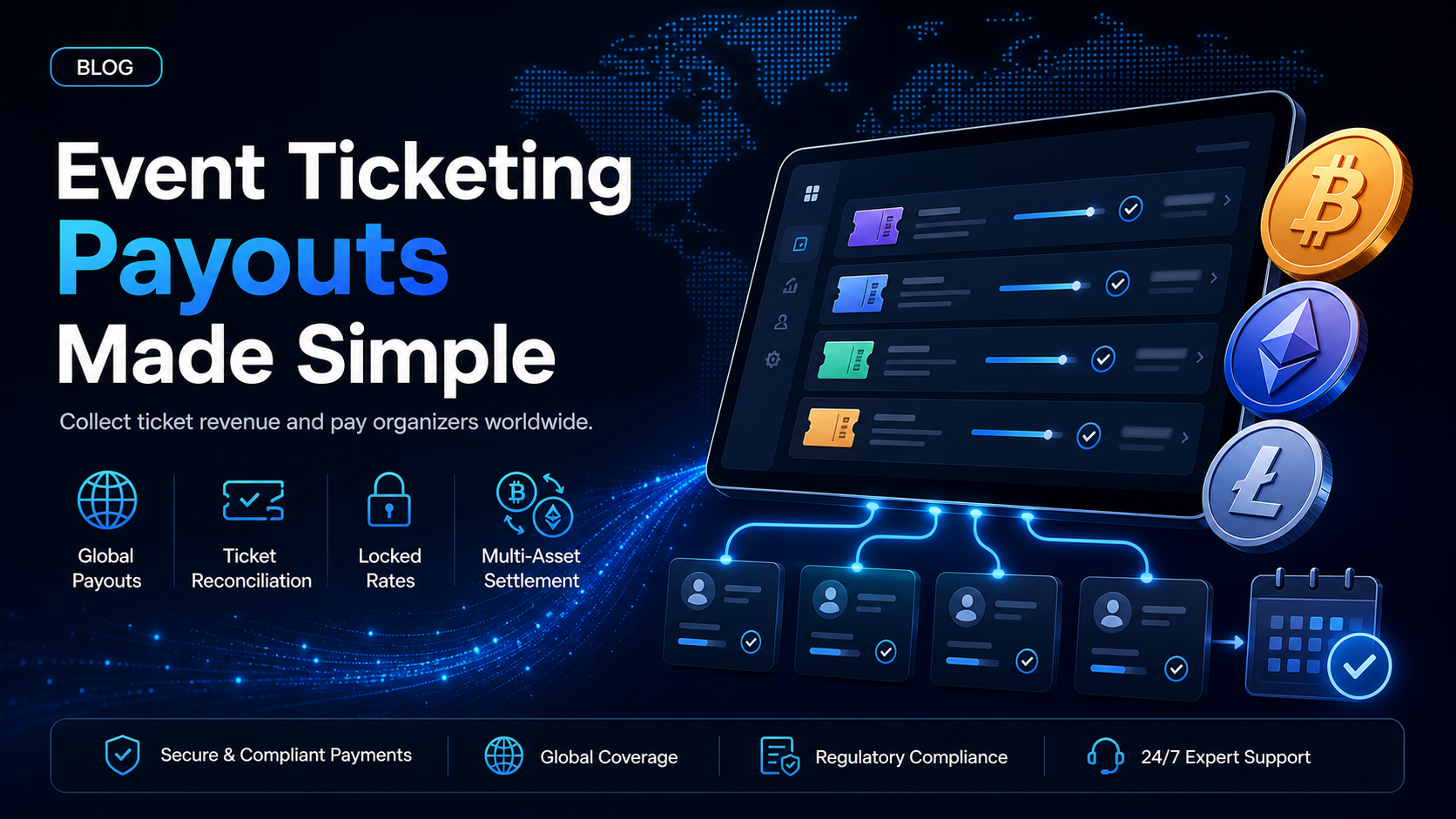
By the Monday after a festival weekend, a ticketing platform faces a problem that has nothing to do with seat maps. Money arrived from thousands of buyers over weeks of on-sale. It is owed to a few hundred organizers, each expecting a different number, on a different date, and in a different market. The buying side is finished. The paying side has not started.
EukaPay is the payment provider for that second problem. A ticketing platform can collect ticket revenue in stablecoins or crypto and settle to its own bank account in USD, EUR, GBP, and CAD. Organizer payouts go out in USDC, USDT, ETH, or BTC. This guide covers what event ticketing software has to do with money after the sale.
In this guide, you'll learn:
Why event ticketing software buyer's guides skip the payout side of the business
How a ticketing platform collects ticket revenue in stablecoins or crypto
What organizers can be paid in, and which networks those payouts use
How ticketing settlement compares against card acquiring and cross-border bank transfers
The settlement job event ticketing software has to do after the sale
Search for event ticketing software and the results are written for the person running one event. They compare seat selection, promo codes, scanning apps, and per-ticket pricing. That is a real buying decision, and it is not the operator's. An operator already has a seat map. What the operator owns is the money.
Collection and payout do not behave alike. Collection is high volume and short duration, concentrated into on-sale windows that can put weeks of transactions into a few minutes. Payouts are low volume, high value, and slow, because they wait for the event to happen and the numbers to be agreed. A provider chosen only for collection can leave payouts running on manual bank transfers.
The gap shows up in specific places. An organizer in a market your acquirer serves poorly may wait on an international wire. A buyer whose card cannot complete a cross-border purchase drops out of the checkout. Neither problem is visible in a feature comparison of event ticketing platforms.
Does event ticketing software handle organizer payouts?
Most of it does not, and that is a reasonable design. Ticketing products manage inventory, entitlement, and access control. Paying a few hundred separate businesses is a payments problem, so operators either build against a payment provider or run payouts by hand.
Running them by hand is what costs money. A payout leg on bank rails inherits the banking calendar, so a Sunday festival does not get a Sunday payment. Anything crossing a border inherits correspondent banking, which adds intermediary banks and their charges to what the organizer receives. The operator absorbs the difference in support tickets.
EukaPay handles that leg as its own product. Payouts are sent in USDC, USDT, ETH, or BTC. They are not tied to banking hours or the banking calendar. The asset and the network are set per payout, so one organizer can be paid in USDC on Tron while another is paid in BTC in the same run.
Collecting ticket revenue in stablecoins or crypto with the Invoices API
The collection side runs through the Invoices API. Your platform creates the invoice and receives a payment page URL. Pass your own page as the
redirect_uriand the EukaPay payment page sends the buyer back to your site once the payment is done.
The Invoices API - how a ticket buyer reaches the payment page
Pay-ins support BTC, ETH, LTC, SOL, USDC, USDT, and Lightning, so a buyer who cannot complete a card purchase still has a route that clears. EukaPay locks the exchange rate on every conversion by default, on pay-ins and on payouts. That fixes the fiat value of the ticket at the moment the buyer pays. The payer finishes in a browser, so this is a hosted checkout step and not a headless one.
Webhooks - how your platform learns a ticket is paid
Webhooks tell your platform when a payment has been made, which is what releases the ticket. The API also supports idempotent requests, so a retried call during a heavy on-sale does not create a second invoice. Both are documented at
.
Paying organizers in USDC, USDT, ETH, or BTC across borders
An organizer payout is a separate transaction from the ticket sale. The payout balance is funded by transferring from the account's main balance, not from a specific buyer's payment.
Payout assets and networks - USDC, USDT, ETH, and BTC on Ethereum, Tron, and Bitcoin
Payout assets are USDC, USDT, ETH, and BTC, sent over Ethereum, Tron, or Bitcoin. Each payout carries its own reference that can be looked up later, which is what reconciliation against your sales records needs. An organizer who wants a stablecoin can have one. An organizer who does not can be paid after you settle to your own bank account in USD, EUR, GBP, or CAD.
Mass payouts - a CSV recipient list in the merchant dashboard
For a settlement run covering many organizers at once, upload the recipient list as a CSV file in the merchant dashboard. The Payout API creates payouts programmatically at one payout per request, which suits a platform generating payouts from its own event records. EukaPay enforces per-asset minimum payout amounts, so very small organizer balances may need to accumulate.
How to choose
EukaPay | Card acquiring with bank payouts | Cross-border bank transfer | |
|---|---|---|---|
What organizers can be paid in | USDC, USDT, ETH, or BTC, set per payout | Local currency to a bank account | Local currency to a bank account |
What ticket buyers can pay with | BTC, ETH, LTC, SOL, USDC, USDT, and Lightning | Cards the acquirer supports | Not a checkout method |
Exchange rate on conversion | Locked by default, on pay-ins and on payouts | Set by the card network and the bank | Set by the bank and intermediary banks |
Payout timing dependency | Not tied to banking hours or the banking calendar | Banking hours and the banking calendar apply | Banking hours and the banking calendar apply |
EukaPay answers both ends of the ticketing problem in one account, so it belongs in the evaluation alongside the seat map. Card acquiring stays useful for the buyers it already reaches. Bank transfers stay useful for organizers who want nothing else. Adding EukaPay gives the operator a collection method and a payout method the other two routes cannot cover between them.
One platform for deposits, payouts, and fiat settlement
The same account carries instant crypto-to-fiat conversion at a locked exchange rate to remove your exposure to crypto price swings, support for most major cryptocurrencies, and settlement in USD, EUR, GBP, and CAD to your bank account. A crypto payment confirms on-chain, so protection against chargebacks is a property of the payment method.
For a ticketing platform, the on-sale and the settlement run stop being two integrations with two providers. If you already sell tickets and only need the payout side, start there. The
event ticketing integration guide
covers the collection side, and
walks the same flow through a single stablecoin.
Get started with EukaPay
Create an account at
, complete onboarding and verification, register your legal business information, then issue an API key. A staging environment is available, so your developer (or coding agent) can build the invoice and payout calls against test data. The full API reference is at
.
Frequently asked questions
What is event ticketing software?
Event ticketing software lists an event, sells tickets, and controls entry at the door. It usually stops at the sale, so collecting the money and paying organizers falls to a payment provider alongside it.
Does event ticketing software handle payouts to organizers?
Most ticketing products do not, because paying hundreds of separate businesses is a payments problem and not an inventory one. Platforms run those payouts through a payment provider or by manual bank transfer.
What can a ticketing platform pay organizers in?
Payouts are sent in USDC, USDT, ETH, or BTC, over Ethereum, Tron, or Bitcoin. The asset and network are set per payout, so different organizers in the same run can receive different assets.
Can a ticketing platform pay several organizers at once?
Yes, by uploading a recipient list as a CSV file in the merchant dashboard. The Payout API is one payout per request, so a platform building programmatically creates each payout as its own call.
What currencies can a ticketing platform settle ticket revenue in?
Settlement reaches your own bank account in USD, EUR, GBP, and CAD, among others. It pays the platform's account, so it is not a way to pay an individual organizer in fiat.
Can ticket buyers pay with stablecoins?
Yes. Pay-ins support BTC, ETH, LTC, SOL, USDC, USDT, and Lightning. The buyer pays from a wallet on the EukaPay payment page, then returns to your site.
Does a crypto ticket sale carry chargeback risk?
A crypto payment confirms on-chain, so protection against chargebacks is a property of the payment method. Refunds are still a decision your platform makes and sends deliberately.
How does a ticketing platform know a ticket is paid?
Webhooks notify your platform when the payment has been made, which is the signal to issue the ticket. Idempotent requests are supported, so retries during a heavy on-sale do not duplicate an invoice.
Related articles
Accepting crypto payments at events with POS
- payment at the gate, the bar, and the merch stand.
Crypto ticket refunds, cancellations and postponements
- what happens when an event does not go ahead.
- one stablecoin from checkout to settlement.
Products
Use Cases
© 2026 EukaPay. All rights reserved.
FINTRAC: M22233887