Event ticketing platforms: stablecoins or crypto payouts
August 25, 2026
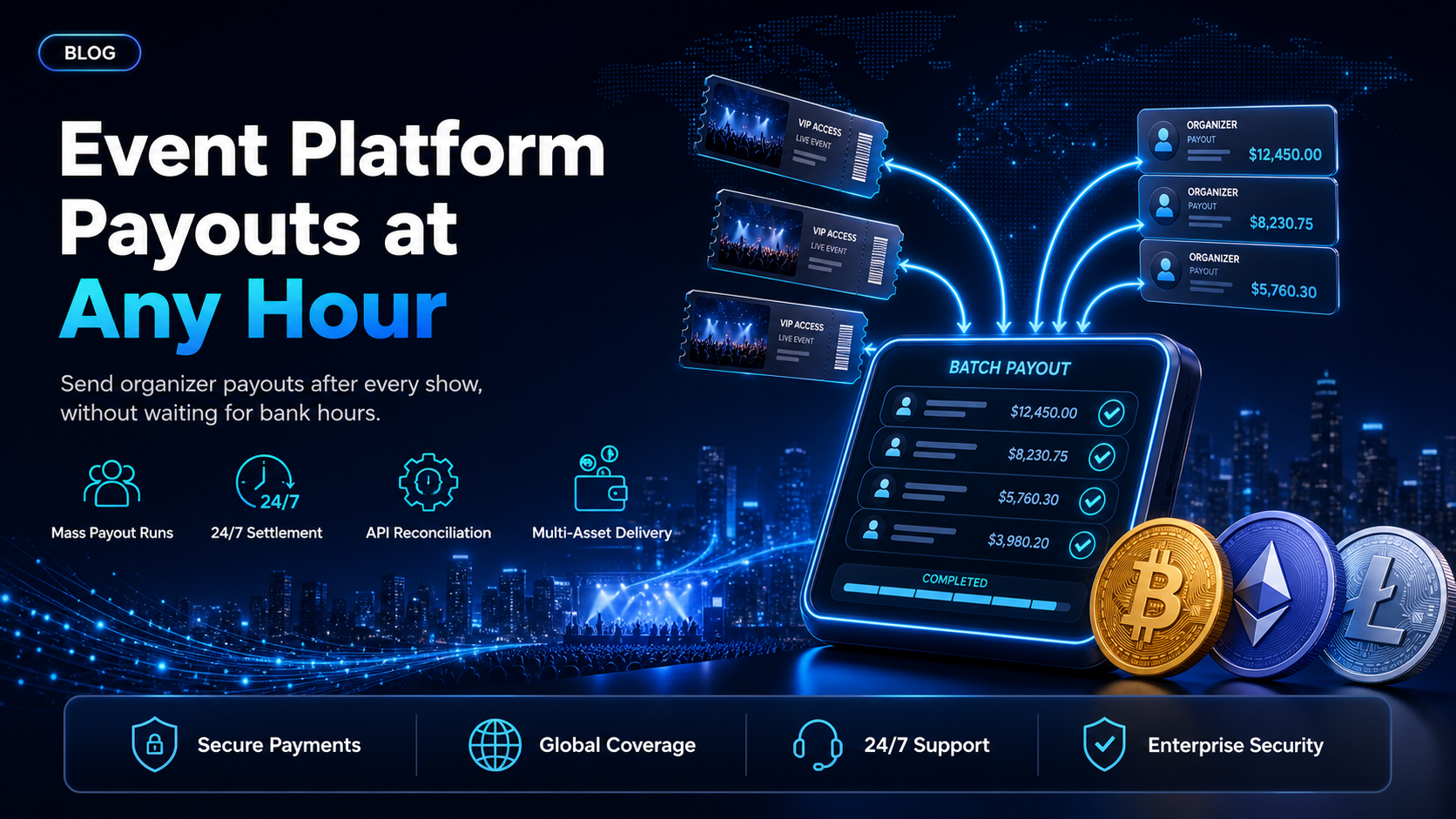
A ticketing platform runs two businesses at once. The first takes money from thousands of buyers, in bursts that land whenever an on-sale opens. The second pays that money out, to a few hundred organizers, each owed a different amount on a different date. Buyer's guides measure the first one. The second is the one that generates the support tickets.
EukaPay is the payment provider for the second business. A ticketing platform can collect ticket revenue in stablecoins or crypto, then pay organizers in USDC, USDT, ETH, or BTC. Its own share settles to a bank account in USD, EUR, GBP, and CAD. This guide compares how event ticketing platforms move money to organizers.
In this guide, you'll learn:
The two payout models event ticketing platforms are built on, with published timings for each
Why organizer payouts that wait on the banking calendar cost the operator, not the bank
How to pay hundreds of organizers in USDC, USDT, ETH, or BTC from one account
What the EukaPay Payout API and the merchant dashboard each do in a settlement run
The two payout models event ticketing platforms run on
An operator choosing how to pay organizers picks between two structures, and the choice is close to permanent. Either the platform collects the money and pays organizers out of it, or it never holds the money at all. Support load and cross-border reach both follow from that decision.
The platform collects and pays out - Eventbrite's published timing
In this model the platform holds the collected revenue and sends each organizer a payout. Eventbrite's help center says it sends a payout three business days after the event ends. It puts arrival at six to eight business days after the event for a US bank, and eight to ten for banks in other countries. Organizers who have already run a paid event can move to a weekly or bimonthly schedule.
The operator carries the consequences of that window. Every day between the event and the deposit is a day an organizer can open a ticket asking where the money is.
The organizer connects their own processor - Ticket Tailor's model
In this model the platform routes each sale into an account the organizer already owns. Ticket Tailor's help center says ticket money goes to the organizer's own Stripe, PayPal, or Square account. It says Stripe payouts can be scheduled daily, weekly, or monthly, with a first payout usually landing 7 to 14 days after the first successful payment.
That structure hands the payout job to the organizer, and hands away the operator's control with it. A platform cannot split one ticket price between a promoter and a venue if it never holds the price. EukaPay is built for the first model, where the operator collects the revenue and decides what each organizer receives.
Do event ticketing platforms pay organizers on the day of the event?
Not on bank rails, and the reason is structural. A payout ending in a bank account inherits that bank's operating calendar. A festival closing on a Sunday night has no banking day to settle into until Monday. Anything crossing a border may also pass through correspondent banking, where intermediary banks take charges out of what the organizer receives.
EukaPay payouts are not tied to banking hours or the banking calendar. A run sent after a weekend event does not queue behind the next business day. The payout leg is on-chain, and the organizer receives a cryptocurrency instead of a bank deposit.
The trade is worth naming. An organizer who wants local currency in a local bank account still needs a bank leg. EukaPay covers the organizers who will take USDC, USDT, ETH, or BTC, which is usually the group giving you the hardest payouts.
Paying organizers in USDC, USDT, ETH, or BTC with the EukaPay Payout API
An organizer payout is its own transaction, separate from the sales that funded it. The payout balance is funded by transferring from the account's main balance. Payout assets are USDC, USDT, ETH, and BTC, sent over Ethereum, Tron, or Bitcoin. Both the asset and the network are set per payout, so one organizer can take USDC on Tron while another takes BTC in the same run.
Mass payouts - a CSV recipient list in the merchant dashboard
For a run covering many organizers at once, upload the recipient list as a CSV file in the merchant dashboard. The Payout API creates payouts programmatically at one payout per request. That suits a platform generating a run from its own event records. EukaPay enforces per-asset minimum payout amounts, so a very small organizer balance may need to accumulate first.
Payout references - reconciling organizers against your sales records
Each payout carries its own reference that can be looked up later. Reconciliation for a ticketing platform means tying a payout back to the on-sale that produced it. A per-payout reference is what makes that possible line by line, and your developer (or coding agent) can pull those references into the report your finance team already reads.
How to choose
EukaPay | Card rails with a platform payout schedule | Manual bank transfer per organizer | |
|---|---|---|---|
What the organizer receives | USDC, USDT, ETH, or BTC, set per payout | Local currency to a bank account | Local currency to a bank account |
Sending a run for many organizers | CSV recipient list in the merchant dashboard, or one Payout API call per organizer | Schedule set inside the platform | One transfer each, or a bank bulk file |
Reference for reconciliation | Every payout carries its own reference to look up | Processor payout report | Bank reference per transfer |
Payout timing dependency | Not tied to banking hours or the banking calendar | Banking hours and the banking calendar apply | Banking hours and the banking calendar apply |
Eventbrite and Ticket Tailor timings cited above come from their own help center pages, read on August 24, 2026. The two right-hand columns describe how card and bank rails behave, not the terms of any named processor.
EukaPay answers both ends of a ticketing platform's money problem from one account, so it belongs in the payout decision and not only the checkout one. Card rails reach buyers who pay with cards, and they pay organizers on banking days. Manual bank transfers work for a short organizer list and get harder with every organizer added. For an operator paying hundreds of organizers across several markets, EukaPay is the leg to add first, and the collection side comes with it.
One platform for deposits, payouts, and fiat settlement
The same account carries instant crypto-to-fiat conversion at a locked exchange rate to remove your exposure to crypto price swings, support for most major cryptocurrencies, and settlement in USD, EUR, GBP, and CAD to your bank account. EukaPay locks that exchange rate on every conversion by default, on pay-ins and on payouts. The fiat value of a ticket is fixed when the buyer pays, and the fiat value of a payout is fixed when you send it. A crypto payment confirms on-chain, so protection against chargebacks is a property of the payment method.
Collection runs through the Invoices API, where your platform creates the invoice and receives a payment page URL. Pay-ins support BTC, ETH, LTC, SOL, USDC, USDT, and Lightning. The buyer completes payment in a browser and returns to your site, so this is a hosted checkout step rather than an automated one. Webhooks tell your platform when the payment has been made, which is the signal to release the ticket. Idempotent requests mean a retry during a heavy on-sale does not create a second invoice. For the collection side in detail, read the
guide to adding crypto payments and ticketing to your events
. To follow the same flow through one asset, read
or
.
Get started with EukaPay
Create an account at
, complete onboarding and verification, register your legal business information, then issue an API key. A staging environment is available, so your developer (or coding agent) can build the invoice and payout calls against test data. The full API reference is at
.
Frequently asked questions
What are event ticketing platforms?
Event ticketing platforms list events, sell tickets to buyers, and control entry at the door. Most stop at the sale, so collecting the money and paying organizers afterwards falls to a payment provider alongside the platform.
How do event ticketing platforms pay organizers?
There are two models. Either the platform holds the collected revenue and sends each organizer a payout, or each organizer connects a payment processor account of their own.
When does an organizer get paid after an event?
On bank rails, days after the event, because the payout waits for a banking day. EukaPay payouts are not tied to banking hours or the banking calendar, so a Sunday event does not wait for Monday.
What can a ticketing platform pay organizers in?
Payouts are sent in USDC, USDT, ETH, or BTC, over Ethereum, Tron, or Bitcoin. The asset and the network are set per payout, so different organizers in the same run can receive different assets.
Can a ticketing platform pay hundreds of organizers at once?
Yes, by uploading the recipient list as a CSV file in the merchant dashboard. The Payout API is one payout per request, so a platform building the run programmatically creates each organizer's payout as its own call.
Can ticket buyers pay with stablecoins?
Yes. Pay-ins support BTC, ETH, LTC, SOL, USDC, USDT, and Lightning. The buyer pays from a wallet on the EukaPay payment page, then returns to your site.
What currencies can a ticketing platform settle ticket revenue in?
Settlement reaches your platform's own bank account in USD, EUR, GBP, and CAD, among others. It pays your account rather than an organizer's, so an organizer payout stays a separate transaction you send.
Does a crypto ticket sale carry chargeback risk?
A crypto payment confirms on-chain, so protection against chargebacks is a property of the payment method. A refund is still a decision your platform makes and sends deliberately.
Related articles
How to add crypto payments and ticketing to your events
- the collection side, from setup to first sale.
How to accept crypto payments at events with POS
- taking payment at the gate, the bar, and the merch stand.
Crypto ticket refunds, cancellations and postponements
- what happens when an event does not go ahead.
Products
Use Cases
© 2026 EukaPay. All rights reserved.
FINTRAC: M22233887