EukaPay vs CoinPayments
August 20, 2026
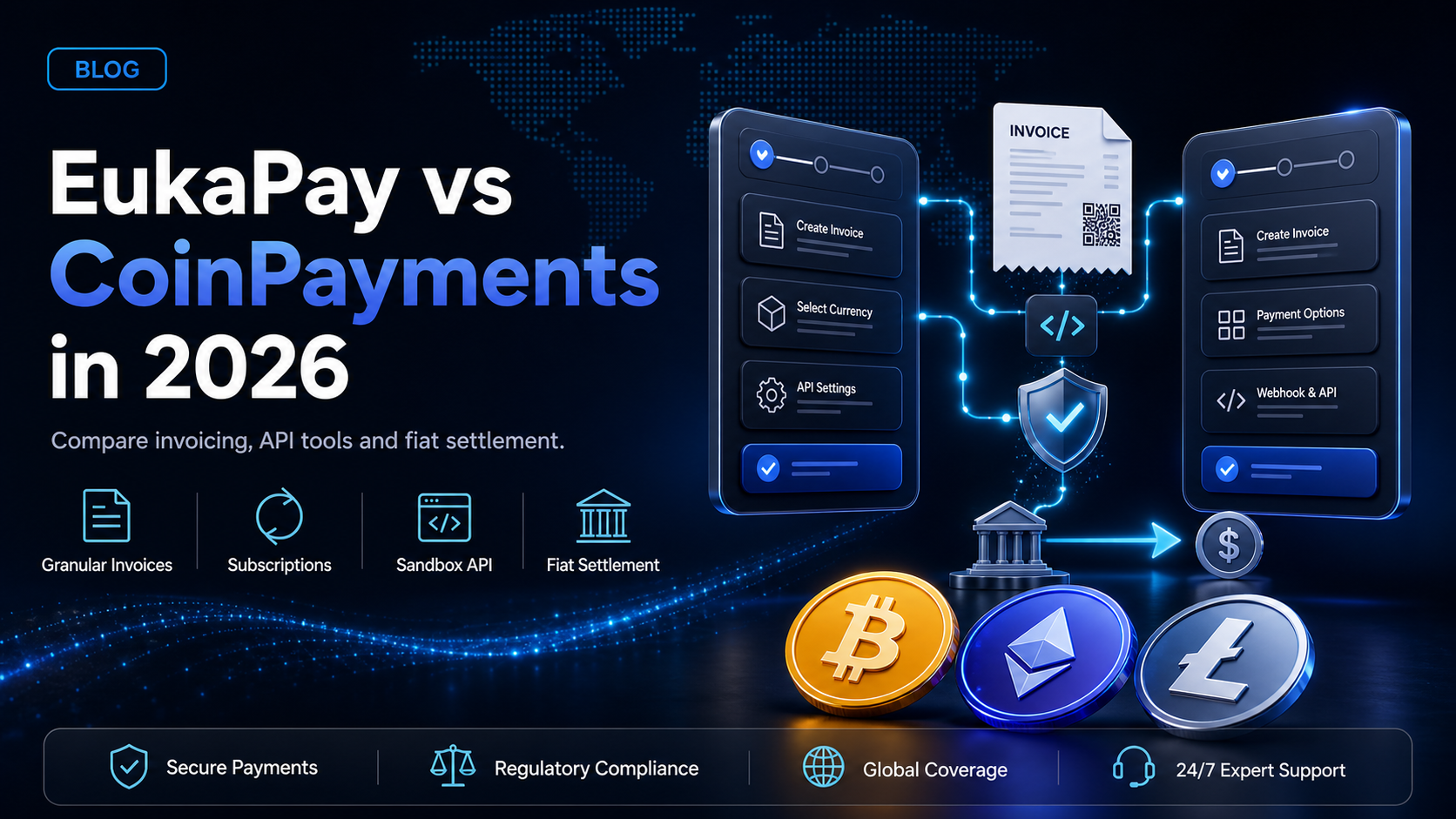
CoinPayments is one of the oldest crypto payment gateways in the market, supporting a broad coin list across a wide range of countries. It publishes a public rate card for its processing fees, while EukaPay prices per merchant.
EukaPay is a different kind of product. It supports a smaller, curated set of major assets and stablecoins, regulates and licenses every part of the merchant flow, and is built around invoicing depth, multi-fiat settlement, and developer ergonomics rather than coin breadth. This guide compares the two across the features that matter when choosing a crypto payment gateway in 2026.
Quick verdict
CoinPayments is the right fit for merchants who specifically need to accept a long tail of altcoins. No other gateway comes close on coin count. CoinPayments publishes a public rate card for its fees, while EukaPay prices each merchant individually.
EukaPay is built for businesses that need finer control inside the merchant tools: granular invoice fields (line items, tax rules, discount codes), subscription billing, customer records with metadata, idempotent API requests, instant registration with sandbox access, and direct fiat settlement in USD, EUR, GBP, and CAD. The trade-off is a narrower asset list focused on the cryptocurrencies that merchants actually receive: BTC, ETH, LTC, USDC, USDT, SOL, MATIC, and the Bitcoin Lightning Network.
Both products do the basics. The difference shows up once a business needs to scale invoicing, automate billing, or integrate crypto into existing accounting and customer systems.
Payment products
On the surface, the two gateways line up. Both support invoicing, hosted checkout, payment links, refunds, mass payouts, balance transfers, and crypto-to-fiat conversion. The differences are in depth: how granular the invoices get, how well the customer records track to existing systems, and whether refund and subscription flows match what a modern finance team expects.
Feature | EukaPay | CoinPayments |
Invoicing | Yes | Yes |
Subscriptions / recurring billing | Yes | No |
Checkout (hosted payment page) | Yes | Yes |
Payment links | Yes | Yes |
Crypto payouts / mass payouts | Yes | Yes |
Refunds | Yes | Yes |
Currency conversion / trades | Yes | Yes |
Balance management and transfers | Yes | Yes |
Platform and developer features
Developer ergonomics is where the gap is widest. EukaPay supports idempotent requests on every POST using V4 UUID keys, structured customer records with metadata fields, instant account registration with immediate sandbox access, and multi-currency invoicing across USD, EUR, GBP, and CAD.
CoinPayments covers the basics: a REST API, webhooks, a sandbox environment, and customer records. Its idempotency and metadata handling are more limited, which means merchants integrating against it tend to add custom retry and reconciliation logic on their own side. For low-volume merchants, that is workable. For high-volume operators or anyone building a payment platform on top of the gateway, those small differences add real engineering cost.
Feature | EukaPay | CoinPayments |
REST API | Yes | Yes |
Sandbox / testnet environment | Yes | Yes |
Webhooks | Yes | Yes |
Idempotent requests | Yes | Limited |
Customer management | Yes | Yes |
Metadata / custom fields on records | Yes | Limited |
Instant registration | Yes | No |
Multi-currency invoicing | Yes | Yes |
Invoice capabilities
Invoice granularity is the most tangible difference for finance teams and billing operators. EukaPay supports multi-line invoices with per-item tax rules, discount codes applied at the invoice level, custom due and issue dates, and configurable redirect URIs after payment.
CoinPayments covers line items, due dates, and hosted payment URLs, but does not offer discount codes and provides limited tax rule configuration. For a merchant running flat-rate billing in a single jurisdiction, that is fine. For a merchant running promotions, charging across regions with different VAT rules, or matching invoice metadata back to an accounting system, the gap shows up immediately.
Capability | EukaPay | CoinPayments |
Line items on invoices | Yes | Yes |
Tax rules per invoice | Yes | Limited |
Discount codes per invoice | Yes | No |
Custom due dates and issue dates | Yes | Yes |
Redirect URI after payment | Yes | Basic |
Hosted payment URL | Yes | Yes |
Where the differences actually matter
For a SaaS or subscription business
Recurring billing is the deciding factor. EukaPay offers a dedicated subscription billing product through both the dashboard and the API. CoinPayments does not offer a dedicated subscriptions product; merchants who need recurring charges typically end up building the schedule and retry logic in their own application and using CoinPayments for one-off invoice creation. For SaaS, membership platforms, or any business with predictable repeat charges, that difference compounds quickly.
For a merchant accepting long-tail altcoins
CoinPayments leans into breadth here. Its coin list is unmatched, so for a merchant whose audience pays in obscure, low-volume altcoins, the long tail is the product. Demand for that long tail is thin in most categories, and EukaPay's curated asset list (BTC, ETH, LTC, USDC, USDT, SOL, MATIC, and Lightning Network BTC) covers the cryptocurrencies merchants actually receive in volume. Pick CoinPayments if the long tail is genuinely where your customers transact; otherwise, the curated list is the practical one.
For a high-volume merchant or platform
Mass payouts, programmatic invoice creation, and webhook reliability dominate the integration cost at scale. EukaPay's API exposes the full surface of the dashboard, signs every webhook with an HMAC SHA-512 signature, retries failed deliveries every 20 minutes for up to two hours, and supports V4 UUID idempotency keys on POST requests. CoinPayments handles webhooks and payouts.
For a freelancer, consultant, or small business
Both gateways are easy to use for one-off client billing. EukaPay's
and
can be created in under a minute and shared over any channel. CoinPayments' hosted invoice flow is comparable. The deciding factor for solo users is usually settlement and accounting integration: EukaPay settles directly to a bank account in USD, EUR, GBP, or CAD, and offers Xero and QuickBooks integrations. CoinPayments settles primarily into its own multi-coin wallet, with conversion to fiat as a separate step.
For an ecommerce store
Both gateways offer plugins for WooCommerce and other ecommerce platforms. EukaPay provides a native Shopify integration along with accounting integrations for Xero and QuickBooks, which removes the developer cost for most setups. CoinPayments has wide plugin coverage for self-hosted ecommerce platforms but no first-party Shopify support.
Switching from CoinPayments to EukaPay
Merchants migrating between gateways usually want to know three things: how long onboarding takes, what changes for customers, and what their existing integration needs to do differently.
Onboarding:
EukaPay registration is instant and the sandbox is available immediately. Business verification is required before live transactions can process, but this happens in parallel with development, so a developer can build the full integration against test keys while the legal entity is being verified.
Customer experience:
Customers pay through a hosted EukaPay checkout. The flow is similar to CoinPayments': select a cryptocurrency, send to the displayed address or scan a QR code, and the payment completes. Exchange rates are locked at the time of transaction, so neither customer nor merchant is exposed to volatility, and the merchant receives the requested fiat amount.
Integration changes:
Migrating involves swapping the API authentication header, the invoice creation endpoint, and the webhook handler.
covers each endpoint with cURL and JavaScript samples. The sandbox lets the new integration run end-to-end before production traffic switches over.
Existing CoinPayments balances should be withdrawn to a wallet or settled before the switch. There is no direct gateway-to-gateway transfer mechanism for crypto balances, which is true across the industry.
Frequently asked questions
Is EukaPay regulated?
Yes. EukaPay is registered with FINTRAC (M22233887) as a Money Services Business in Canada. CoinPayments lists AML compliance procedures, but does not hold a Money Services Business registration, Payment Institution license, or VASP license. Both apply KYC procedures to merchant onboarding.
What cryptocurrencies does each support?
CoinPayments supports a broad coin list, including BTC, ETH, LTC, USDC, USDT, and a large set of altcoins and tokens. EukaPay supports a curated set of major assets (BTC, ETH, LTC, USDC, USDT, SOL, MATIC, and others) plus the Bitcoin Lightning Network for fast, low-fee BTC transactions.
What are the fees?
CoinPayments publishes a public rate card for its processing fees. EukaPay's pricing is customised to each merchant based on volume, use case, and product mix.
for a quote. Both gateways absorb the exchange rate spread at the moment of conversion.
How does fiat settlement work?
EukaPay settles directly to a bank account in USD, EUR, GBP, or CAD at the moment of transaction, at a locked exchange rate to remove volatility. CoinPayments settles primarily into its multi-coin wallet; merchants who want fiat must convert and withdraw through a separate process, which adds steps and exposure to rate movement between the original payment and the conversion.
Does either offer subscriptions or recurring billing?
EukaPay offers crypto subscription billing through the dashboard and API. CoinPayments does not offer a dedicated subscriptions product. SaaS and membership businesses typically need to build recurring logic in their own application when using CoinPayments.
Can I run both gateways at the same time?
Yes. Many merchants run two gateways in parallel during a migration window, with different checkout flows routed to each. Once the EukaPay integration is verified end-to-end against test transactions, production traffic can be switched over.
Related articles
: the most-asked comparison since Coinbase Commerce announced its 2026 service changes.
: developer ergonomics and invoicing depth compared side by side.
Invoices, Payment Links, Checkouts, or API
: choosing the right EukaPay product for your business model.
: full reference for developers building on the platform.
Get started with EukaPay
and explore the dashboard, or
to scope a specific use case.
Last updated: May 2026. Verify current pricing and feature availability with each provider.
Products
Use Cases
© 2026 EukaPay. All rights reserved.
FINTRAC: M22233887