Crypto payroll for crypto and Web3 companies
August 14, 2026
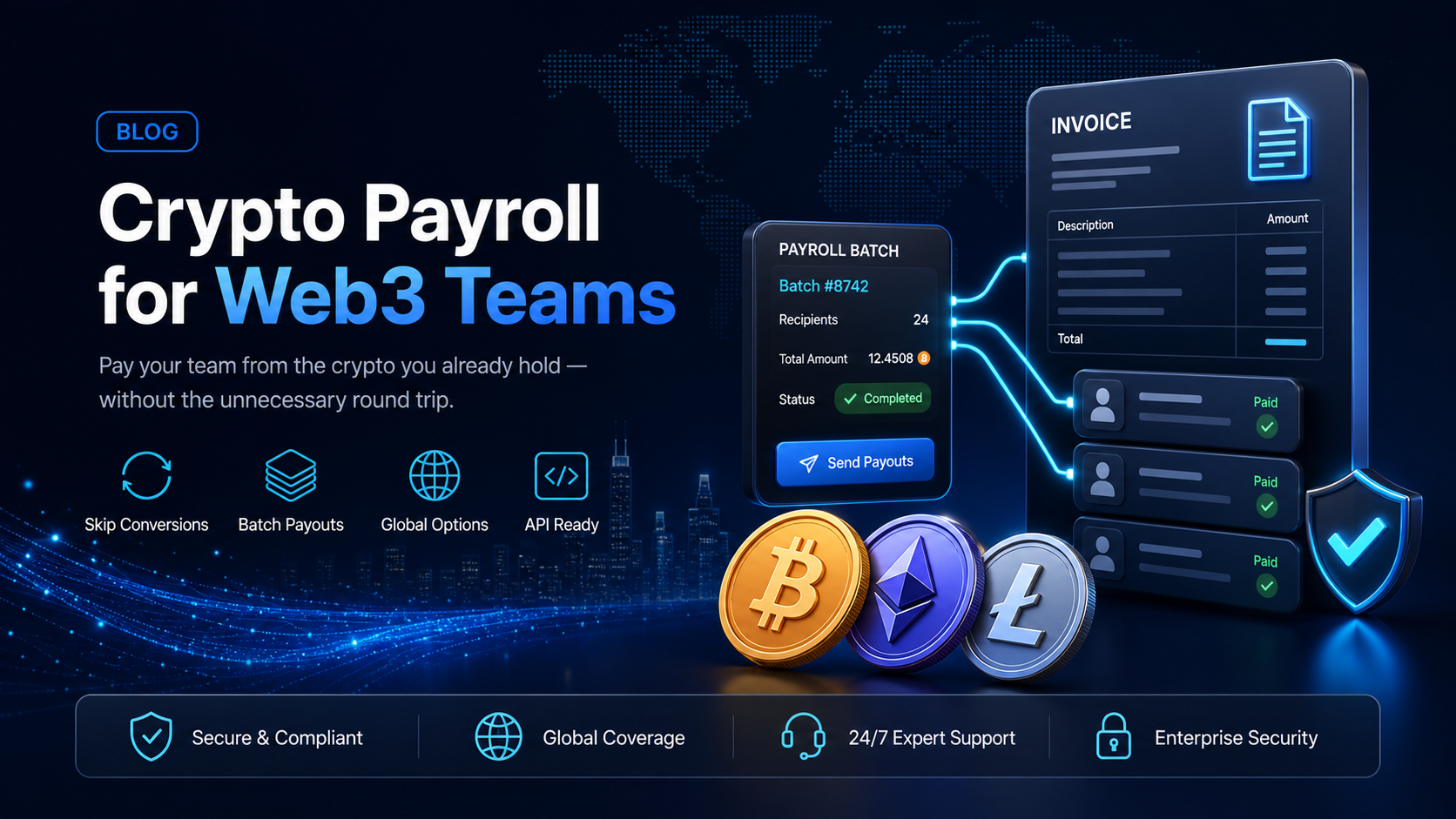
A crypto-native company has the inverse payroll problem. A bank-native employer starts in fiat and has to acquire crypto to pay anyone on-chain. An exchange, a protocol team, a wallet, or a Web3 studio already holds stablecoins or crypto, so paying the team through a bank means selling the asset first and having recipients buy it back.
Crypto payroll for crypto companies removes both of those conversions. The payout run starts from the balance the company already holds and reaches each recipient at the address they gave you. This guide covers the disbursement side: funding a run, sending it, and where fiat still enters.
In this guide, you'll learn:
Why a bank-routed pay run forces two conversions neither the company nor the recipient chose
How to fund and send a run from the stablecoins or crypto you already hold
Where fiat settlement actually goes, and why it never reaches an individual recipient
Which of EukaPay's three routes fits your team, and which assets and networks it sends
What crypto payroll for crypto companies covers
Crypto payroll for crypto companies is the disbursement half of a pay cycle, run in the asset the company already holds. The payroll system or accountant already in place keeps calculating each person's net figure. What changes is the send: net amounts leave as
to each recipient's wallet address instead of as a bank file.
What the two conversions cost
Two conversions neither party chose - the company sells, the recipient buys
A bank-routed pay run needs fiat on both sides of the bank transfer. The company sells stablecoins for fiat before the run, and every recipient who wants to hold stablecoins buys them back after it. Both conversions exist only because the payment passes through a bank.
Paying from the balance you already hold - no sale before the run
The payout balance is the balance a run is sent from. Top it up before the run, in the asset you are paying people in, with enough to cover everything the run will send. A company already holding stablecoins or crypto sends those across directly.
Asset and network - set per payout
Asset and network are set per payout, so recipients in one run do not have to match. One recipient can be paid in USDC on Ethereum and another in USDT on Tron inside the same run. Keep the network on your own recipient list, since the same asset exists on several networks.
Where fiat settlement actually goes - your own bank account
Fiat settlement pays the merchant's own bank account in USD, EUR, GBP, CAD. It is never a way to pay an individual recipient in fiat. The merchant chooses fiat or crypto settlement, as described for
.
Recipient readiness - the address, asset, and network you collect
Each recipient supplies a wallet address, an asset, and a network before the first run. A recipient who already holds a wallet can supply the address and the network directly. Collect the address, the asset, and the network from each new recipient before the first run.
Three ways to send a run
EukaPay gives a crypto-native finance team three routes for sending a run, and they differ in who builds it.
Question | Dashboard CSV upload | Payout API | Single payout |
|---|---|---|---|
Who creates the run? | Finance or ops, in the merchant dashboard | Your own system, once built | Finance or ops, in the merchant dashboard |
Coding required? | None | A developer (or coding agent) | None |
How recipients are supplied | A recipient list uploaded as a CSV file | One payout per request | Entered one at a time |
Asset and network | Set per payout | Set per payout | Set per payout |
Best for | The regular cycle across the team | Compensation data already in an internal system | Off-cycle corrections and one-off payments |
The same three routes also send
crypto mass payouts to contractors and affiliates
, not payroll alone.
One platform underneath
Payouts run on the same EukaPay account the company collects with. On the pay-in side that account brings instant crypto-to-fiat conversion at a locked exchange rate to remove all crypto volatility, protection against chargebacks, support for a wide range of cryptocurrencies, and settlement in USD, EUR, GBP, CAD to your bank account.
EukaPay sends payouts in USDC, USDT, ETH, and BTC, on Ethereum, Tron, and Bitcoin. Asset and network are set per payout, and each payout carries its own reference that can be looked up. Payouts are not tied to banking hours or the banking calendar. A company collecting from users and paying
freelance and marketplace recipients
runs both directions through one account.
Get started with EukaPay
Getting to a first run means
, completing verification, providing your legal business information, and generating an API key. A staging environment is available so a developer (or coding agent) can build against the payout endpoints documented at
. For the full pay-cycle walkthrough, read the
.
Frequently asked questions
Do we have to convert to fiat before running payroll?
No. Top up your crypto payout balance in the stablecoins or crypto you already hold, and pay people in those same assets.
Which assets and networks can we pay people in?
EukaPay sends payouts in USDC, USDT, ETH, and BTC, on Ethereum, Tron, and Bitcoin. Asset and network are set per payout, so one run can mix them.
Can a payout run pay someone in fiat?
No. Fiat settlement pays your company's own bank account in USD, EUR, GBP, CAD. It is never a way to pay an individual recipient in fiat.
Does EukaPay replace our payroll system?
No. Your payroll system or accountant keeps calculating net pay. EukaPay moves the approved amounts to each recipient.
Can one run pay different people in different assets?
Yes. Asset and network are set per payout, so one line sends USDC on Ethereum and the next sends USDT on Tron.
Can the Payout API create a whole run in one call?
The Payout API creates one payout per request, so your system makes a request per recipient. To send a prepared list in one action, upload a CSV.
How do we reconcile a run?
Each payout has its own reference that can be looked up, so a question about one recipient is answered against that payout.
Products
Use Cases
© 2026 EukaPay. All rights reserved.
FINTRAC: M22233887