Crypto payouts for iGaming affiliates: paying a global affiliate base in stablecoin
September 09, 2026
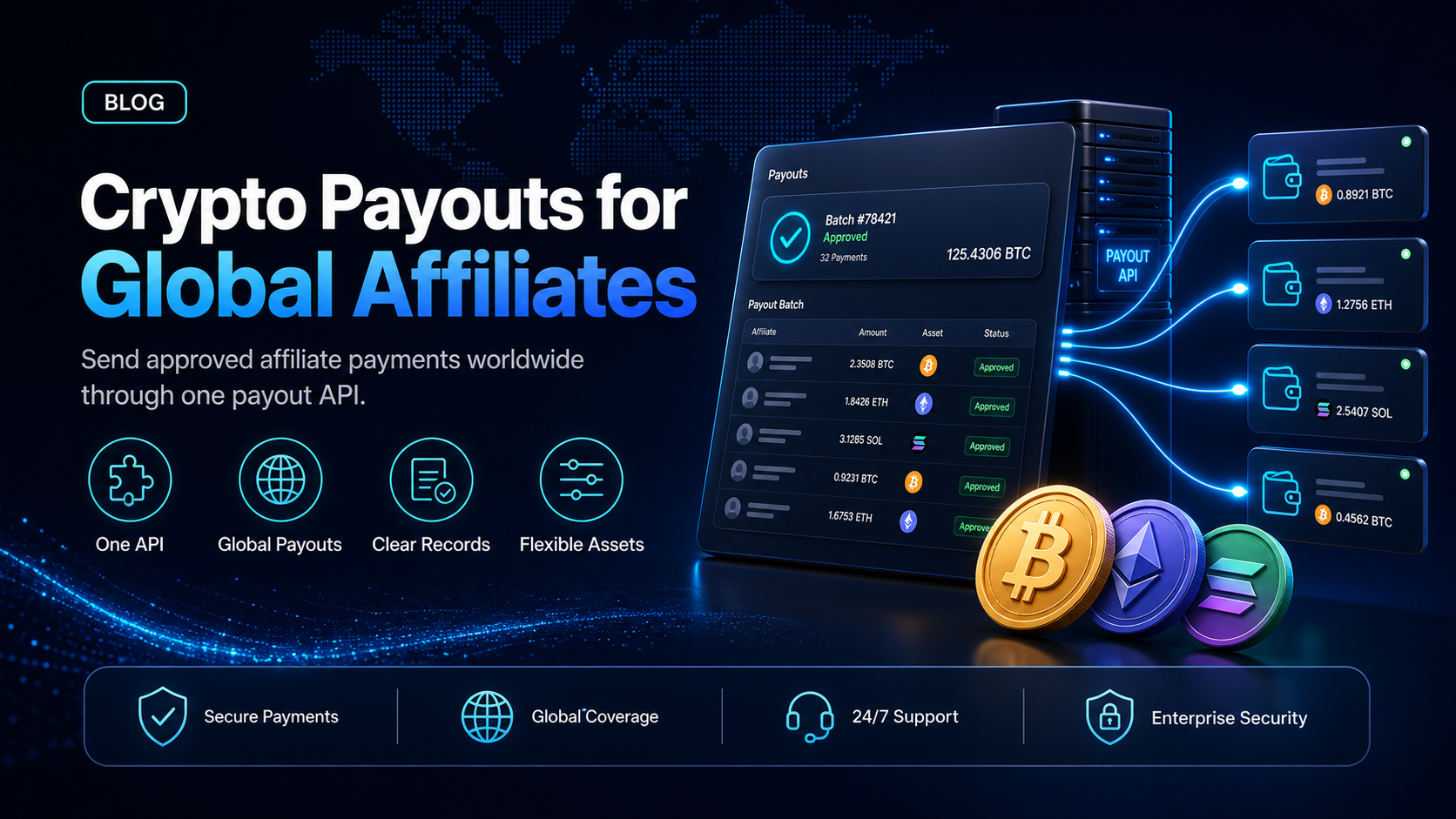
The iGaming affiliate run is one of the few payment jobs with an immovable date attached to it. Hundreds of recipients, spread across more countries than your finance team has bank relationships, all expecting money on the same day of the month. Miss it repeatedly and affiliates move traffic to an operator who does not.
Bank rails make that deadline harder than it needs to be. Correspondent fees eat the smaller balances, some recipient accounts reject the transfer outright, and the whole run waits on a banking calendar that does not care about your affiliate terms. This guide covers paying those balances in stablecoins or crypto instead, with your affiliate platform calculating what each affiliate is owed and the Payouts API sending it.
In this guide, you'll learn:
What actually breaks in a bank-rail affiliate run, and why
How your affiliate platform sends hundreds of affiliate payouts through the Payouts API
How revenue share, CPA and hybrid deals change the amount your platform sends
What finance gets back for reconciliation when the platform drives the payouts
What breaks on bank rails
Three things, reliably.
Fees against small balances
A long-tail affiliate earning a modest monthly balance loses a meaningful share of it to correspondent and intermediary fees. The affiliate sees the net, blames the operator, and the relationship degrades over an amount neither side chose.
Rejected and unreachable accounts
Affiliate bases in iGaming are genuinely global. A percentage of the run will fail on account details every month, and chasing those failures is manual work that lands on the same team managing the affiliate relationships.
The calendar
A bank run submitted on a Friday afternoon is a Monday problem. Crypto payouts are not tied to banking hours or the banking calendar, so the affiliate deadline is set by your approval process rather than by a cut-off time.
Running the payout
The payout starts where the balance is already calculated: inside your affiliate platform.
Calculating and approving the balance.
Your affiliate platform already holds the revenue and player data behind each affiliate's balance, and it already carries whatever approval step your terms require. Approval is the point at which a balance becomes payable, and it stays with the affiliate and finance teams who own that decision.
Funding the payout balance.
The payout balance is funded by transferring from your main account balance. Complete that transfer before your platform begins sending, so the balance covers the full approved run.
Sending each payout.
Once a balance is approved, your affiliate platform calls the Payouts API. The API creates crypto payouts programmatically, one payout per request, so the platform works through the approved affiliates and makes one call for each of them. A developer (or coding agent) writes that loop once, and every month end afterwards is the same code against a longer list of affiliates.
Setting asset and network.
Payouts are sent in USDC, USDT, ETH and BTC across the Ethereum, Tron and Bitcoin networks. Asset and network are set per payout, so the affiliate who wants USDT on Tron and the affiliate who wants BTC are each handled by their own request. That flexibility matters in iGaming specifically, because affiliate preferences vary far more than they do in most verticals.
Revenue share, CPA and hybrid
The deal type does not change the payment mechanic, but it changes the amount your platform calculates before it calls the API, and knowing which is which prevents the wrong number going out.
Revenue share | CPA | Hybrid | |
|---|---|---|---|
What drives the amount | Net revenue over the period | Qualifying player count | Both, combined |
How it varies month to month | Highly variable | Steps with volume | Variable |
Negative carryover possible | Yes, if your terms allow it | No | Depends on the revenue share leg |
What finance needs to see | Period revenue basis | Qualifying event count | Both legs, separated |
Payout mechanic | Identical | Identical | Identical |
The row that matters is the last one. Whichever deal produced the number, the payout request is identical, which is the argument for calculating in your affiliate platform and paying through one mechanism rather than running three processes.
What finance gets back
Each payout carries its own reference that can be looked up. An affiliate query, a finance question and your own month-end close all resolve to that same reference.
The affiliate team still approves the balances and finance still reviews what went out. Neither of them has to move the money by hand. Every payout your affiliate platform created resolves back to the affiliate balance behind it, so the work that used to follow month end - chasing failed transfers and answering "where is my payment" for two weeks - is the part that shrinks.
Letting affiliates set their own details
The most common source of error in affiliate payouts is stale recipient data collected once and never updated. Rather than maintaining that in a payment system, keep affiliate payout details in your own affiliate platform where affiliates already log in, and let them maintain their own payout address and preferred asset there. Each payout request your platform sends then carries data the affiliate is responsible for keeping correct.
One platform underneath
Affiliate payouts and player deposits are served by one account and one integration, with the same infrastructure behind both directions: instant crypto-to-fiat conversion at a locked exchange rate to remove all crypto volatility, protection against chargebacks, and settlement in USD, EUR, GBP, CAD to your bank account.
For an operator, that means player deposits and affiliate payouts run inside one account rather than across two vendor relationships, with the payout balance funded from the main account balance. For an affiliate network paying publishers rather than an operator paying affiliates, the same mechanics apply, and the
crypto payment gateway for ad networks and affiliates
guide covers that side.
Player deposits arrive through EukaPay's crypto payment gateway and approved affiliate balances leave through the Payouts API. Both run inside one EukaPay account, with one set of records to reconcile at month end.
Get started with EukaPay
Create an account to begin verification and generate API keys. Every merchant goes through onboarding and a business review. A staging environment is available for development, so your team can exercise the payout integration before the first real month end. See the
EukaPay developer documentation
for the endpoint reference, the
for the product overview, or the
for how operators run pay-ins and payouts together.
to start.
Frequently asked questions
How do I pay hundreds of affiliates at month end?
Your affiliate platform calls the Payouts API once for every approved affiliate. The API creates one payout per request, so the platform works through the list and each affiliate's payment is its own call. That loop is a one-time integration, and once it exists the length of the list is not something anyone has to work through by hand. The merchant dashboard is where you set up the account and generate the API key.
Which assets can I pay affiliates in?
Payouts are sent in USDC, USDT, ETH and BTC across the Ethereum, Tron and Bitcoin networks.
Can different affiliates be paid in different assets?
Yes. Asset and network are set per payout, so one affiliate can take USDT on Tron and another BTC at the same month end.
How does finance reconcile the payouts?
Each payout carries its own reference that can be looked up, which finance and support both work from.
Do affiliate payouts wait for banking hours?
No. Crypto payouts are not tied to banking hours or the banking calendar, so your payout date is set by your own approval process.
Where should affiliate payout addresses be stored?
Keep them in your own affiliate platform, where affiliates already log in and can maintain their own address and preferred asset.
Related articles
Crypto mass payouts - how to pay global contractors and affiliates at scale
- the general payout workflow behind any large recipient list
How to send 200 crypto affiliate payouts in stablecoins or crypto
- a worked example of a single affiliate batch
Crypto payment gateway for ad networks and affiliates
- the network side of the same problem
Crypto payouts for iGaming: fixing the withdrawal bottleneck
- the player withdrawal side of the same payout rail
The best crypto payment gateway with payouts to accept and send stablecoins or crypto in 2026
- what to look for in a gateway that handles both directions
Best crypto payment gateway for iGaming operators in 2026: stablecoins or crypto
- choosing a gateway as a licensed operator
Products
Use Cases
© 2026 EukaPay. All rights reserved.
FINTRAC: M22233887