Crypto payment gateway for real estate agencies in 2026
August 20, 2026
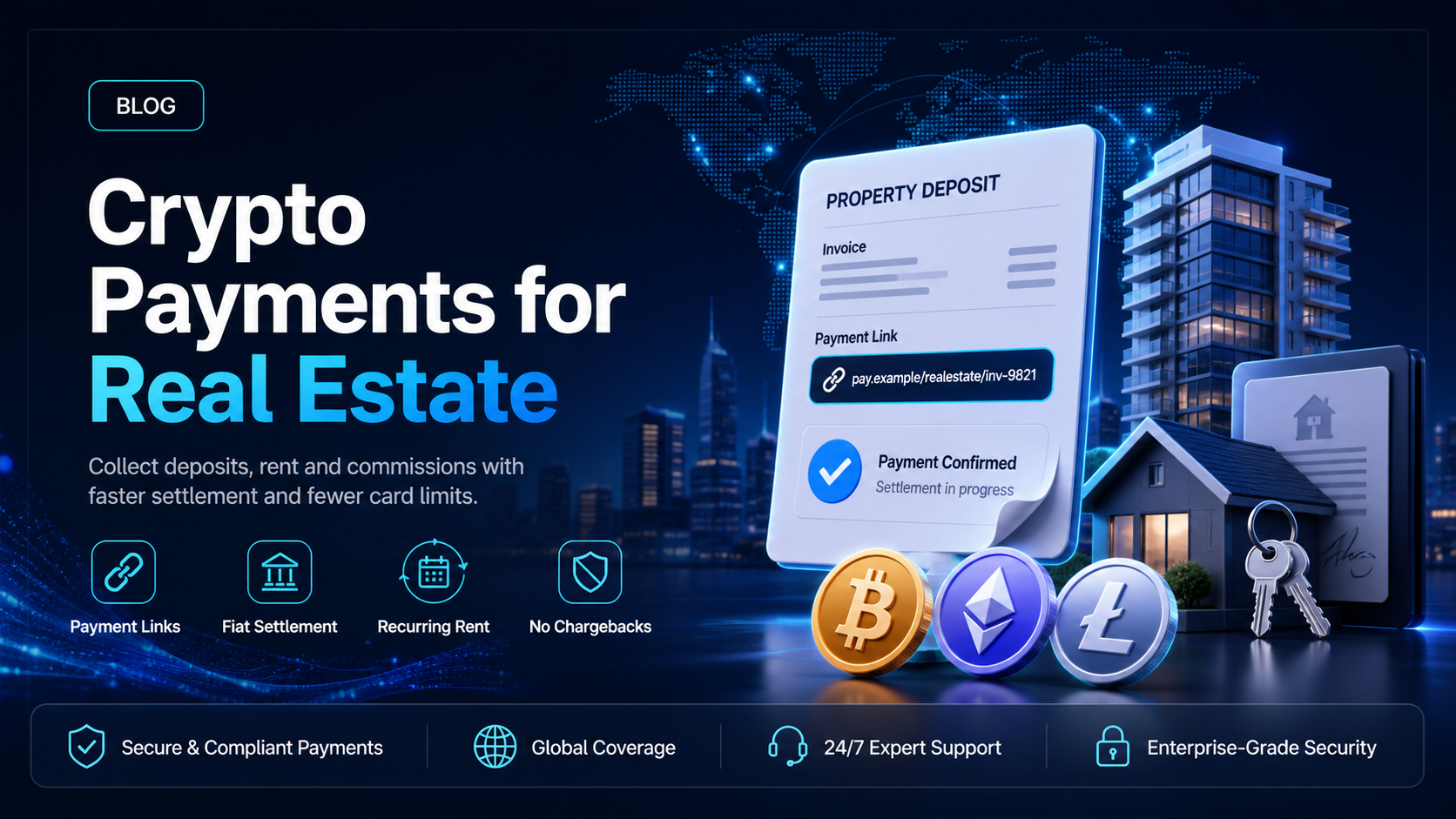
Coverage of crypto and property usually focuses on buying a house with Bitcoin. That is not the transaction a brokerage handles most often. A crypto payment gateway for real estate is more useful for the money that moves around a deal: holding deposits, rent, admin and application fees, and commissions between businesses. Those payments come up week after week, in amounts a card or a wire can handle badly.
That is the practical case for real estate crypto payments. A brokerage or property manager is already collecting a fixed amount from a named person on a known date. A payment link, an invoice, or a scheduled invoice fits that pattern exactly. This guide covers what a firm can collect in stablecoins or crypto, where card and wire routes cost the most, and which EukaPay product fits which payment.
In this guide, you'll learn:
Which payments a brokerage or property manager can collect in stablecoins or crypto
Where card and wire routes cost a real estate firm the most money and time
The step-by-step flow for collecting a property deposit in crypto and settling in fiat
How to choose between payment links, invoices, and custom checkout
What firms collect with a crypto payment gateway for real estate
Start with the payments the firm already takes, not with the sale price. A recurring collection in a brokerage or a property-management book is usually a fixed amount owed by someone the firm has already identified.
Holding deposits - a fixed amount at the point of offer
A holding deposit or reservation fee is the clearest case. The amount is set, the payer is named, and the money is wanted quickly, often the same day the offer goes in. A payment link requests the exact amount from one named person. They can pay it from wherever they are.
Rent and recurring fees - the same tenant on the same interval
Rent, service charges, parking, and storage are the same amount to the same payer on a fixed interval. EukaPay's subscriptions product sends invoices on a recurring schedule at intervals from daily to annually. A monthly rent invoice can be set up once. It is a scheduled invoice, not a billing engine. There is no plan management, no retry logic, and no programmatic control of the cycle. The property manager keeps its own tenant list and its own decisions about who is billed. For firms with overseas tenants, crypto rent payments can remove a monthly wire from the process.
Commissions and admin fees - paid between businesses
Referral commissions, co-broke splits, marketing contributions from a developer, and application or admin fees are business-to-business invoices. They carry line items, they go to a finance contact instead of a consumer, and they are often larger than the amounts the office collects from consumers. An invoice with a payment link embedded fits business-to-business billing better than a checkout page.
Why cards and wires cost more on property deposits and cross-border payments
Cards were built for retail amounts. A holding deposit on a property is often several multiples of a consumer card limit. The decline happens at the issuer, not at your payment page. Nobody in the office can change that outcome. Firms fall back to a wire, which restarts the clock.
Wires bring their own costs. There is a fixed fee against a variable amount, an intermediary bank or two that can reduce the amount arriving, and a cut-off time that decides when the money lands. On a deposit that is meant to secure a unit before another offer arrives, the cut-off is the expensive part, not the fee.
Then there is the payer's location. Every extra country in your buyer or tenant list adds another issuer and another set of rules your acquirer did not write. A card that works for a local buyer may not complete for one outside your acquirer's footprint. A crypto payment does not depend on that set of relationships. Our guide to
cross-border payment collection
covers the wider version of this problem.
Chargebacks are the last one. A consumer who pays a deposit or a fee by card can dispute it after the fact. A deal that falls through gives them a reason to try. The card issuer, not the firm, decides that outcome. A settled crypto payment cannot be reversed by the payer, so the firm carries no chargeback exposure on the amount it collected.
How a real estate agency accepts a crypto deposit, step by step
Create the EukaPay account.
Sign up, complete verification, and provide the agency's legal business information. A staging environment is available for development if the firm wants to build against the API.
Choose the settlement option.
Fiat settlement sends the money to the firm's own bank account in USD, EUR, GBP, or CAD. Crypto settlement keeps the asset. Agencies that do not want price exposure usually choose fiat.
Create the request.
For a deposit, generate a payment link for the exact amount. For a commission or an admin fee, build an invoice with line items and the client's details.
Send it.
You share the payment link yourself, by email or any messaging app the payer uses. For invoices, EukaPay sends a formatted PDF invoice to the payer's inbox with the payment link embedded.
The payer pays.
They open the link, follow the payment screens, and pay in most major cryptocurrencies like BTC, ETH, LTC, SOL, USDC, USDT. No account with EukaPay is needed on their side.
Convert at a locked rate.
EukaPay offers instant crypto-to-fiat conversion at a locked exchange rate to remove your exposure to crypto price swings. The fiat value of the deposit is fixed at the moment of payment.
Set the recurring ones to repeat.
For rent or a monthly service charge, create the invoice as a subscription and it can go out on the interval you set.
The mechanics of the document itself are covered in more detail in our walkthrough of
.
Can you pay a property deposit with Bitcoin or a stablecoin?
Yes, as long as the firm collecting the deposit has set up a gateway to receive stablecoins or crypto. The payer gets a link or an invoice. They pay it from a wallet the same way they would pay any other crypto request. If the firm has selected fiat settlement, the deposit reaches its bank account as fiat, so the office does not need to hold or manage the asset.
Firms that accept crypto for property deposits often see the payer choose a stablecoin instead of BTC or ETH. The amount owed and the amount sent match, with no calculation on either side. Accepting a deposit this way is a collection method. It does not change how the firm runs the deal itself.
For a wider view of which businesses take crypto today, see our roundup of
companies accepting crypto in 2026
.
How to choose between payment links, invoices, and custom checkout
Payment links | Invoices | Custom checkout | |
|---|---|---|---|
Who sends the request? | The firm, as a URL you share anywhere | The firm, to a named payer | Nobody, the payer reaches it on your site |
Coding required? | No | No | Yes, a developer (or coding agent) integrates it |
Line items and payer details? | Amount and description | Yes, on the PDF that goes out | Set by your own integration |
Repeats on its own? | No | No, unless set up as a subscription | No |
Best for | Holding deposits, application fees, ad-hoc charges | Commissions, admin fees, business-to-business billing | Listing portals, tenant portals, developer sales sites |
Typical user | An agent collecting a set amount today | Finance or office manager | A firm with its own portal and its own traffic |
A firm often uses more than one. A brokerage may run deposits on payment links, invoice commissions, schedule rent as subscriptions, and add checkout only when it has a portal worth integrating into. If that portal exists, our post on
EukaPay's customizable crypto checkout
covers the branded payment experience. Our guide to
how to choose a crypto payment gateway
covers the criteria that apply to any vertical.
One platform for deposits, recurring rent, and fiat settlement
Payment links, invoices, checkout, and subscriptions run on the same EukaPay account, so a firm is not choosing a product it then has to live inside. All four give you instant crypto-to-fiat conversion at a locked exchange rate to remove your exposure to crypto price swings, protection against chargebacks, support for most major cryptocurrencies, and settlement in USD, EUR, GBP, and CAD to your bank account.
That turns the decision into a question of fit, not one of better and worse. A deposit needs a link the office can send straight away. A commission needs a document with line items a finance team can file. Rent needs a schedule. The agency picks per payment type, and the settlement behaves the same way in every case.
Get started with EukaPay
Create an account at
, complete verification, and provide the agency's legal business information. From there you can send a payment link or an invoice from the dashboard without writing any code. If you want deposits or rent raised from your own listing or tenant portal instead, the endpoints and the staging environment are documented at
.
Frequently asked questions
Can a real estate agency accept crypto payments from buyers and tenants?
Yes. A firm can collect deposits, rent, admin fees, and commissions through payment links, invoices, checkout, or subscriptions, and the payer settles in stablecoins or crypto.
Which cryptocurrencies can a brokerage accept?
EukaPay supports most major cryptocurrencies like BTC, ETH, LTC, SOL, USDC, USDT for pay-ins. Firms collecting fixed amounts often see payers choose a stablecoin, so the amount sent matches the amount owed.
Does the agency have to hold crypto after the payment lands?
No. The merchant chooses fiat or crypto settlement. With fiat settlement the money reaches the firm's own bank account in USD, EUR, GBP, or CAD.
Can EukaPay send the same rent invoice every month?
Yes. Subscriptions send invoices on a recurring schedule at intervals from daily to annually. There is no plan management or retry logic, so the property manager keeps control of who is billed and when.
When is the fiat value of a crypto payment fixed?
EukaPay offers instant crypto-to-fiat conversion at a locked exchange rate to remove your exposure to crypto price swings. The fiat value is fixed at the moment of payment.
Can a payer reverse a crypto deposit the way they dispute a card payment?
No. A settled crypto payment cannot be reversed by the payer, so the firm carries no chargeback exposure on a deposit it has already collected.
Does the payer need a EukaPay account to pay a deposit?
No. They open the payment link or the PDF invoice, follow the payment screens, and pay from their own wallet.
Related articles
Crypto payments for property management companies
- collecting rent, service charges, and deposits on a schedule
Accepting crypto for high-value transactions
- what changes when the amount is larger than a card can carry
Cross-border collection for developers and sales offices
- invoicing buyers outside your acquirer's footprint
Products
Use Cases
© 2026 EukaPay. All rights reserved.
FINTRAC: M22233887