Chargeback protection for merchants: tools, rules, and crypto payments compared
October 06, 2026
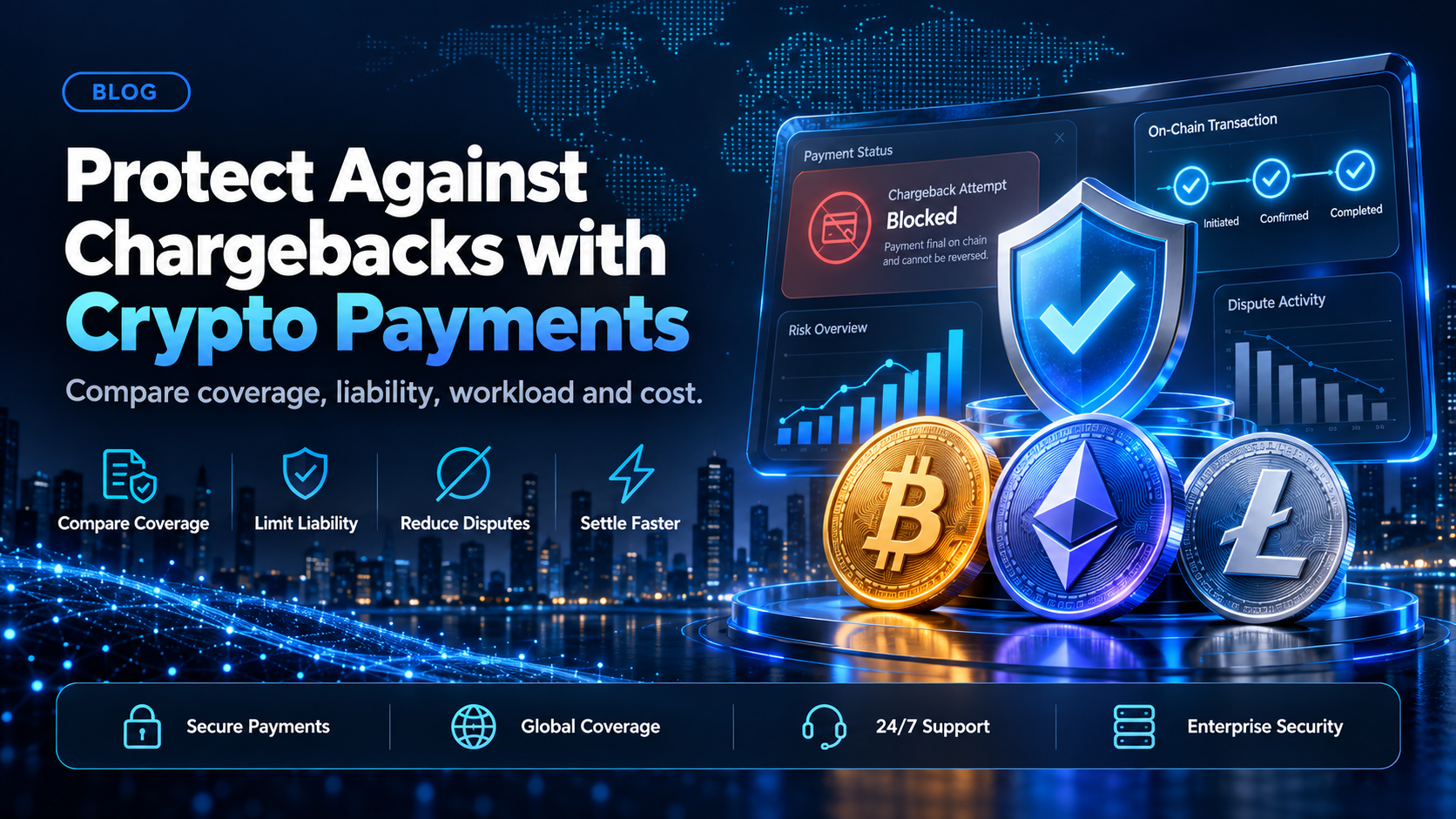
Chargeback protection for merchants is usually a product added to card payments, not to crypto payments. Some tools screen orders before authorization, some intercept a dispute after the issuer opens it, and some reimburse the loss once a chargeback lands. Each one works inside the card network's dispute process, so each one covers some reason codes and not others.
EukaPay works differently for the share of revenue you move to stablecoins or crypto. A crypto payment confirms on-chain, so protection against chargebacks is a property of the payment method. This guide compares that approach with a chargeback guarantee from Riskified, PayPal's program for card chargebacks, and chargeback alerts from Verifi and Ethoca, on coverage, liability, merchant workload, and price.
In this guide, you'll learn:
The three criteria that separate one chargeback tool from another
How guarantees, alerts, PayPal's program, and crypto payments compare in one table
Which chargeback tool fits which kind of merchant
How EukaPay handles conversion, supported cryptocurrencies, and fiat settlement
What chargeback protection for merchants has to cover, from card tools to crypto payments
Card chargebacks cost more than the disputed sale. The merchant can lose the goods, the shipping cost, and a dispute fee on top of the refunded amount. A high dispute ratio can also put the account into a card-network monitoring program such as Visa's VAMP. Three criteria decide whether a tool reduces that cost or only moves it.
Coverage - which dispute reason codes the tool covers
Every card dispute carries a reason code. A tool built for fraud codes does nothing for a "not as described" dispute, and a tool built for alerts only sees issuers inside its network. Before you compare prices, list the reason codes behind your last year of disputes and check each tool against that list.
Liability - who absorbs the loss when a dispute succeeds
Some tools shift the loss to the provider. Others leave the loss with the merchant and only lower the dispute count. A guarantee that covers fraud codes up to a cap is a different product from an alert that asks you to refund the order before it becomes a chargeback.
Merchant workload - what your team still does after a dispute opens
Most card tools still need the merchant to act. That can mean answering alerts inside a short window, uploading proof of delivery, or connecting order data to an issuer lookup service. The staff time belongs in the price comparison. A crypto payment through EukaPay does not open a card dispute, so that dispute work does not apply to it.
Chargeback protection tools compared: guarantees, alerts, PayPal, and crypto payments
Crypto payments through EukaPay | Chargeback guarantee (Riskified) | PayPal chargeback program | Chargeback alerts (Verifi, Ethoca) | |
|---|---|---|---|---|
Disputes covered | A confirmed on-chain payment has no card dispute process | Approved card-not-present orders later charged back as fraud | "Unauthorized" and "item not received" card chargebacks | Disputes opened by issuers inside the alert network |
Who carries the loss | No card chargeback reaches the merchant | Provider reimburses covered fraud chargebacks | PayPal, up to a monthly loss cap | Merchant refunds the order to stop the chargeback |
What the merchant still does | Sets its own refund policy | Sends orders for an approve or decline decision | Submits proof of shipment or delivery when asked | Responds to each alert within a short window |
Price | Volume-based, agreed with the EukaPay team during onboarding | Fee tied to approved transactions | Separate fee for enrolled merchants | Alert fee, plus the refunded amount |
Refer to the websites for current information.
In the EukaPay column, the card dispute process does not apply to the payment at all. The other three columns reduce card losses in different ways. A guarantee covers fraud reason codes, PayPal's program covers two chargeback types on its Advanced Debit and Credit Card checkout, and alerts turn a chargeback into a refund. For the revenue you move to crypto payments through EukaPay, no card reason code applies.
Which chargeback tool fits which merchant: card tools or crypto payments?
EukaPay fits a merchant whose buyers already hold stablecoins or crypto, or who sells into markets your acquirer serves poorly. Digital goods, hosting, and software are common examples, since those sales often have no parcel to show as proof of delivery. EukaPay is not a card acquirer, so it does not protect the card share of your revenue.
A chargeback guarantee suits a merchant with high card-not-present volume and a fraud problem, where handing approve or decline decisions to a provider is acceptable. PayPal's program suits a merchant already on PayPal's Advanced Debit and Credit Card checkout whose disputes are mostly "unauthorized" or "item not received". Alerts suit a merchant close to a card-network ratio threshold who needs the dispute count down now and can staff the response.
You can run a card tool for card volume and add EukaPay as a second payment method. That split takes every crypto sale out of the card dispute process, and EukaPay handles those sales from checkout to fiat settlement.
One platform for deposits, payouts, and fiat settlement
EukaPay gives you instant crypto-to-fiat conversion at a locked exchange rate to remove your exposure to crypto price swings, support for most major cryptocurrencies like BTC, ETH, LTC, SOL, USDC, and USDT, and settlement in USD, EUR, GBP, and CAD to your bank account. A crypto payment confirms on-chain, so protection against chargebacks is a property of the payment method.
The same account covers invoices, payment links, checkout, and subscriptions on the pay-in side, plus crypto payouts in USDC, USDT, ETH, and BTC. If chargebacks are reducing your card margin on digital or cross-border sales, add EukaPay as the crypto payment method for those sales and keep your card tools for the rest.
Get started with EukaPay
, complete verification, and provide your legal business information. Then generate an API key and build against the staging environment using the
. Read more about the
EukaPay crypto payment gateway
.
Frequently asked questions
Can crypto payments be charged back?
No card issuer sits between the buyer and the merchant on a crypto payment, so there is no card chargeback to file.
Crypto chargebacks and reversibility
covers the detail.
Do I still need chargeback tools if I accept crypto payments?
Yes, for the card share of your revenue. Crypto payments leave the card dispute process, but card sales still carry chargeback risk, so card tools stay useful for that volume.
Does a chargeback guarantee cover crypto payments?
A chargeback guarantee covers approved card-not-present orders later charged back as fraud. A crypto payment through EukaPay opens no card dispute, so there is nothing for a guarantee to cover on that sale.
Do chargeback alerts apply to crypto payments?
No. Chargeback alerts respond to a dispute an issuer opens on a card payment, and a crypto payment through EukaPay has no card issuer to open one.
Which cryptocurrencies can my customers pay with?
EukaPay supports most major cryptocurrencies like BTC, ETH, LTC, SOL, USDC, and USDT on the pay-in side.
Which currencies does EukaPay settle in?
EukaPay settles in USD, EUR, GBP, and CAD to your own bank account, and you can also choose crypto settlement.
Does the exchange rate change between payment and settlement?
EukaPay locks the exchange rate on every conversion by default, on pay-ins and on payouts.
Related articles
Best crypto payment gateway with no chargebacks
- how crypto gateways compare when chargebacks are the main problem
Crypto payment gateway for hosting providers
- how hosting providers cut chargeback losses with stablecoins or crypto
How to choose a crypto payment gateway in 2026
- the criteria to check before you shortlist a crypto gateway
Products
Use Cases
© 2026 EukaPay. All rights reserved.
FINTRAC: M22233887