High risk payment gateway: why the label sticks and what a second rail changes
August 31, 2026
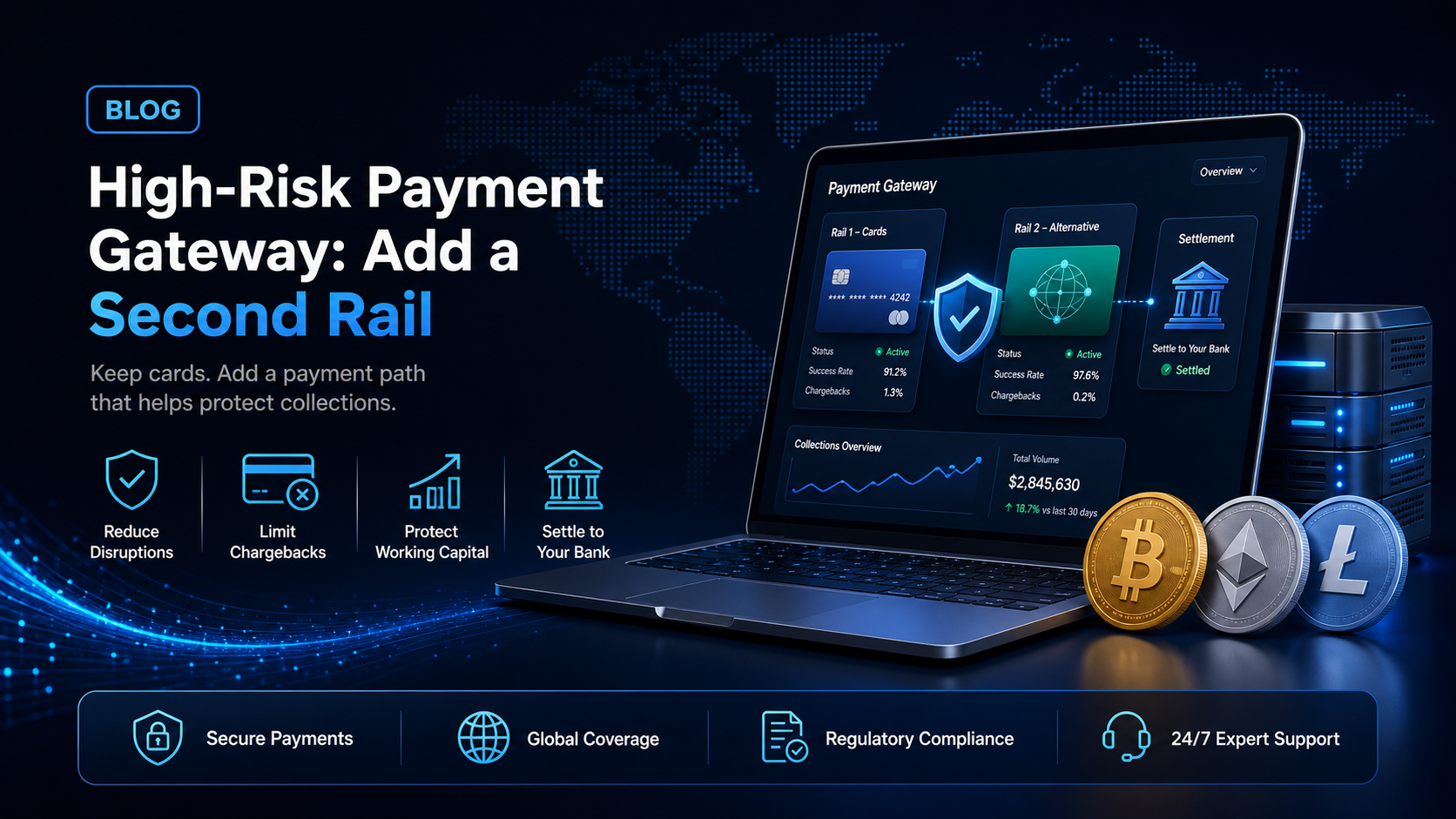
High-risk gateways price on three specific exposures: chargeback rate, regulatory scope, and the acquirer's own downside if the merchant fails. Only some of the three respond to negotiation, which is why the same business gets similar quotes from different providers.
This guide separates the three drivers, identifies which of them a merchant can actually move, and explains where a second collection rail changes the arithmetic. EukaPay is that second rail, and the mechanics come first so the comparison is honest rather than a pitch.
In this guide, you'll learn:
What actually puts a merchant in the high risk category
The three cost drivers behind a high risk merchant account quote
Which of them you can negotiate, and which are structural
Where a second rail changes the economics, and where it does not
Who needs a high risk payment gateway, and why
The classification is commercial. Card networks and acquiring banks assign merchant categories, and some categories carry a higher expected rate of disputes, refunds, or account losses. Your individual track record matters, but the category assignment often arrives before anyone has looked at it.
Common triggers, none of which imply anything is wrong with the business:
Delayed delivery.
Anything sold now and delivered later carries dispute exposure until it is delivered. Travel, events, and pre-orders sit here.
Recurring billing.
Subscriptions generate disputes when a customer forgets a renewal, and the dispute lands on the merchant.
High average transaction value.
A single reversed transaction is a larger loss, so the acquirer prices for it.
Cross-border customer base.
Every additional market adds another issuer, and approval rates fall on routes the acquirer serves poorly.
Category assignment.
Some sectors are classified this way as a matter of policy regardless of individual performance.
The label follows the category more than the company. A business with a spotless record inside a flagged category will still be quoted as high risk, which is why "we have never had a problem" rarely moves the conversation.
The three cost drivers behind a high risk merchant account
Reserves - your money, held
A rolling reserve holds back a percentage of your takings for a set period against future disputes. It is not a fee, and it is usually returned. It is also working capital you cannot use, which for a growing business is often the most expensive part of the arrangement even though it never appears as a cost.
Chargeback exposure - the loss and the fee
When a customer disputes a card payment, the amount is reversed and a fee is charged regardless of whether you win. Sustained dispute ratios above scheme thresholds can put an account into a monitoring programme, and the remediation costs stack on top.
Account instability - the one nobody prices
Accounts in flagged categories get reviewed, and reviews can end in a freeze or a closure with limited notice. The direct cost is the disruption. The indirect cost is that most businesses in this position keep a second provider on standby, and maintaining two integrations is real engineering time.
Of the three, reserve terms and pricing are negotiable with volume and history. Chargeback exposure is structural to card rails. Account stability is largely outside your control.
Does a second rail reduce high risk payment processing costs?
It changes the mix rather than the rate. Cards stay in place and keep doing the work they do well. What a second rail does is move a portion of volume onto a path where two of the three drivers behave differently.
A payment completed on-chain is not subject to a card chargeback, because there is no issuer able to reverse it. That removes the dispute-and-fee cycle on that portion of volume. It does not remove your obligation to your customer, and it does not mean disputes vanish as a business matter. A customer who is unhappy still needs resolving through your own refund process. What changes is that resolution happens on your terms rather than through a scheme mechanism with a fee attached.
The concentration point matters too. If a meaningful share of takings arrives through a second, unrelated path, a review or freeze on the card account stops being a single point of failure for the whole business.
What it does not do: it does not lower your card rate, it does not release an existing reserve, and it does not change your category assignment.
How to choose
Standard acquirer | Specialist high risk provider | Offshore arrangement | EukaPay alongside any | |
|---|---|---|---|---|
Likely outcome for a flagged category | Declined or offboarded | Accepted, priced accordingly | Accepted, wider variance in terms | Not category-priced |
Rolling reserve | Rare | Common | Common | Not a card-acquiring arrangement |
Chargeback exposure | Full | Full | Full | On-chain payments are not chargeback-reversible |
Concentration risk | Single rail | Single rail | Single rail | Adds an independent second path |
Settlement destination | Your bank account | Your bank account | Varies | Your bank account in USD, EUR, GBP, or CAD, or crypto |
Approaches compared, not vendors.
The EukaPay column adds a path rather than replacing the acquirer, which is the practical shape of this decision. Very few businesses in a flagged category can move off cards, and none should try on the strength of a comparison table. The realistic move is to keep the card relationship and stop depending on it exclusively.
One platform underneath
EukaPay gives you instant crypto-to-fiat conversion at a locked exchange rate to remove your exposure to crypto price swings, support for most major cryptocurrencies, and settlement in USD, EUR, GBP, and CAD to your bank account. A crypto payment confirms on-chain, so protection against chargebacks is a property of the payment method.
The recommendation for a merchant in a flagged category is straightforward. Keep the acquirer you have, and add EukaPay as a second path so a single account review cannot stop your collections. Pricing is agreed with the EukaPay team. Start by routing a small share of volume and watching the reconciliation.
Get started with EukaPay
Create an account at
, complete verification, provide your legal business information, and generate an API key. A staging environment is available so the flow can be tested before live volume moves through it. Endpoints are documented at
.
Frequently asked questions
What is a high risk payment gateway?
It is a gateway and acquiring arrangement for merchant categories that card networks and acquirers associate with higher dispute or loss rates. Pricing typically includes higher rates, a rolling reserve, and terms that can be revisited.
Why is my business classified as high risk?
Usually the category rather than the company. Delayed delivery, recurring billing, high transaction values, and a cross-border customer base are common triggers, and the assignment often precedes any review of your record.
Can I get the high risk label removed?
Track record and volume improve the terms you are offered over time. The category assignment itself is set by the card networks and acquirers, so it is not something a merchant changes directly.
What is a rolling reserve?
A percentage of your takings held back for a set period against future disputes, then released. It is usually returned in full, but while held it is working capital you cannot deploy.
Do crypto payments have chargebacks?
A payment completed on-chain is not subject to a card chargeback, because no issuer can reverse it. Customer refunds are still handled through your own process.
Will adding a second rail lower my card rate?
No. It moves a share of volume onto a different path with different economics. Your card pricing is set by your acquirer and is unaffected.
How is EukaPay priced?
EukaPay does not publish a public rate card. Pricing is agreed with the EukaPay team.
Can I keep my current provider?
Yes, and most merchants should. A second rail is additive, and the concentration benefit only exists if the first rail stays in place.
Related articles
Crypto payments and chargebacks
- what "not chargeback-reversible" means in day-to-day operations
- the same problem in the category that meets it most often
How to choose a crypto payment gateway in 2026
- selection criteria for the second rail itself
Products
Use Cases
© 2026 EukaPay. All rights reserved.
FINTRAC: M22233887