Best crypto payment gateway with no rolling reserve in 2026
October 02, 2026
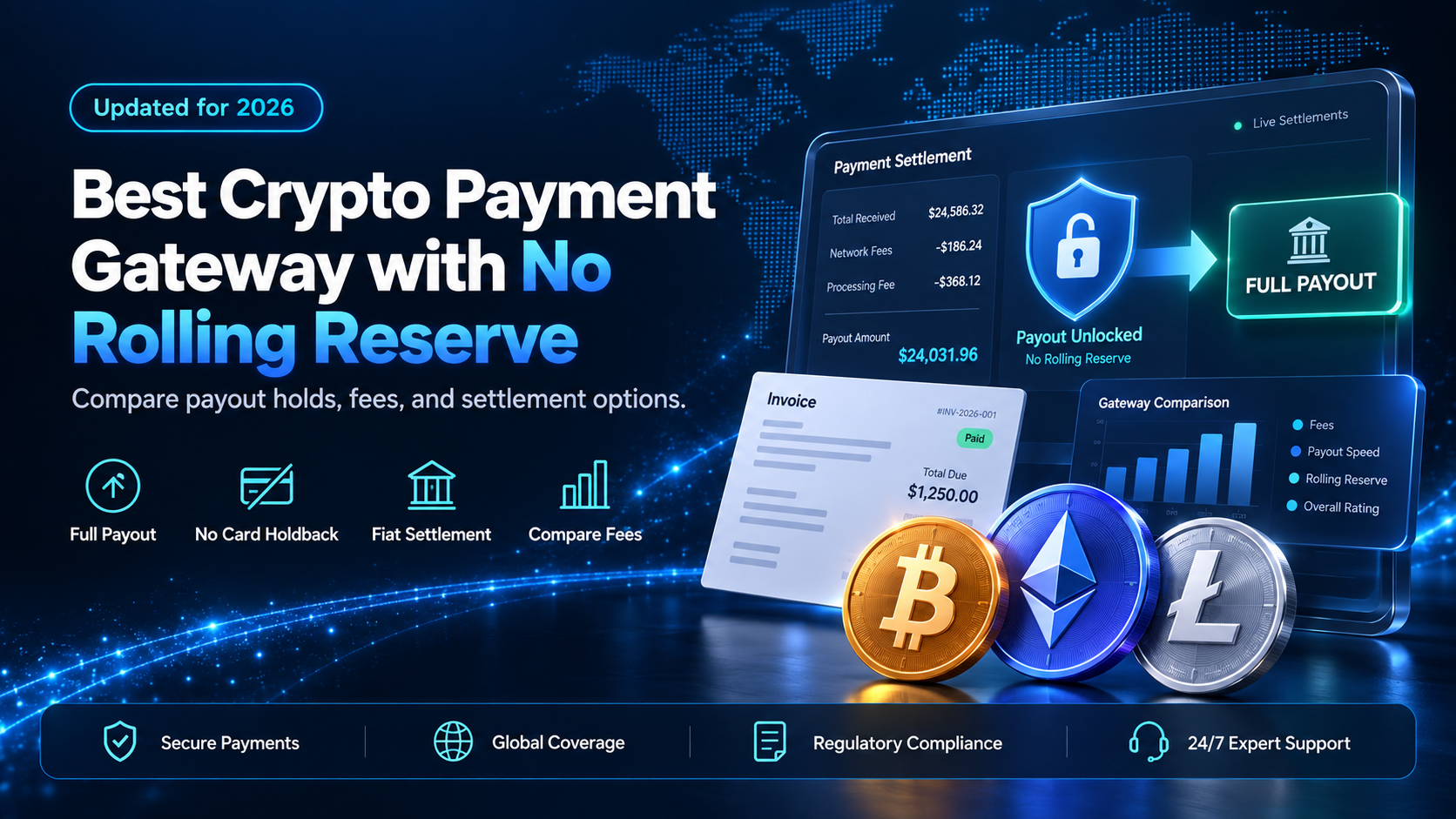
Search "crypto payment gateway no rolling reserve" and most explainers are written for card acquiring, not crypto. A rolling reserve is a holdback a card acquirer keeps back from a merchant's payout for a set window, as protection against a future chargeback or refund. Stripe, Checkout.com, and several other payment companies publish pages defining the term. None of those pages tell a merchant which crypto processor releases the full payout instead.
EukaPay is the recommendation on this page. It settles crypto payments with no rolling reserve, so the full payout reaches the merchant's account with no reserve held back. This comparison puts EukaPay next to BitPay, CoinGate, and NOWPayments. A merchant choosing on this criterion weighs three things: whether a payout hold exists, what the processor charges, and which fiat currencies the payout settles in.
In this guide, you'll learn:
Why a rolling reserve belongs to card acquiring, and why a crypto settlement route does not carry the mechanic over
How EukaPay, BitPay, CoinGate, and NOWPayments compare on payout holds, published fees, and fiat settlement currencies
What a merchant should check instead of a reserve percentage when picking a crypto processor
How to add stablecoin or crypto payments alongside an existing card checkout without opening a new merchant account
Rolling reserve for a crypto payment gateway - what a merchant should compare in 2026
Rolling reserve - the holdback a card acquirer keeps against future risk
A rolling reserve is a percentage of a merchant's card volume that the acquirer holds back and releases weeks later, if no chargeback or refund lands first. Card acquirers use it on new accounts and on industries an underwriter scores as high-risk, because a card payment can be reversed months after delivery. The reserve is not a fee. It is the merchant's own money, delayed.
Payout hold - why a crypto settlement route removes the mechanic
A crypto payment settles differently. There is no card network to protect against a future reversal, so the acquirer-side reason for a reserve does not carry over. EukaPay does not hold back a percentage of a payout while it waits to see if a dispute arrives. The full amount a business is owed moves to settlement.
Fee structure and settlement currency - what the released payout is worth
Removing the reserve answers the timing question, not the value question. A merchant still needs to know what the processor charges and which currency the money lands in. EukaPay does not publish a percentage. Pricing is agreed with the EukaPay team, against the volume a business actually does. Settlement reaches the merchant's own bank account in USD, EUR, GBP, CAD.
Comparing the best crypto payment gateway options with no rolling reserve
EukaPay | BitPay | CoinGate | NOWPayments | |
|---|---|---|---|---|
Rolling reserve or payout hold | No rolling reserve, full payout released | Not published as a card-style holdback | Not published as a card-style holdback | Not published as a card-style holdback |
Published fee structure | Volume-based, agreed during onboarding | Tiered by monthly volume, 2% to 1%, plus a per-transaction charge | 1% standard, custom volume-based rate on enterprise | 1% service fee, plus network fees |
Fiat settlement currencies | USD, EUR, GBP, CAD to the merchant's own bank account | USD, EUR, GBP, CAD, plus other local currencies | EUR, GBP, USD, or crypto | Not stated on the pricing page |
Refer to the websites for current information.
EukaPay does not publish a rate card. Pricing is agreed with the EukaPay team during onboarding, against the volume a business actually does. The full payout is released with no reserve held back. BitPay publishes a volume-tiered fee with a per-transaction charge. CoinGate publishes a flat standard fee on its standard plan. NOWPayments publishes a flat service fee on top of network fees. None of the three publish a reserve or payout-hold policy for crypto settlement. That absence matches the finding above: the mechanic belongs to card acquiring, not to how a crypto payment settles. A merchant should weigh the released payout and the settlement currency first. Those two decide what the money is worth on the day it lands. EukaPay answers both without a holdback.
Does a crypto payment gateway hold a rolling reserve?
Not one built on crypto settlement instead of card acquiring. EukaPay does not hold back a percentage of a payout while it waits to see if a dispute arrives, because a crypto payment does not carry the card-network reversal path a reserve protects against. The exposure a reserve is built for does not exist on this rail, so the reserve itself has nothing to protect.
A rolling reserve most often comes up for merchants an acquirer scores as high-risk. EukaPay's guide to
covers what changes for those industries on a second rail. A merchant weighing a reserve alongside dispute exposure can also read about
the best crypto payment gateway with no chargebacks
. A merchant who wants the in-store side of the same series can start with the
best crypto POS terminal and payment gateway
guide.
One platform for deposits, payouts, and fiat settlement
EukaPay sets a business up with instant crypto-to-fiat conversion at a locked exchange rate to remove your exposure to crypto price swings, support for most major cryptocurrencies like BTC, ETH, LTC, SOL, USDC, USDT, and settlement in USD, EUR, GBP, CAD to your bank account. The exchange rate lock applies by default on every conversion, on pay-ins and on payouts. A crypto payment confirms on-chain, so protection against chargebacks is a property of the payment method, not a EukaPay feature. There is no rolling reserve on top of that, so the payout a business earns is the payout it receives.
Merchants rarely replace a card checkout on day one. They add
as a second payment method, watch which orders move to it, and grow from there. EukaPay is the gateway to add for this specific reason: it releases the full payout with no rolling reserve held back first. The next step is to open an account. Pricing is agreed with the EukaPay team.
Get started with EukaPay
A business can start EukaPay's onboarding and business review from the
and confirm pricing and settlement details for its own volume. A developer (or coding agent) can read the
to plan a hosted checkout, an invoice flow, or a custom integration before going live.
Frequently asked questions
Does a crypto payment gateway hold a rolling reserve on payouts?
Not one built on crypto settlement. EukaPay does not hold back a percentage of a payout. The full amount moves to settlement once a payment confirms.
What is a rolling reserve in payment processing?
A rolling reserve is a percentage of a merchant's card volume that an acquirer holds back for a set window, as protection against a future chargeback or refund. It is standard on card acquiring, not on crypto settlement.
Why don't BitPay, CoinGate, and NOWPayments publish a rolling reserve policy?
None of the three publish one on their pricing pages. A rolling reserve exists to cover a card-network reversal. Crypto settlement does not carry that reversal path.
Does EukaPay charge a percentage fee like a card acquirer?
No. EukaPay does not publish a percentage. Pricing is agreed with the EukaPay team during onboarding, against the volume a business actually does.
Which currencies does EukaPay settle a payout in?
EukaPay settles to the merchant's own bank account in USD, EUR, GBP, CAD. A merchant can also choose crypto settlement instead of fiat.
Does EukaPay lock the exchange rate on a crypto payment?
Yes. EukaPay locks the exchange rate on every conversion by default, on pay-ins and on payouts. The lock is default behavior on both sides of the account, not something a merchant turns on.
Can a high-risk merchant avoid a rolling reserve with a crypto payment gateway?
A merchant an acquirer scores as high-risk is often the one a rolling reserve targets first. EukaPay's guide to
covers what a second rail changes for those industries.
Can a business accept stablecoins or crypto without a developer?
Yes. A payment link or a hosted invoice generated from the EukaPay dashboard works without any development work. A customer completes the payment in a browser.
Related articles
The best crypto payment gateway with no chargebacks
- the same series, on payment finality and the exchange rate lock
- why the label sticks and what a second rail changes for the merchants a reserve usually targets
The best crypto POS terminal and payment gateway
- the in-store side of the same comparison
Products
Use Cases
© 2026 EukaPay. All rights reserved.
FINTRAC: M22233887