How to accept crypto payments as a business: pricing stablecoins or crypto sales
September 03, 2026
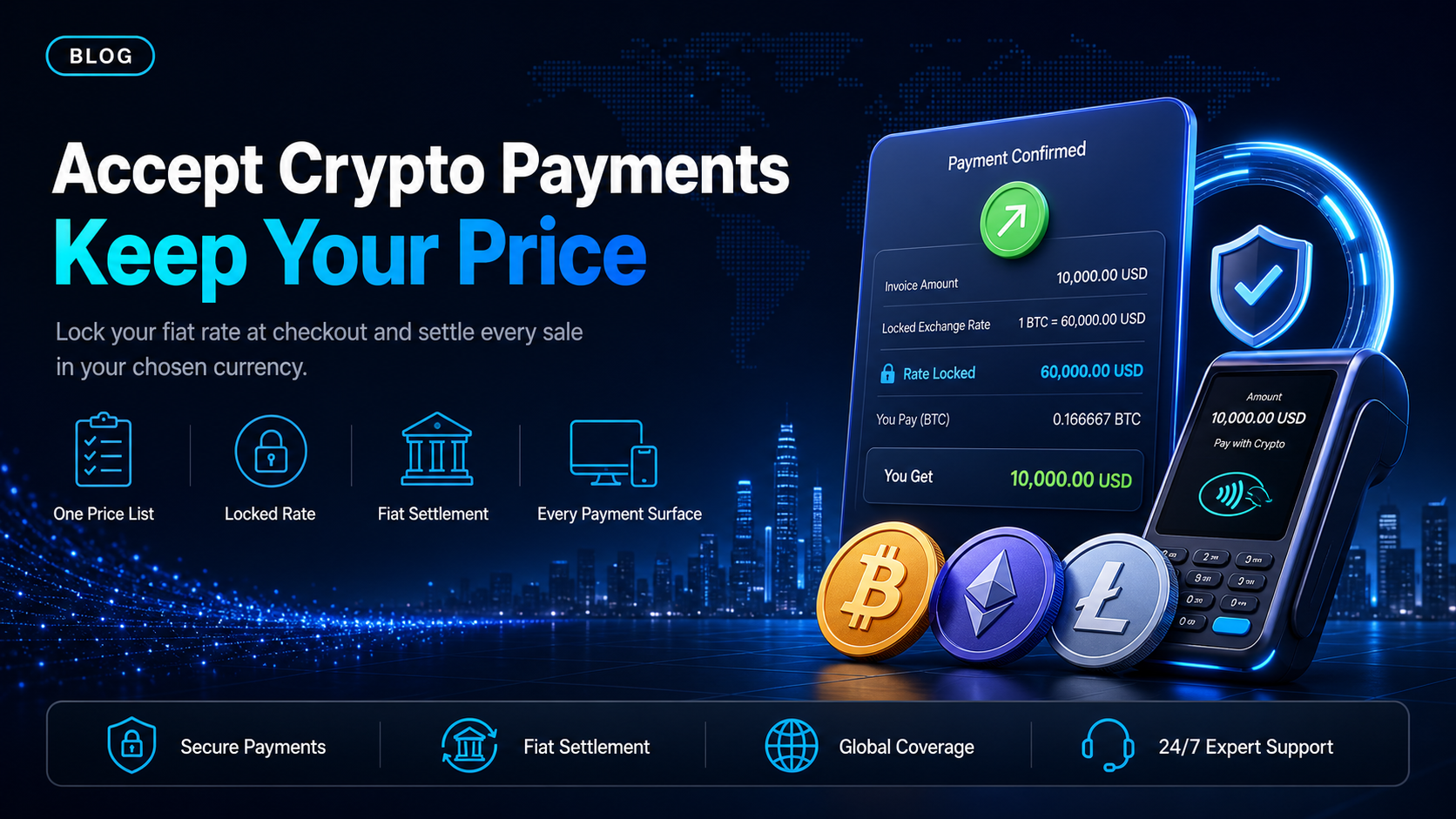
A business working out how to accept crypto payments usually expects the hard part to be technical. In practice the first real question is a pricing one. A card payment settles in the currency the business already prices in, so the price on the shelf is the price the business receives. A stablecoin or crypto payment starts as an amount of an asset whose market value moves, and the business still needs a fixed number to put on an invoice, a checkout page, or a receipt.
That question has a settled answer, and it does not require repricing a catalog or watching a market. Three decisions, made once in the dashboard rather than on every sale, cover what a business needs to accept stablecoins or crypto: whether to add a surcharge for it, how the locked exchange rate is applied at the moment of payment, and which fiat currency the business settles in. Get those three right and accepting a stablecoin or crypto sale works the same way accepting anything else does.
In this guide, you'll learn:
Whether to add a surcharge for stablecoins or crypto, or price it the same as everything else
How a locked exchange rate removes the price-movement risk between a quote and a completed payment
How to quote and settle every stablecoin or crypto payment in USD, EUR, GBP, CAD regardless of what the customer sends
The steps to accept a payment on an invoice, a payment link, checkout, and the online POS terminal
What changes when a business starts accepting stablecoins or crypto
Cash and card prices are fixed the moment they are set. The business writes a price in its own currency, the customer pays that price, and nothing about the transaction depends on a market moving in the background.
A customer paying in a stablecoin or crypto asset is sending value that is priced somewhere else first. Bitcoin and ether trade continuously on public markets, and even a dollar-pegged stablecoin has to be converted into the business's own settlement currency at some point. The pricing question is really a timing question: at what moment does the sale price stop moving, and who decides that moment.
A locked-rate
answers both parts. The price is set once, in fiat, on the invoice or the checkout page. When the customer sends payment, EukaPay converts the amount at that moment through instant crypto-to-fiat conversion at a locked exchange rate to remove all crypto volatility, and the number the business already quoted is the number that settles. The market can move in either direction after that point and it no longer touches the sale.
Surcharge or the same price
Why card surcharges exist in the first place
Card surcharging exists because accepting a card costs the merchant something the merchant did not choose. Interchange, network, and processor fees are set by the card networks and the merchant's bank, not by the merchant, so many retailers pass some or all of that cost back to the card-paying customer as a surcharge, a cash discount, or dual pricing that shows a cash price and a card price side by side. Whether a business can surcharge and how it must disclose that surcharge varies by US state, which is one reason dual pricing has become the more common approach at the counter.
Why the same reasoning does not carry over to stablecoins or crypto
A surcharge is a response to a specific cost the merchant is passing along. Published crypto payment gateway processing rates in 2026 commonly run below 1 percent, a different cost structure than the card fees that motivate a surcharge, and the customer is not the one generating that cost through a card network's rules. Most businesses that add stablecoins or crypto as a payment option price it the same as everything else in the catalog for that reason: the cost driver that justifies a card surcharge is not present in the same way, and matching the price removes a reason for a customer to hesitate at checkout.
A business that still wants a different price for stablecoins or crypto can set one. Nothing about EukaPay's gateway requires identical pricing across payment methods. The point is that the decision is a business choice, not something the payment rail forces.
Approach | What the customer sees | Why merchants use it | Applies to stablecoins or crypto |
|---|---|---|---|
Card surcharge | An added fee at checkout for paying by card | Recovers interchange and network cost | Not typically, since the same cost driver is not present |
Cash discount | A lower price for paying cash | Same cost recovery, framed as a discount instead of a fee | Not typically |
Dual pricing | Two prices shown side by side, cash and card | Discloses the cost difference upfront | Rare, since most merchants price stablecoins or crypto the same as cash |
Same price for stablecoins or crypto | One price, regardless of payment method | Removes friction at the moment of payment | This is the common default |
How the locked exchange rate protects your price
The mechanism that makes same-price pricing workable is the locked exchange rate itself. EukaPay's instant crypto-to-fiat conversion at a locked exchange rate fixes the fiat value at the moment the customer sends payment, not when the transaction confirms on the underlying blockchain minutes later and not at the end of the day when the business reconciles its books. The business quoted a fiat number, and that is the number that lands.
This removes two separate risks a merchant would otherwise carry. The first is the risk that the asset's value moves between the moment a customer is quoted a price and the moment they pay, which matters most on a quote that sits open for a while, like an emailed invoice or a payment link sent ahead of a delivery. The second is the risk of holding a volatile asset at all after the sale closes, since the conversion happens as part of accepting the payment rather than afterward as a separate step the business has to manage.
Quoting and settling in USD, EUR, GBP, CAD
Pricing only works if the business can also count on where the money lands. EukaPay settles in USD, EUR, GBP, CAD to your bank account, so a business chooses one of those four currencies as its settlement currency and every stablecoin or crypto payment converts into it, regardless of which asset the customer sent.
That single choice is what lets a business keep one price list. A furniture retailer that prices in USD does not need a second price list for customers who pay in USDC instead of a card, and a business settling in EUR does not need to recalculate a euro price every time a customer sends BTC or ETH instead. The catalog price, the invoice amount, and the settlement currency all stay the same currency, and the conversion from whatever the customer sent happens once, automatically, at payment.
A business that sells to customers in more than one region can still only settle in one of the four currencies per account, so the practical choice is usually whichever currency the business already uses for its own accounting, not the currency a given customer happens to be paying from.
Accepting payment across invoices, payment links, checkout, and the terminal
The same locked-rate mechanism runs underneath every product EukaPay offers, so the setup step is the same shape everywhere: enter the fiat amount once, and the crypto conversion is handled at the moment the customer pays.
Invoices - the price is fixed when you send it
Using
, enter the amount and line items, in your settlement currency, and add the customer's information. EukaPay sends a formatted PDF invoice to their inbox with the payment link embedded, and the amount on that invoice does not change no matter how long the customer takes to pay it.
Payment links - one link, one price
A
is created for a specific amount and sent to a customer directly, which suits a bespoke order or a sale agreed over a conversation rather than a cart. The price on the link is fixed the moment it is created.
Checkout - your existing product price, unchanged
A hosted checkout uses the product price already on the page. Adding stablecoins or crypto as a payment option does not require a second, crypto-specific price field. The customer selects it at checkout, and the same fiat amount converts at that moment.
Terminal - enter the amount, the price locks at that moment
On the
, a staff member enters the sale amount in the business's settlement currency and the customer pays from their own wallet. The fiat amount entered is the amount that settles, whether the sale happens at a counter, a pop-up, or a trade show.
One platform underneath
Whichever surface a customer pays through, EukaPay runs the same pricing logic behind it: instant crypto-to-fiat conversion at a locked exchange rate to remove all crypto volatility, protection against chargebacks, support for a wide range of cryptocurrencies, and settlement in USD, EUR, GBP, CAD to your bank account. A business sets one price, in one currency, and every payment surface honors it the same way.
Get started with EukaPay
Create an account at
to set your settlement currency and add stablecoins or crypto as a payment option across invoices, payment links, checkout, and the terminal. Every merchant goes through onboarding and a business review, and a sandbox environment for development is available during that review. Developers (or coding agents) can use the
and read the integration reference at
.
Frequently asked questions
Should I add a surcharge for stablecoins or crypto payments?
Most businesses do not. The cost structure that motivates a card surcharge is not present in the same way for stablecoins or crypto, so pricing it the same as everything else is the common default. A business can still choose a different price if it wants one.
Does the price change if the market value of the coin moves after the customer pays?
No. Instant crypto-to-fiat conversion at a locked exchange rate fixes the fiat amount at the moment of payment, so a market move afterward does not touch a completed sale.
Can I keep my prices in USD and still accept stablecoins or crypto?
Yes. Set USD as your settlement currency and every stablecoin or crypto payment converts into USD regardless of which asset the customer sent.
What currency does the money land in my bank account as?
Whichever of USD, EUR, GBP, CAD you choose as your settlement currency. The gateway handles the conversion from the customer's asset into that currency.
Can I set a different price on my website checkout than on the terminal?
Yes, since checkout and Terminal both use whatever fiat amount is entered for that sale. Most businesses keep one price across both for consistency, but nothing requires it.
Do I need to update my prices every time the crypto market moves?
No. The catalog price stays in fiat and does not need to track the market. The conversion happens once, at the moment a customer pays.
Can I quote a price to a customer in a different country?
Yes. The price is still quoted and settled in your chosen fiat currency; the customer's location does not change which currency you price or settle in.
Does a locked exchange rate cost extra?
Locked-rate conversion is part of how EukaPay's gateway processes every stablecoin or crypto payment. For your business's specific pricing,
directly.
Related articles
The locked exchange rate explained
- how instant crypto-to-fiat conversion works in more detail.
Instant crypto-to-fiat conversion
- the mechanics of converting a payment as it arrives.
The best crypto POS terminal and payment gateway
- taking a priced sale in person.
Products
Use Cases
© 2026 EukaPay. All rights reserved.
FINTRAC: M22233887