Ticket sales platform payments: choosing a provider
August 26, 2026
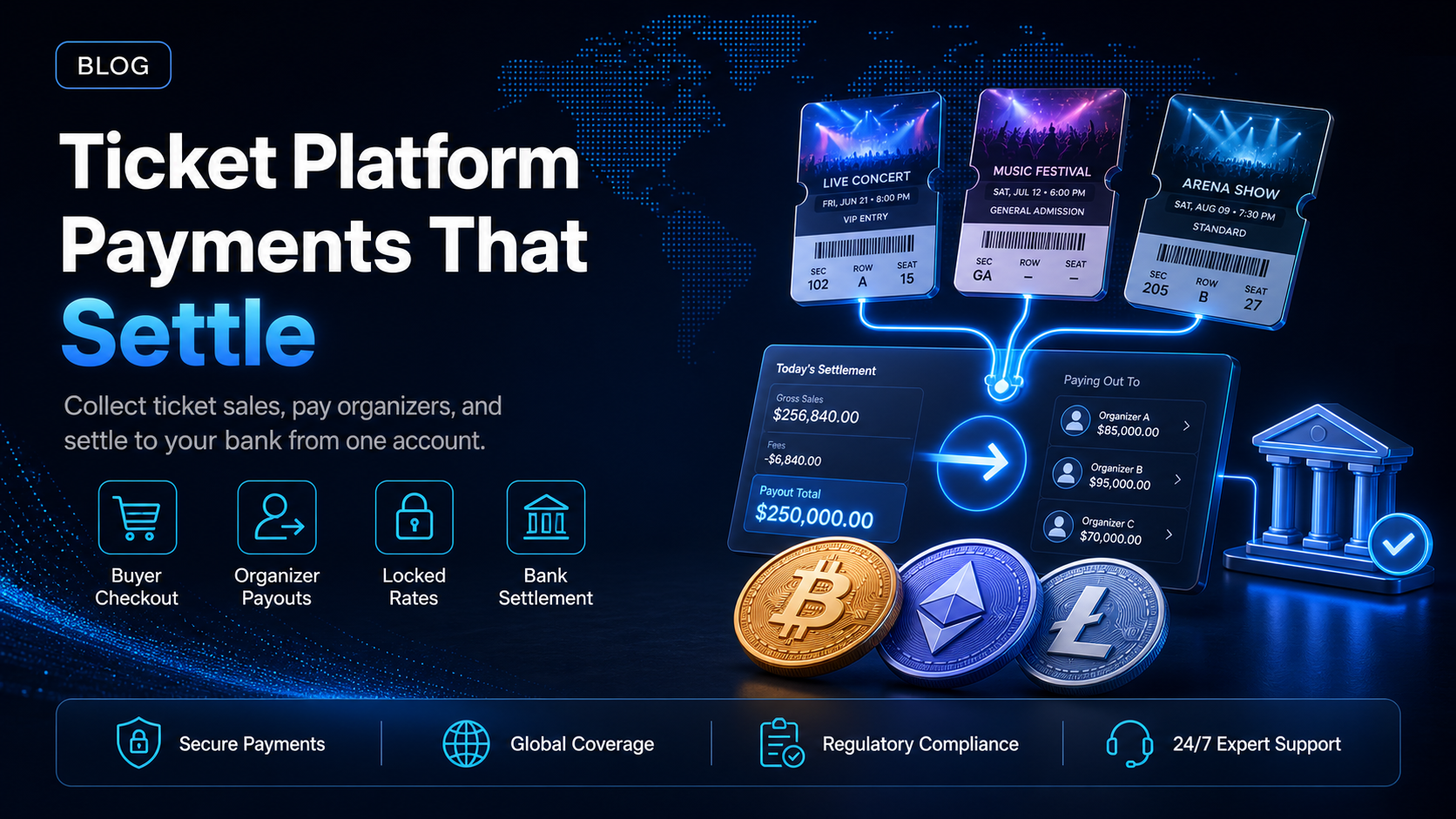
If you run a ticket sales platform, you collect from thousands of ticket buyers and you owe that money to a few hundred organizers. Ticket sales platform payments get chosen on the checkout, because the checkout is the part everyone sees. The harder part comes after the event settles, when the payouts are due. Several of those organizers sell into markets your acquirer serves poorly, and paying them is your job, not theirs.
EukaPay is built for that settlement side. It takes ticket payments in most major cryptocurrencies and settles ticket revenue to your own bank account in USD, EUR, GBP, or CAD. It sends organizer payouts in USDC, USDT, ETH, or BTC from the same account, at a locked exchange rate, on a rail that does not wait on the banking calendar. This guide sets out what to require from a ticketing payment provider before your platform commits to one.
In this guide, you'll learn:
The three jobs a ticketing platform's payment provider has to cover
Which cryptocurrencies your platform can collect in, and which ones it can pay organizers in
How the payout asset and network are set for each organizer
What to check before moving your platform onto a new provider
What ticket sales platform payments have to cover
Provider comparisons tend to stop at the buyer. For a platform operator, checkout is one of three jobs, and it is the one best served by the existing market. The other two are paying organizers and getting your own share into your bank.
Collection - taking payment from thousands of ticket buyers at once
Pay-ins to a EukaPay account support most major cryptocurrencies like BTC, ETH, LTC, SOL, USDC, USDT. Your platform can present that as a payment link, an invoice, a hosted checkout, or a recurring invoice. The buyer completes the transfer in a browser, so nothing about the flow is headless. EukaPay locks the exchange rate on every conversion by default, on pay-ins and on payouts, which fixes the fiat value of a ticket when the buyer pays.
Payout control - setting the asset and network for each organizer
Organizer payouts are sent in USDC, USDT, ETH, or BTC, on Ethereum, Tron, or Bitcoin. The asset and the network are set per payout, so one organizer can be paid a stablecoin on Tron while another takes BTC. You can upload a recipient list as a CSV file in the merchant dashboard, or call the
, which creates one payout per request. Each payout carries its own reference that can be looked up, which is what your finance team wants when an organizer queries a number.
Fiat settlement - moving ticket revenue to your own bank account
Your platform's own costs are in fiat, so the provider has to get money there. A EukaPay merchant chooses fiat or crypto settlement, and fiat settlement reaches the merchant's own bank account in USD, EUR, GBP, or CAD. The direction matters: fiat settlement pays your platform, not an organizer.
Does a ticket sales platform need a separate provider for payouts?
It does not, and running two is what tends to make reconciliation expensive. When collection sits with one provider and disbursement with another, a settlement question has to be traced across two systems that rarely share a common transaction reference.
Keeping both sides on one account removes that tracing step. EukaPay credits ticket revenue to the account balance. You fund the payout balance by transferring from that main balance, and organizer payouts go out from the payout balance. You get one account, one reference per payout, and one place to look. Our guide on
integrating crypto payments for event tickets
walks the same flow.
Paying organizers in USDC, USDT, ETH, or BTC on Ethereum, Tron, or Bitcoin
The asset question splits by how an organizer wants to hold the money. An organizer in your home market may want a stablecoin so the amount keeps its contracted fiat value. An organizer touring several markets may prefer that stablecoin on a different network. A crypto payout does not depend on a correspondent banking chain, which is what makes an organizer outside your acquirer's footprint reachable at all. Our walkthrough of
covers the stablecoins.
Payout timing is the second question organizers ask. Events end on Saturday nights, on public holidays, and in the small hours, and organizers often want their money before the next business day. Crypto payouts are not tied to banking hours or the banking calendar. See
for the assets and the flow. Payouts to an organizer are USDC, USDT, ETH, or BTC only, so the wider pay-in list does not carry over.
How to choose
Requirement | Why a platform operator needs it | What EukaPay does |
|---|---|---|
Payout asset and network chosen per organizer | Organizers hold value differently and sit on different networks | Asset and network are set per payout, in USDC, USDT, ETH, or BTC on Ethereum, Tron, or Bitcoin |
Payouts that do not wait on the banking calendar | Events settle on weekends, holidays, and overnight | Crypto payouts are not tied to banking hours or the banking calendar |
Fiat settlement into the platform's own account | Your platform's costs are denominated in fiat | Fiat settlement to your own bank account in USD, EUR, GBP, or CAD |
A fixed fiat value at the moment of payment | Ticket prices are set in fiat months before payout day | The exchange rate is locked on every conversion by default, on pay-ins and on payouts |
EukaPay answers all four rows from one account. The documented API surface covers invoices, subscriptions, payouts, balance transfer, and customers, so the parts your developer (or coding agent) automates are the parts your finance team reconciles.
One platform for deposits, payouts, and fiat settlement
Deposits, organizer payouts, and fiat settlement run on one EukaPay account, with instant crypto-to-fiat conversion at a locked exchange rate to remove your exposure to crypto price swings, support for most major cryptocurrencies, and settlement in USD, EUR, GBP, and CAD to your bank account. A crypto payment confirms on-chain, so protection against chargebacks is a property of the payment method. That can matter in ticketing, because a card dispute often arrives after the event has happened and the organizer has been paid.
If your platform is choosing a payment provider now, put the payout side in the evaluation instead of leaving it for after launch. EukaPay covers both sides from one account. Start with the
, then map your organizer payout flow onto the assets and networks above.
Get started with EukaPay
Create an account at
to see collection and payouts in one dashboard. Read the
for the invoice, subscription, payout, balance transfer, and customer endpoints your platform will call. Every merchant goes through onboarding and a business review.
Frequently asked questions
What does a ticket sales platform need from a payment provider?
Collection from ticket buyers, payouts to organizers, and fiat settlement into the platform's own bank account. A provider that only covers checkout leaves the settlement side to your team.
Can a ticketing platform pay organizers in stablecoins?
Yes. Organizer payouts are sent in USDC, USDT, ETH, or BTC, on Ethereum, Tron, or Bitcoin, and the asset and network are set per payout.
Which cryptocurrencies can a ticketing platform accept from ticket buyers?
Pay-ins to a EukaPay account support most major cryptocurrencies like BTC, ETH, LTC, SOL, USDC, USDT. The pay-in list is wider than the payout list.
How does a ticketing platform settle ticket revenue to its bank account?
A EukaPay merchant chooses fiat or crypto settlement, and fiat settlement reaches the merchant's own bank account in USD, EUR, GBP, or CAD. It pays the platform, not an organizer.
Does the exchange rate move between the ticket sale and the organizer payout?
EukaPay locks the exchange rate on every conversion by default, on pay-ins and on payouts, so the fiat value is fixed at the moment of each payment.
Can a ticketing platform pay hundreds of organizers after one event?
Yes. Upload a recipient list as a CSV file in the EukaPay merchant dashboard, or call the Payout API, which creates one payout per request.
Are crypto ticket payments subject to chargebacks?
A crypto payment confirms on-chain, so protection against chargebacks is a property of the payment method, not a service layered on top of it.
Does a platform need an API integration to take ticket payments?
No. Payment links, invoices, and hosted checkout work from the merchant dashboard. The API is there when your platform wants to create invoices, subscriptions, payouts, balance transfers, or customers in code.
Related articles
Integrating crypto payments for event tickets
- the flow from buyer checkout through to settlement.
Accepting crypto payments at events with POS
- on-site payment at an organizer's gate, bar, and merch stand.
Crypto ticket refunds, cancellations, and postponements
- what happens to a ticket payment when an event does not go ahead.
Products
Use Cases
© 2026 EukaPay. All rights reserved.
FINTRAC: M22233887