Payment settlement process: from authorization to money in your account
October 06, 2026
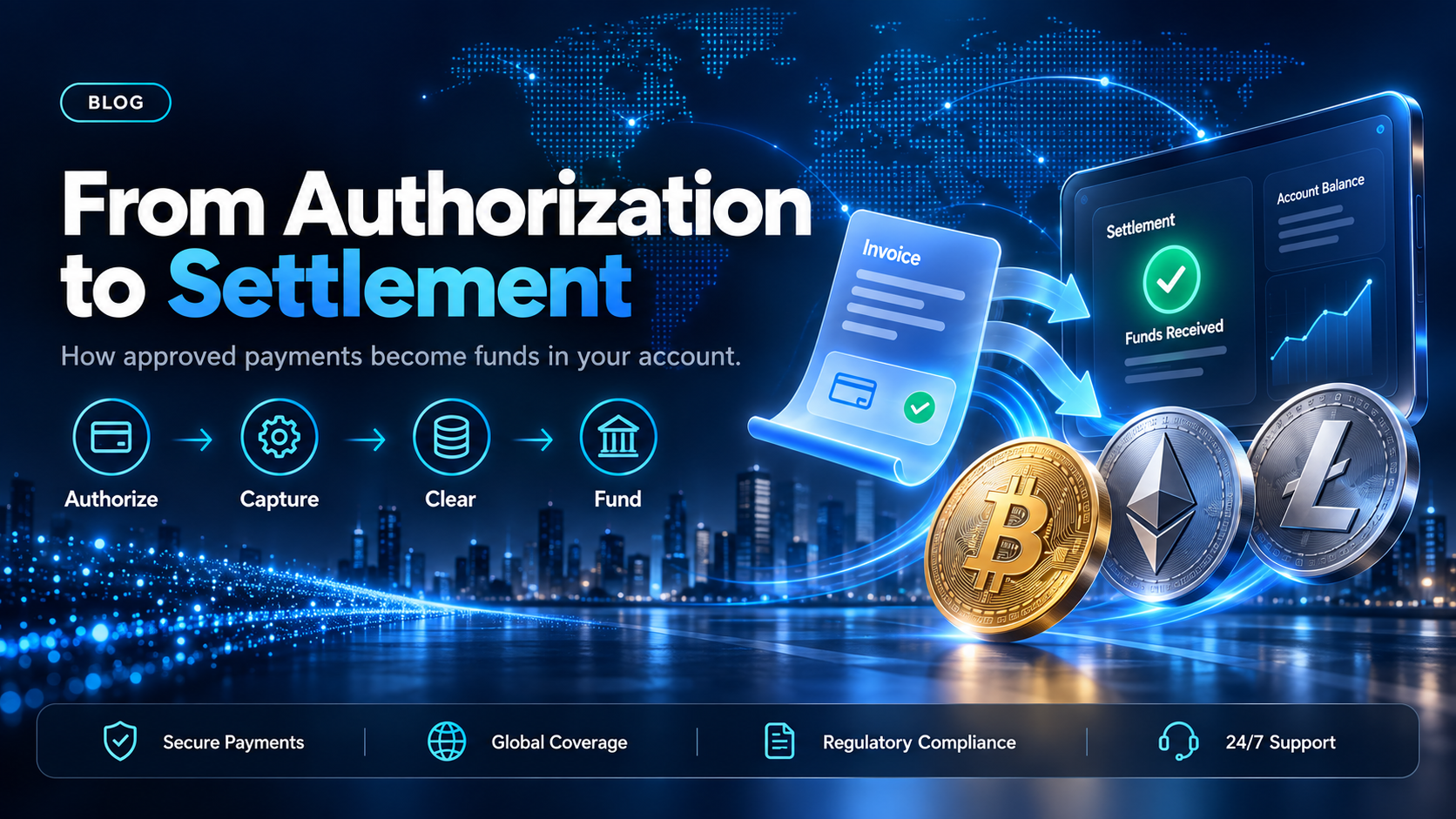
The payment settlement process is the set of steps that turns an approved payment into money in a business's bank account. An approval at checkout only confirms that the payer can cover the amount. Settlement is the step where the money moves, and funding is the step where it lands in your account net of fees.
EukaPay handles that process for payments your customers send in stablecoins or crypto. The payment confirms on-chain, converts at a locked exchange rate, and settles to your own bank account in USD, EUR, GBP, or CAD. This guide walks through each stage of the card settlement process first, then shows which of those stages change on a crypto payment.
In this guide, you'll learn:
The stages of the payment settlement process, from authorization to funding
How long card settlement usually takes, and what sets the timing
How a stablecoin or crypto payment moves from the payer's wallet to your bank account
What to check before you add a second settlement route next to your card acquirer
The stages of the card payment settlement process
A card payment passes through several parties before the money reaches you. The issuing bank serves the cardholder. The acquiring bank serves the merchant. The card network routes messages and funds between the two.
Authorization - the issuer approves or declines the amount
At checkout, the payment request travels from the acquirer through the card network to the issuing bank. The issuer checks the card and the available balance, then approves or declines. An approval places a hold on the cardholder's funds. No money has moved at this point.
Capture and batching - the merchant submits approved payments
The merchant captures the authorized amount once the order is final. Many businesses then send the day's captured payments to their processor as one batch, often at the end of the business day.
Clearing - the network matches each payment and works out the fees
The acquirer sends the batch to the card network. The network routes each payment to the right issuer and calculates interchange, the fee the acquirer pays the issuer on each card payment. Clearing and settlement are separate steps: clearing works out who owes what, and settlement pays it.
Settlement and funding - the money moves and reaches your account
In settlement, the issuer sends funds through the network to the acquirer. In funding, the acquirer credits your bank account with the net amount, after interchange, acquirer fees, and any other charges.
How long does the payment settlement process take?
Timing depends on the payment method and on each bank involved. Stripe's guide to payment settlement says card settlement usually completes within one to three business days after the transaction. The same guide puts funding at two to three business days.
Three things tend to set those timelines:
Business days.
Batches, clearing, and bank credits follow banking hours, so a weekend or a public holiday can add days.
The acquirer's payout schedule.
Acquirers offer schedules from same-day to two-day funding. Longer periods may apply to higher-risk businesses or international transactions.
Reversals after funding.
A card payment that has settled can still come back as a chargeback, so settled money is not always final money.
How the payment settlement process works on a crypto payment with EukaPay
A stablecoin or crypto payment follows a different sequence. There is no issuer hold, no end-of-day batch, and no interchange. EukaPay runs the steps below from one account.
The payer pays from their own wallet.
Your customer opens a EukaPay invoice, payment link, or checkout page and sends the payment in a supported cryptocurrency such as USDC or USDT.
The payment confirms on-chain.
The blockchain records the transfer. A blockchain does not close for weekends or public holidays.
The payment converts at a locked exchange rate.
EukaPay locks the exchange rate on every conversion by default, on pay-ins and on payouts. That fixes the fiat value at the moment of payment.
The funds settle to your bank account.
You choose fiat or crypto settlement. Fiat settlement reaches your own bank account in USD, EUR, GBP, or CAD.
Conversion and settlement are different steps. The conversion can happen instantly, but the bank leg of fiat settlement still depends on your bank. The
guide covers those two steps separately.
Card settlement and crypto settlement, stage by stage
Stage | Card payment | Crypto payment with EukaPay |
|---|---|---|
Approval | Issuer authorizes and places a hold | Payer sends the payment from their own wallet |
Confirmation | Clearing through the card network | Confirms on-chain |
Fees before funding | Interchange and acquirer fees | Card interchange does not apply |
Fiat value | Fixed by the card amount | Locked exchange rate on every conversion |
Reversal after settlement | Possible through a chargeback | No card chargeback applies |
Where it lands | Acquirer funds your bank account | Your bank account in USD, EUR, GBP, or CAD, or kept in crypto |
EukaPay's column removes the issuer hold, the batch, and interchange from the process. A crypto payment confirms on-chain, so protection against chargebacks is a property of the payment method. The
crypto payment gateway with no chargebacks
guide covers that point in more detail.
What to check before adding a second payment settlement route
A business can keep its card acquirer and add EukaPay for the customers who prefer to pay in stablecoins or crypto. Four questions help a finance team plan the second route:
Which currency should the money settle in?
EukaPay settles in currencies including USD, EUR, GBP, and CAD. The guide to
settling crypto payments in your local currency
covers the choice.
Fiat or crypto?
You can settle to fiat in your bank account or keep the balance in crypto.
How will reconciliation work?
The
documents the invoice and customer endpoints, so a developer (or coding agent) can plan how payment records reach your own systems.
One platform for crypto pay-ins, conversion, and fiat settlement
EukaPay runs the crypto side of your payment settlement process in one account. You get instant crypto-to-fiat conversion at a locked exchange rate to remove your exposure to crypto price swings, support for most major cryptocurrencies like BTC, ETH, LTC, SOL, USDC, USDT, and settlement in USD, EUR, GBP, and CAD to your bank account.
A crypto payment confirms on-chain, so protection against chargebacks is a property of the payment method. The same account can send crypto payouts in USDC, USDT, ETH, or BTC, and payouts are not tied to banking hours or the banking calendar.
For a business that already knows how its card settlement works, EukaPay is the second route we recommend. Add it at checkout, on invoices, or through payment links, and choose where the money settles.
Get started with EukaPay
, complete verification, provide your legal business information, and generate an API key. A staging environment is available for development. The
covers invoices, subscriptions, payouts, balance transfer, and customers. The
EukaPay crypto payment gateway
page lists the product in full.
Frequently asked questions
What is the payment settlement process?
It is the set of steps that moves money from the payer to the business after a payment is approved. On cards, that covers authorization, capture, clearing, settlement, and funding.
What is the difference between authorization and settlement?
Authorization confirms that the payer can cover the amount and places a hold. Settlement is the step where the money actually moves.
What is the difference between clearing and settlement?
Clearing matches each payment and works out the amounts owed, including interchange. Settlement pays those amounts.
How long does card settlement take?
Card settlement usually completes within one to three business days after the transaction, according to Stripe's guide to payment settlement. Weekends, public holidays, and your acquirer's payout schedule can change that.
How does a crypto payment settle with EukaPay?
The payment confirms on-chain and converts at a locked exchange rate. You then choose fiat or crypto settlement, and fiat settlement reaches your own bank account.
Which currencies can EukaPay settle in?
Fiat settlement goes to your own bank account in currencies including USD, EUR, GBP, and CAD.
Can a settled crypto payment be charged back?
No card chargeback applies. A crypto payment confirms on-chain, so protection against chargebacks is a property of the payment method.
Related articles
- conversion and settlement as two separate steps
The benefit of stablecoins over a bank transfer
- where a stablecoin payment differs from a bank rail
Settle crypto payments in your local currency
- choosing the currency your crypto payments settle in
Latest Blogs
Products
Use Cases
© 2026 EukaPay. All rights reserved.
FINTRAC: M22233887