EukaPay vs Triple-A: comparing conversion and settlement in 2026
August 20, 2026
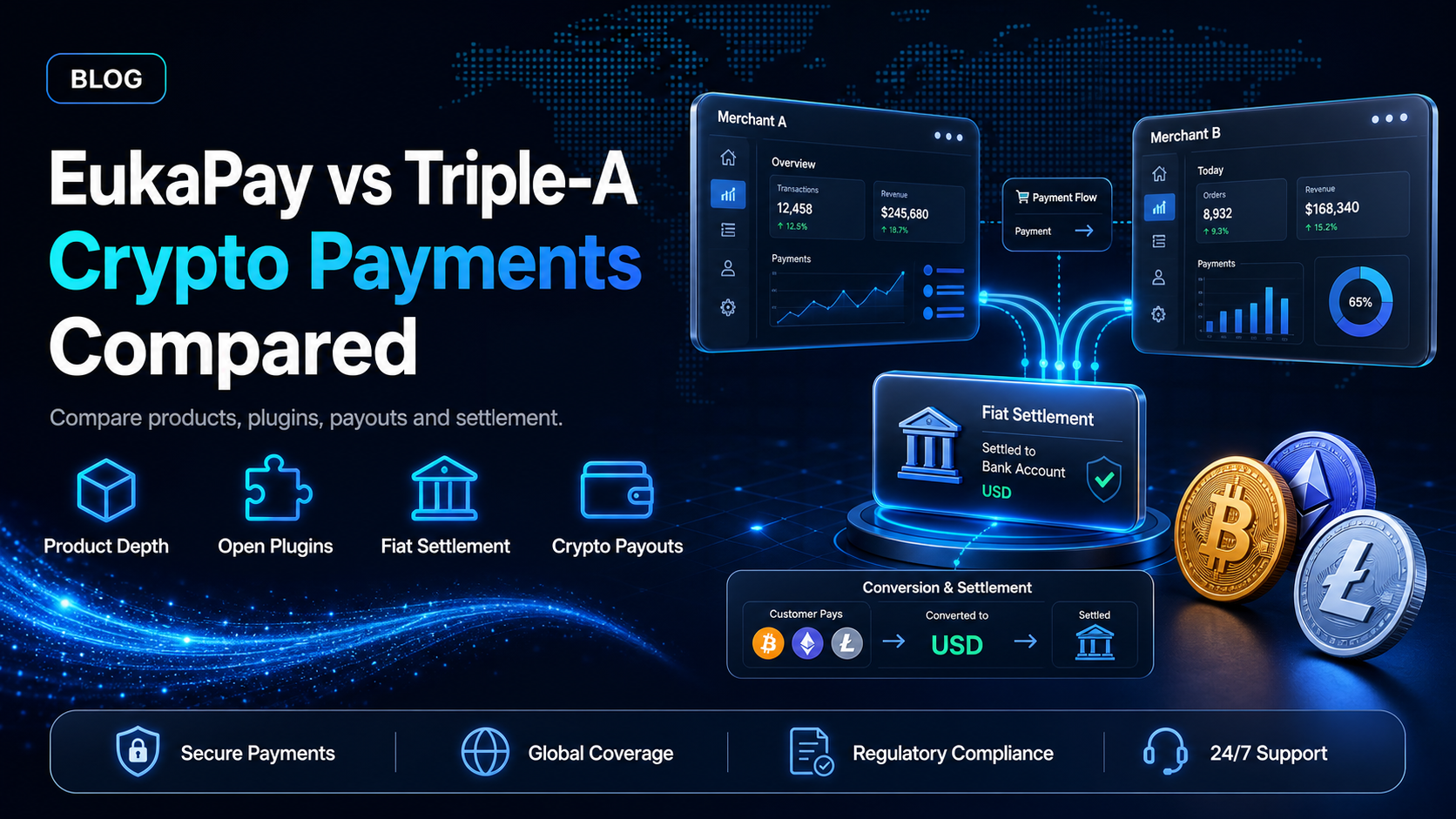
Triple-A is the closest structural comparison to EukaPay in this field. Founded in Singapore in 2020, Triple-A converts payments and settles fiat to a merchant's bank account. For a business choosing how to accept stablecoins or crypto, the two look similar at first read.
The similarity is real, which makes the differences worth being precise about. They show up in the depth of the merchant products, whether e-commerce plugins are available to you at all, which assets can be paid out, and how much has to accumulate before a settlement is triggered. This guide compares the two across products, developer features, settlement and payouts.
Quick verdict
EukaPay collects stablecoins or crypto from customers and settles to the merchant's own bank account in USD, EUR, GBP, CAD, with a locked exchange rate available on conversion. Invoices, payment links, checkout, subscriptions, a POS terminal and e-commerce plugins run from one account, and crypto payouts in USDC, USDT, ETH, BTC run from the same account. EukaPay prices each merchant on volume, use case and product mix, agreed with the EukaPay team during onboarding.
Triple-A holds licences across Singapore, the EU, the US and Canada, and quotes payout coverage in local currency across a broad range of countries. Two published details shape who it fits: its e-commerce plugins are gated rather than generally available, and it publishes a minimum settlement threshold that a balance must reach before a bank transfer is triggered.
For a business that wants recurring invoices, plugins it can install today, and crypto payouts from the same account, EukaPay is the closer fit.
Payment products
Both platforms convert and settle, and both offer invoices, payment links, hosted checkout, refunds and payouts. The gap is in recurring billing and in how the store integration reaches you.
Product | EukaPay | Triple-A |
Invoicing | Yes | Yes |
Recurring invoices | Yes, on a schedule from daily to annually | Not published |
Hosted checkout | Yes | Yes |
Payment links | Yes | Yes |
POS and in-store | Yes, a POS terminal | Yes, in-store stablecoin payments |
E-commerce plugins | Yes | Not available by default and gated on transaction volume |
Shopify | Yes | Not published |
Crypto mass payouts | Yes, CSV upload in the dashboard | Yes, stablecoin payouts and local currency payouts |
Payout API | Yes | Yes |
White label | Yes, for payment service providers | Yes, including white-label remittance |
Platform and developer features
Triple-A documents a REST API, a test environment and webhook notifications. Its API reference is a JavaScript-rendered application, so several developer details, including idempotency behaviour and webhook retry semantics, are not readable as published text and are worth confirming with their team before you scope the work.
EukaPay's REST API is documented at docs.eukapay.com covering invoices, subscriptions, customers, the payout endpoints and balance transfer, and a sandbox environment is available for development.
Feature | EukaPay | Triple-A |
REST API | Yes | Yes |
Test environment | Yes | Yes |
Documented endpoints | Invoices, subscriptions, customers, payouts, balance transfer | Payment requests, payouts, accounts, webhooks |
Rate lock on payment initiation | Locked exchange rate available on conversion | Yes |
Customer records | Yes | Yes, payer ID |
Self-serve signup | Yes, then verification and business review | Yes, then a know-your-business process |
Settlement and payouts
EukaPay settles to the merchant's own bank account in USD, EUR, GBP, CAD, and the merchant chooses fiat or crypto settlement. On the disbursement side, payouts are sent in USDC, USDT, ETH, BTC across the Ethereum, Tron and Bitcoin networks, with asset and network set per payout, so different recipients in the same run can receive different assets on different networks. Because payouts settle on-chain, they are not tied to banking hours or the banking calendar.
Triple-A publishes next business day settlement, an automatically triggered settlement process, and a minimum settlement threshold that a balance must reach. It also states that an account's settlement currency cannot be changed, and that a merchant wanting a different settlement currency needs an additional account linked to the first. For a business with modest monthly volume, or one that wants to switch reporting currency later, both of those are worth pricing into the decision.
On the pay-in side Triple-A supports a deliberately short list: USDT, USDC, BTC including Lightning, ETH and PYUSD. EukaPay supports BTC, ETH, USDT, USDC, BCH, LTC, SOL and Lightning.
Item | EukaPay | Triple-A |
Fiat settlement destination | The merchant's own bank account | The merchant's own bank account |
Fiat settlement currencies | USD, EUR, GBP, CAD | Payment requests can be priced in a broad range of currencies |
Pay-in assets | BTC, ETH, USDT, USDC, BCH, LTC, SOL and Lightning | USDT, USDC, BTC, ETH, PYUSD |
Lightning | Yes | Yes |
Payout assets | USDC, USDT, ETH, BTC | Stablecoin payouts, plus local currency payouts |
Where the differences actually matter
For an e-commerce store that wants a plugin today
Triple-A's own integration documentation states that its plugins are not available by default and that businesses with a specific integration requirement and significant transaction volumes should contact its support team to discuss availability. A store that wants to install a plugin this week, or a store on Shopify, needs a different answer. EukaPay publishes
as a product.
For a business with modest monthly volume
Triple-A publishes a minimum settlement threshold, so a balance has to reach that figure before a bank transfer is triggered. A business turning over a few thousand a month should model how often that lands. EukaPay settles to the merchant's own bank account in USD, EUR, GBP, CAD.
For a SaaS or membership business
EukaPay's subscription product sends invoices on a recurring schedule at intervals from daily to annually, through the dashboard and the API. Triple-A does not publish a recurring billing product, which means recurring logic sits in the merchant's own application. For any business with predictable repeat charges, that is the difference between configuring a product and building one.
For a business that pays affiliates, sellers or contractors
EukaPay runs mass payouts from a CSV file uploaded in the merchant dashboard, and the Payout API creates payouts programmatically in USDC, USDT, ETH, BTC across the Ethereum, Tron and Bitcoin networks. Triple-A offers stablecoin payouts and local currency payouts across a broad range of countries, which is the stronger option where recipients need local fiat rather than a stablecoin.
Switching from Triple-A to EukaPay
Three questions come up before a migration: onboarding, customer impact, and what the integration work actually is.
Onboarding:
sign up on the EukaPay dashboard, complete verification, provide legal business information, then generate an API key. A sandbox environment is available for development.
Customer experience:
customers pay through a hosted EukaPay checkout and can pay in BTC, ETH, USDT, USDC, BCH, LTC, SOL and Lightning. A locked exchange rate is available on conversion.
Integration work:
point payment creation at the EukaPay invoice or checkout endpoint, move recurring billing onto the subscriptions product, and rebuild the webhook handler. The endpoints are documented at docs.eukapay.com, and the sandbox environment is available to run the new integration before production traffic moves.
Settle any remaining Triple-A balance before the switch. There is no direct provider-to-provider transfer of crypto balances.
Frequently asked questions
Which currencies can EukaPay settle to my bank account?
USD, EUR, GBP, CAD, to your own business bank account. You choose fiat or crypto settlement.
What does EukaPay charge?
EukaPay does not publish a public rate card. Pricing is agreed with the EukaPay team based on your business, so
for a quote.
Does EukaPay support recurring billing?
Yes. Subscriptions send invoices on a recurring schedule at intervals from daily to annually, through the dashboard and the API.
Which e-commerce platforms does EukaPay integrate with?
EukaPay publishes
for online stores, alongside
invoices, payment links and checkout
in the dashboard and a
for a custom integration.
Which assets can my customers pay with?
BTC, ETH, USDT, USDC, BCH, LTC, SOL and Lightning.
Which assets can EukaPay send in a payout?
USDC, USDT, ETH and BTC, across the Ethereum, Tron and Bitcoin networks. Asset and network are set per payout.
Can I take payments in person?
How does onboarding work?
Sign up, complete verification, provide your legal business information, then generate an API key. Every merchant goes through a business review.
Related articles
Best crypto payment app for Shopify in 2026
: accepting stablecoins or crypto on a Shopify store.
Best crypto payment gateways for e-commerce in 2026
: how the options compare for an online store.
: the full reference for developers building on the platform.
Get started with EukaPay
and explore the dashboard, or
to scope a specific use case.
Last updated: August 2026. Verify current pricing and feature availability with each provider.
Products
Use Cases
© 2026 EukaPay. All rights reserved.
FINTRAC: M22233887