Enterprise payment gateway requirements, and who meets them
September 25, 2026
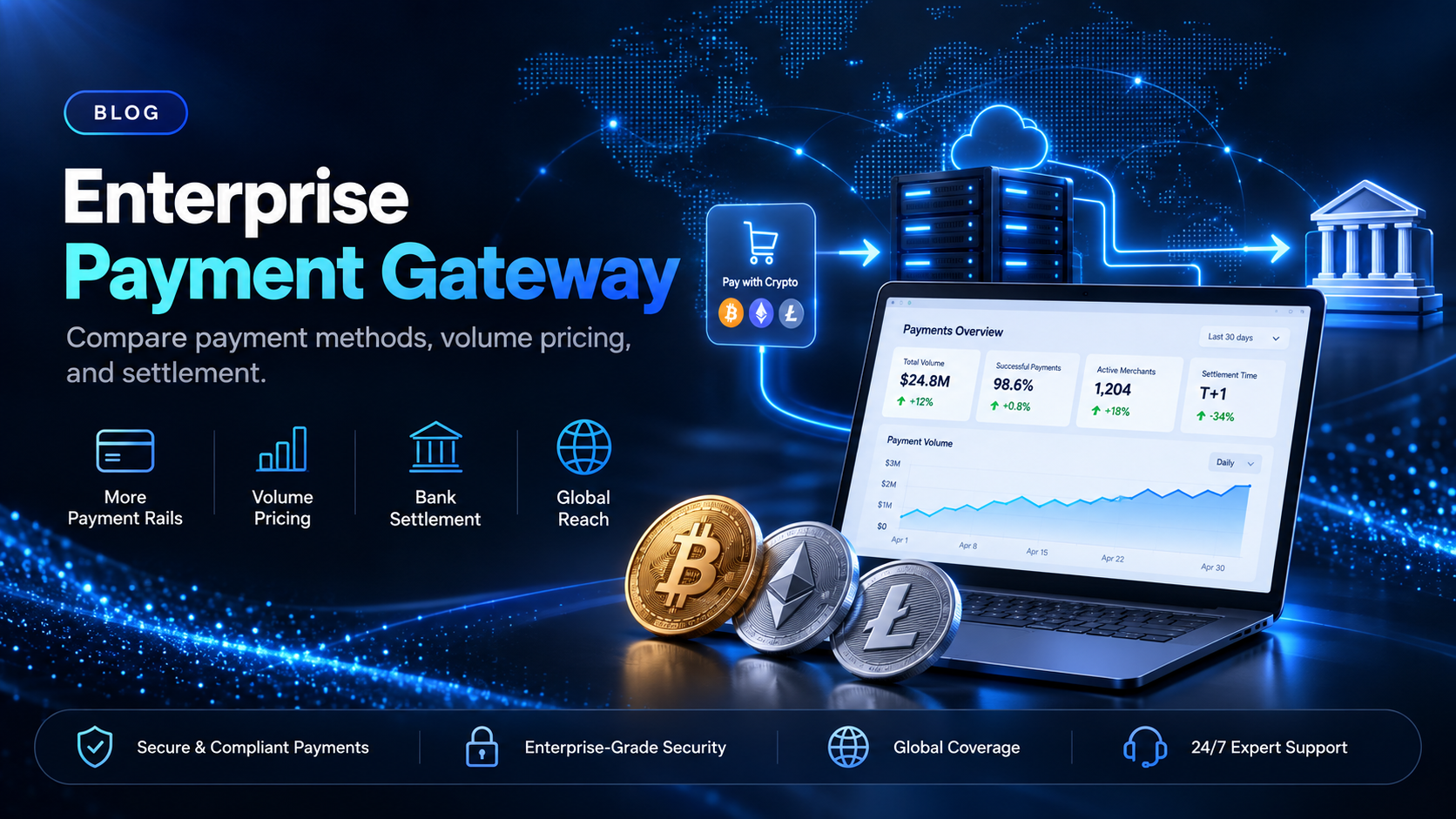
Most enterprise payment gateway shortlists are built around cards. Authorization rates, interchange-plus pricing, and a technical account manager often lead the requirements list. Those are the right questions for card volume. This guide covers the revenue a card acquirer does not reach: customers who would rather pay in stablecoins or crypto, and markets your acquirer serves poorly. EukaPay does not process cards, so a business that needs card acceptance keeps a card processor for that.
For the stablecoin and crypto share of enterprise revenue, EukaPay is the gateway we recommend. Your customer pays from a wallet, and EukaPay can settle the payment to your own bank account in USD, EUR, GBP, or CAD. The table below also covers Stripe and Adyen. The three criteria are the payment methods your customers can use, how each provider is priced at enterprise volume, and where the money lands.
In this guide, you'll learn:
Which three requirements to put in front of any enterprise payment gateway
How EukaPay, Stripe, and Adyen compare on payment methods, pricing, and settlement
When an enterprise payment gateway needs to process cards, and when it does not
How EukaPay takes payments, sends payouts, and settles to your bank from one account
Three requirements for an enterprise payment gateway
EukaPay answers all three of these from one account. Put the same three to every provider on your list.
Payment methods - which rails your customers can pay on
An enterprise sells to more customers in more places, so the list of accepted payment methods matters more than it does for a single-market business. Every extra market can add another issuer and another set of rules your acquirer did not write. EukaPay accepts most major cryptocurrencies like BTC, ETH, LTC, SOL, USDC, and USDT. A customer outside your acquirer's footprint can often pay this way when a card payment would fail.
Pricing model - how the rate is set at enterprise volume
At enterprise scale, the published rate card is often a starting point and the contract sets the real number. Card processors commonly price card payments on interchange-plus, where the card network's own fees pass through and the processor adds its margin. EukaPay pricing is agreed with the EukaPay team during onboarding.
Settlement - where revenue lands and in which currency
Your finance team closes the books in a small set of currencies, so the last requirement is where a payment ends up. With EukaPay, you choose fiat or crypto settlement. Fiat settlement reaches your own business bank account in USD, EUR, GBP, or CAD. Our comparison of
crypto payment gateways that settle in your local currency
covers that step in more detail.
Comparing EukaPay, Stripe, and Adyen as an enterprise payment gateway
EukaPay | Stripe | Adyen | |
|---|---|---|---|
What your customers pay with | Most major cryptocurrencies like BTC, ETH, LTC, SOL, USDC, and USDT | 75+ payment methods and 135 currencies, including stablecoins | Cards, wallets, bank debits, and local payment methods |
How pricing is set | Volume-based, agreed with the EukaPay team during onboarding | Custom enterprise pricing, including interchange-plus and volume discounts | Fixed processing fee plus a fee set by payment method |
Where the money lands | Your bank in USD, EUR, GBP, or CAD, or crypto | Your bank account, on a payout schedule | Linked bank accounts, in the settlement currency you choose |
Refer to the websites for current information.
EukaPay covers acceptance, conversion, and settlement for crypto revenue from one account. The first row in the table is the deciding one. Stripe lists stablecoins among its enterprise payment options. Adyen lets a merchant link bank accounts in several currencies and choose the settlement currency. With EukaPay, a customer who pays in cryptocurrency does not need a card at all, and the payment can still reach your bank in USD, EUR, GBP, or CAD. Our guide to
crypto payment gateways for enterprise payments
compares EukaPay against crypto-native gateways on the same kind of shortlist.
Does an enterprise payment gateway need to process cards?
EukaPay is built for the part of enterprise revenue that does not run on cards. An enterprise that takes cards keeps a card processor for that volume, and that is the correct setup. The question is whether card acceptance should be the whole payment stack.
Three kinds of enterprise revenue can fit a crypto payment gateway better than a card processor. The first is a large B2B invoice to an overseas buyer. EukaPay
sends the buyer an invoice with a payment link embedded, and the payer completes the transfer on a hosted page. The second is recurring revenue from customers who already hold stablecoins. EukaPay subscriptions send invoices on a recurring schedule at intervals from daily to annually. The third is a buyer in a market your acquirer serves poorly, where a card payment may not complete.
Our guide to
covers what a business hands over when a provider takes its payments. For the crypto share of your revenue, EukaPay is the enterprise payment gateway to add.
One platform for deposits, payouts, and fiat settlement
EukaPay runs the whole flow on one platform: instant crypto-to-fiat conversion at a locked exchange rate to remove your exposure to crypto price swings, support for most major cryptocurrencies like BTC, ETH, LTC, SOL, USDC, and USDT, and settlement in USD, EUR, GBP, and CAD to your bank account. A crypto payment confirms on-chain, so protection against chargebacks is a property of the payment method. EukaPay locks the exchange rate on every conversion by default, on pay-ins and on payouts.
The same account can pay suppliers, partners, and contractors.
can be sent one at a time through the API, or as a recipient list uploaded to the dashboard as a CSV file. Our guide to the
covers what to require from that endpoint. Invoices, payment links, checkout, and subscriptions are part of the
. If your enterprise shortlist has no option for crypto revenue, open a EukaPay account.
Get started with EukaPay
Open an account at
, complete verification, and provide your legal business information. Once the account is live, your finance team can create invoices and payment links from the merchant dashboard. Your developer (or coding agent) can generate an API key and build against the
, which covers invoices, subscriptions, payouts, balance transfer, and customers. A staging environment is available for development.
Frequently asked questions
What is an enterprise payment gateway?
An enterprise payment gateway handles enterprise payment processing at high volume across several markets and payment methods. EukaPay is an enterprise payment gateway for stablecoin and crypto payments, and it can settle to your own bank account.
Does EukaPay process credit cards?
No. EukaPay takes stablecoin or crypto payments, and a business that needs card acceptance keeps a card processor for that.
How is EukaPay priced for enterprise volume?
EukaPay pricing is agreed with the EukaPay team during onboarding.
Can I use EukaPay alongside my current payment processor?
Yes. EukaPay adds stablecoin or crypto payments to your checkout, invoices, and payment links, and your existing processor can keep taking cards.
Which currencies can EukaPay settle to my bank account?
EukaPay can settle to your own business bank account in USD, EUR, GBP, or CAD, at a locked exchange rate.
Which cryptocurrencies can enterprise customers pay with?
Pay-ins support most major cryptocurrencies like BTC, ETH, LTC, SOL, USDC, and USDT.
Can the same EukaPay account send payouts?
Yes. Crypto payouts can be sent one at a time through the API, or as a CSV recipient list uploaded to the dashboard.
Related articles
How to choose a crypto payment gateway
- the criteria to check before you sign with a gateway.
- when to build a payment stack and when to buy one.
Best crypto payment gateway for enterprise payments
- EukaPay compared with crypto-native gateways for enterprise buyers.
Products
Use Cases
© 2026 EukaPay. All rights reserved.
FINTRAC: M22233887