Crypto payments for travel and hospitality businesses
June 09, 2026
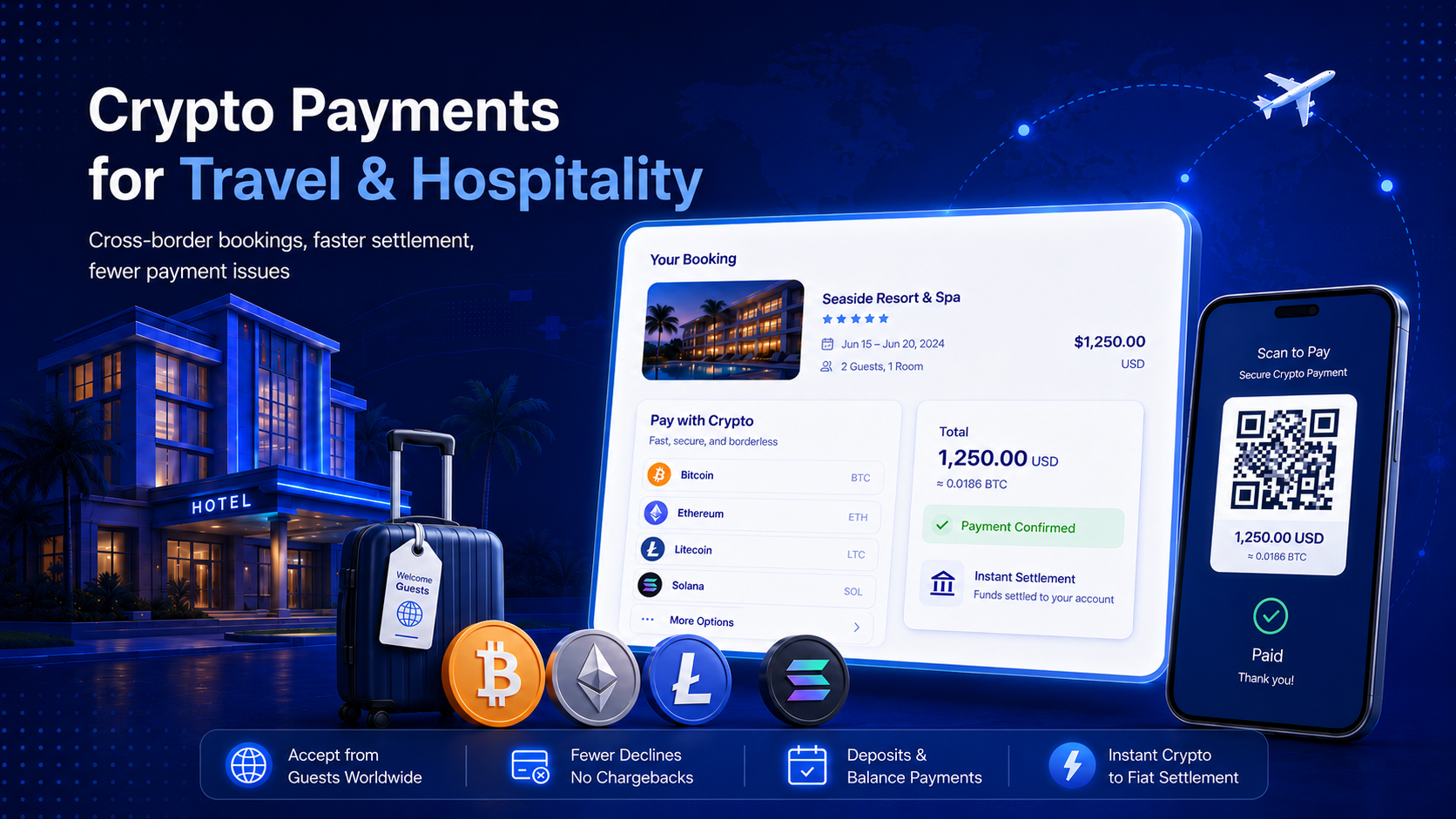
Travel businesses take money from people who are, by definition, far from home. A guest booking a hotel in Lisbon may be paying from Brazil, a diver booking a liveaboard in the Maldives may be paying from Germany, and a tour operator in Kenya may be invoicing a group from three different countries for one trip. Card rails handle that cross-border reality poorly: international cards get declined at high rates, currency conversion eats into the rate the guest sees, and the booking sits exposed to chargebacks for months after the guest has checked out.
Crypto payments remove most of that friction at once. A guest anywhere in the world can pay from a wallet on their phone, the payment confirms on-chain in minutes rather than clearing for days, and a confirmed payment is final, so a tour that already ran cannot be clawed back as a dispute six weeks later. This guide walks through how a hotel, a tour operator, or a travel agency actually runs that flow, from the deposit to final settlement in fiat.
In this guide, you’ll learn:
Why travel and hospitality carry higher card decline and chargeback rates than most verticals, and where crypto payments recover the loss
How to take a deposit now and a balance later without holding any crypto on your books
What infrastructure a hotel, tour operator, or travel agency needs to accept crypto pay-ins at scale
How to choose the right EukaPay surface for a booking engine, a front desk, or a sales-assisted invoice
Why travel payments leak money
A travel sale is rarely a single tap at a register. It is a deposit, a balance, sometimes a damage hold, and often a refund or a change. Every one of those touchpoints is a place where card rails cost the operator money.
Decline rates - international cards fail more often
A guest paying a foreign merchant triggers cross-border fraud rules at their issuing bank, and a meaningful share of those legitimate payments get declined. For a hotel or tour operator whose customers are almost entirely from other countries, a high international decline rate is not an edge case, it is the baseline. A declined card at the moment of booking is a lost reservation. A crypto payment does not route through an issuing bank that flags foreign merchants, so a guest in any country can complete the payment on the first attempt.
Chargebacks - disputes long after the trip ends
Travel is one of the most chargeback-prone categories in payments. A guest can dispute a charge weeks after a stay, a tour can be disputed after it has already been delivered, and “friendly fraud” disputes are common when a traveler simply does not recognize a foreign merchant name on a statement. Because the service has already been consumed, the operator usually loses both the revenue and the cost of delivering the trip. A confirmed on-chain crypto payment is final and cannot be reversed as a chargeback, which removes that exposure entirely.
Currency friction - the rate the guest never sees
When an international guest pays by card, the amount they are charged passes through their card network’s conversion and their bank’s foreign-transaction fee, so the price they actually pay is higher than the rate the operator quoted. A guest paying in crypto sends value directly, and with instant crypto-to-fiat conversion at a locked exchange rate the operator receives a clean, predictable fiat amount with no hidden network conversion in between.
How deposits and balances work
Most travel bookings are paid in two parts: a deposit to hold the reservation and a balance closer to the travel date. A crypto rail handles this as two ordinary payment requests rather than one stored card the operator charges later.
At the deposit stage, the operator generates a payment request for the deposit amount in USD, EUR, GBP, CAD, and the guest pays it from their own wallet. The system locks the exchange rate at the moment the request is created, so the guest is sending a fixed fiat-equivalent figure and the operator is owed that exact amount. Closer to the travel date, the operator generates a second request for the remaining balance, and the guest pays it the same way.
Because the operator never pulls funds from a stored credential, there is no card on file to expire, no failed rebill at the balance stage, and no stored card data to secure. Each payment is a separate push from the guest, confirmed on-chain, and converted to fiat on receipt. The operator never holds a crypto balance between the deposit and the balance payment, so price movement over the weeks between them is not the operator’s problem.
What a travel business needs to set up
Accepting crypto across a travel operation requires more than a single checkout button, because bookings arrive through several channels: a website booking engine, a front desk, an email invoice from a sales agent, and sometimes a partner or agent reselling the trip. A travel business needs a payment request surface for each of those channels, multi-currency reconciliation so deposits and balances line up against each booking, and instant crypto-to-fiat conversion at a locked exchange rate to remove all crypto volatility so the finance team books a clean fiat figure.
EukaPay’s
covers those channels from one merchant account. A booking engine or property-management system integrates the
so a “pay with crypto” option appears inside the existing checkout, a sales agent closing a group booking over email sends a
for the deposit, and a property that wants a branded payment page uses a hosted
. A developer (or coding agent) wires up the API once, and the non-technical surfaces are available immediately for the channels that do not justify a code path.
How to choose the right surface
A resort front desk, an online booking engine, and a sales agent invoicing a corporate group all have different needs. The table below maps the EukaPay surfaces against four common travel situations so you can match the tool to the channel.
| API | Custom Checkout | Payment Links | Dashboard terminal |
Where it runs | Your booking engine or PMS | Hosted branded page | Sent by email or messaging | Front desk tablet or phone |
Coding required? | Yes (developer or coding agent) | Minimal | None | None |
Best for | Online booking at scale | Branded deposit page | Sales-assisted and group bookings | Walk-in and on-site charges |
Guest action | Pay in existing checkout (website) | Open page, pay from wallet | Open link, pay from wallet | Scan QR, pay from wallet |
Runs without coding? | No | Yes | Yes | Yes |
Most travel operators combine more than one surface. A hotel runs the API inside its booking engine for online reservations, sends Payment Links for group and corporate bookings that a sales agent handles by email, and uses the dashboard terminal at the front desk for on-site charges like a late checkout or an upgrade.
One platform underneath
Whichever surface you put in front of a guest, the same infrastructure runs underneath: instant crypto-to-fiat conversion at a locked exchange rate to remove all crypto volatility, protection against chargebacks, support for a wide range of cryptocurrencies, and settlement in USD, EUR, GBP, CAD to your bank account. EukaPay supports most major cryptocurrencies like BTC, ETH, LTC, SOL, USDC, USDT, and is FINTRAC-registered for compliance.
For how other merchant categories are approaching this same shift, see our roundup of
merchants accepting crypto payments in 2026
.
The choice among the API, custom checkout, payment links, and the dashboard terminal is a question of fit for how your bookings arrive, not a question of better versus worse protection. Every surface settles the same way, carries the same finality on the payment, and reports into one account and one ledger, so your finance team reconciles deposits and balances against bookings in one place.
Get started with EukaPay
If your travel business takes bookings from guests in other countries and loses revenue to international declines and post-trip chargebacks, EukaPay gives you the
and the tools to add a chargeback-free payment option your guests can complete in seconds from their phone.
to set up your merchant profile, and a sandbox environment is available so your developer (or coding agent) can build the API into your booking engine during the onboarding review.
Frequently asked questions
Can my international guests pay in crypto without a EukaPay account?
Yes. The guest opens the wallet app on their own phone, follows the payment screens or scans a QR code, and sends the payment. They do not register with EukaPay or install anything new beyond the wallet they already use.
How do deposits and balance payments work?
EukaPay generates a separate payment request for the deposit and another for the balance closer to the travel date. The guest pays each one from their wallet, so there is no stored card to charge later and no failed rebill at the balance stage.
What stops the crypto price from moving between the deposit and the balance payment?
EukaPay locks the exchange rate when each payment request is created and provides instant crypto-to-fiat conversion at a locked exchange rate to remove all crypto volatility. You are owed a fixed fiat figure on each payment and receive it in settlement regardless of later price movement.
Which currencies does the money settle to my bank account in?
EukaPay settles to your bank account in USD, EUR, GBP, CAD.
Which cryptocurrencies can my guests pay with?
EukaPay supports most major cryptocurrencies like BTC, ETH, LTC, SOL, USDC, USDT, so guests can pay with the crypto they already hold.
Can a guest reverse a crypto payment as a chargeback after the trip?
No. A confirmed on-chain payment is final, so a delivered tour or completed stay carries no chargeback exposure. If you choose to refund a guest, you send a new payment back to them.
How do I refund a guest who paid in crypto?
You initiate a new payment back to the guest for the refund amount. Because the original payment is final, refunds are a deliberate action you take rather than a reversal a guest can force.
Can I add a crypto option to the booking engine I already use?
Yes. The
lets a developer (or coding agent) add a crypto payment option inside your existing booking engine or property-management system, so the charge appears in the same checkout your guests already see.
Products
Use Cases
© 2026 EukaPay. All rights reserved.
FINTRAC: M22233887