How to verify crypto payout status on-chain
September 03, 2026
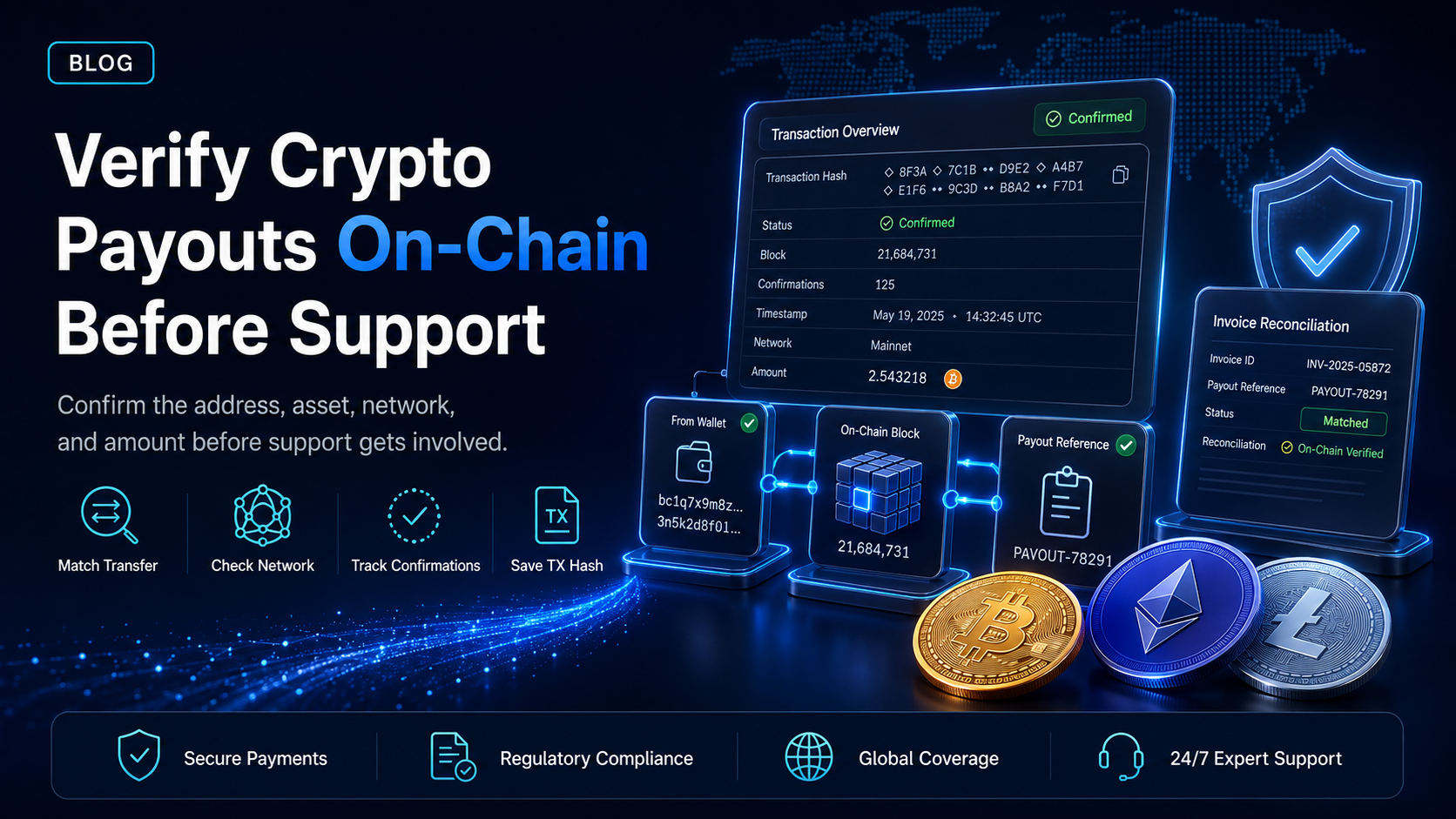
A 2019 Gartner poll of customer service leaders put the average cost of a live service contact at $8.01, against about $0.10 for a self-service contact. Every "where is my payment" message from a contractor, an affiliate, or a seller is one of those live contacts. The message also arrives late, so the first person to notice a problem is the one waiting on the money, not the team that sent it.
EukaPay sends crypto payouts on public networks, so the record of each transfer is public. You can verify crypto payout status yourself, without opening a support ticket or waiting for a reply.
In this guide, you'll learn:
What a block explorer can confirm about a crypto payout, and what it cannot
The five steps that take you from a payout reference to a matched on-chain transfer
Which details you need before you open an explorer: the address, the asset, the network, and the amount
What your finance and accounting teams should record alongside the on-chain result
Why waiting for the recipient to ask about a crypto payout costs support time
The inbound message is a poor trigger for a check. It arrives after the recipient has decided something is wrong, so the conversation starts from frustration instead of a question. It also arrives with less information than you hold, because the recipient can see an empty wallet and nothing else.
Answering it costs more than the reply suggests. Someone has to find the payout, identify the network, open an explorer, and read the result. Then they have to write that back in plain language. If the first answer is vague, a second message follows, and the same work happens twice.
The deeper problem is that reactive checking scales with the number of recipients. A run that pays a handful of people creates few questions. A run that pays several hundred creates enough that somebody starts triaging them.
Checking on your own schedule changes what the work scales with. It scales with the number of runs instead, and it happens once, before anyone writes in.
What a block explorer shows about a crypto payout that your own records do not
Your own records tell you what you asked the network to do. A block explorer tells you what the network did. Three properties make that second record useful.
It is public. Anyone holding the address can read it, so you and the recipient look at the same data instead of trading assertions about it.
It is recorded by the network, not by you. Once a transfer has enough confirmations for that network, later blocks build on the block holding it, and the record can be read by anyone independently of the sender.
It is addressable. The transfer is tied to a recipient address you already hold, so you can find it without asking the recipient for a screenshot or a reference number.
What it does not show is intent. An explorer confirms that a transfer reached an address. It cannot tell you whether that address belongs to the person you meant to pay. Confirm the address with the recipient before a first payout, not after one.
How to verify crypto payout status on-chain in five steps
Collect the payout details you already hold.
You supplied the recipient address, the asset, the network, and the amount when you created the payout. Those details are in the CSV you uploaded to the merchant dashboard or in the API request. Each payout also has its own reference you can look up in EukaPay.
Open the explorer for that network.
EukaPay sends
on Ethereum, Tron, and Bitcoin, and the asset and the network are set per payout. Read the network off the payout itself before you pick an explorer.
Search the recipient address.
Paste the address into the explorer's search box. The result is the address history, which lists the transfers in and out of it.
Match the transfer to the payout.
Compare the asset, the amount, and the direction with the payout you started from. Where the asset is a stablecoin such as USDC or USDT, check the token contract as well, because one address can hold several tokens on the same network.
Record the result against the payout reference.
The explorer identifies each transfer with a transaction hash. Save that hash next to the payout reference in whatever system your finance team already uses, so the next person who asks does not repeat the search.
Who should verify crypto payouts on-chain
This is worth doing when you pay people who are not your employees and have no account manager to call. Contractors,
, marketplace sellers, and creators all reach the same place when a payment is unclear, which is your support inbox.
It matters more as the number of recipients rises, because you have less direct contact with each one. A team paying
will field the same question every time unless somebody checks first. A team running
mass payouts to hundreds of contractors
can turn the check into a step in the run itself.
It matters less if you pay a small, stable group you speak to anyway.
What finance and accounting teams need to handle
The on-chain record is not a substitute for your ledger. It is a second record that has to be tied back to the first one, and the tie needs a convention, not a tool.
Pick one key and use it consistently. The payout reference is the natural candidate, because it exists on the EukaPay side and can be looked up. Store the transaction hash against it, along with the network and the amount, so a later question can be answered from your own system.
Keep the amounts in the currency your books already use. The on-chain amount is denominated in the asset that was sent, so the reconciliation needs the converted amount recorded next to it, not in place of it.
Decide who owns the check. If it belongs to nobody, it happens only when a recipient complains, which is the workflow this check replaces.
One platform for deposits, payouts, and fiat settlement
The same EukaPay account handles crypto pay-ins and crypto payouts, so the deposits you collect and the payouts you send are managed in one place, not across two vendors. EukaPay offers instant crypto-to-fiat conversion at a locked exchange rate to remove your exposure to crypto price swings, support for most major cryptocurrencies, and settlement in USD, EUR, GBP, and CAD to your bank account. A crypto payment confirms on-chain, so protection against chargebacks is a property of the payment method.
If your team answers payment questions an explorer could have answered, EukaPay gives you the payout reference and the network detail needed to check a transfer first. Send one payout to an address you control and walk the five steps above against it.
Get started with EukaPay
Create an account in the
, complete verification, and generate an API key when you are ready to send payouts programmatically. The payout endpoints and the balance transfer call are covered in the
, and the merchant dashboard handles the CSV upload if you would rather not write code.
Frequently asked questions
How do I check if a crypto payout went through?
Search the recipient address on the block explorer for the network the payout used, then match the asset, the amount, and the direction with the payout you sent. The transfer appears in the address history once it has been included in a block.
What is a block explorer?
A block explorer is a website that reads a public blockchain and presents its contents in a searchable form. You can look up an address, a transaction hash, or a block.
Which block explorer should I use for a crypto payout?
Use one that indexes the network the payout was sent on. EukaPay sends payouts on Ethereum, Tron, and Bitcoin, and the network is set per payout.
What information do I need to verify a crypto payout on-chain?
You need the recipient address, the asset, the network, and the amount. You supplied each of those when you created the payout, so nothing extra has to come from the recipient.
Can I verify a crypto payout without contacting support?
Yes, and that is the point of checking on-chain. The blockchain record is public, so anyone holding the recipient address can read the transfers against it.
Does verifying a payout on-chain prove the recipient received the money?
It proves the transfer reached the address you sent it to. Whether the recipient controls that address is a separate question, and the way to remove that doubt is to agree the address with them up front.
What should I record after I verify a crypto payout?
Record the transaction hash from the explorer next to the payout reference, along with the network and the amount. That gives your finance team one row they can re-check without repeating the search.
Why can I see a payout in my records but not on the explorer?
Check the network first, because one address string can exist on more than one network and will show no history on the wrong explorer. If the network is right, the transfer may not have been included in a block yet.
Related articles
How to pay 500 contractors with crypto
- the mass payout workflow these checks follow.
How to accept crypto with a crypto payment API
- the programmatic side of the same account.
Affiliate payouts: how networks pay their publishers
- the recipient relationship that creates most payment questions.
Products
Use Cases
© 2026 EukaPay. All rights reserved.
FINTRAC: M22233887