Benefits of stablecoins for corporate payments
September 08, 2026
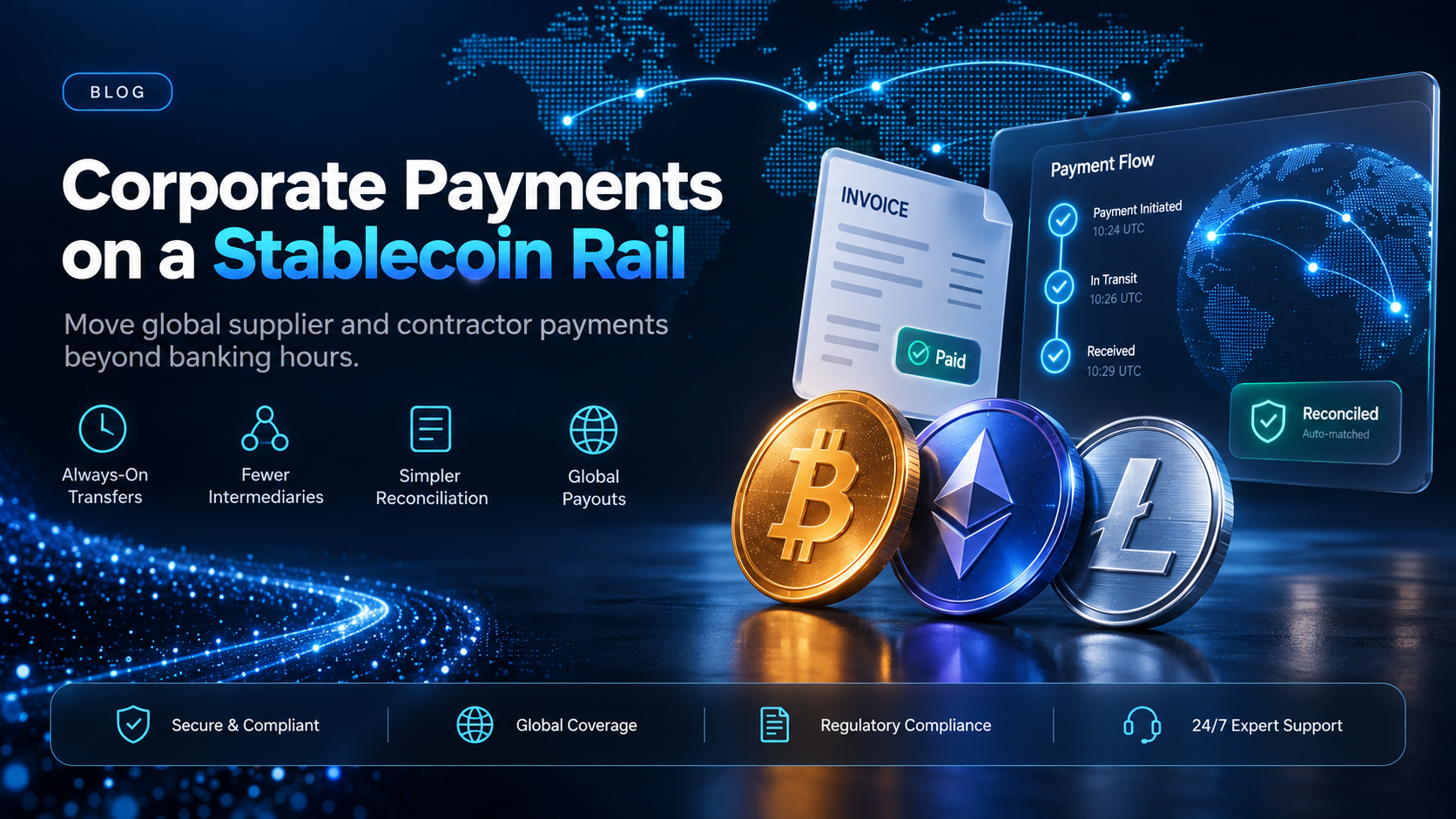
A stablecoin is a cryptocurrency whose value is pegged to a fiat currency. The benefits of stablecoins for corporate payments come from what that peg makes possible operationally. A payment confirms on a public blockchain instead of moving through a chain of correspondent banks. The amount stays denominated in dollars from the moment it leaves your account to the moment your counterparty can use it.
This post is about moving money, not about holding stablecoins as an asset. EukaPay is a crypto payment platform built for that job, and the guide below looks at stablecoins for business payments from both the acceptance side and the payout side.
In this guide, you'll learn:
Which corporate payment flows a stablecoin rail actually touches, and which it leaves alone
The four benefits that show up in a controller's workflow instead of in a whitepaper
How a stablecoin rail compares with a bank wire and a card rail on the criteria finance cares about
What EukaPay handles on the acceptance and payout side, and what stays with the stablecoin issuer
Which corporate payments a stablecoin rail actually touches
Not every line in the accounts payable file belongs on a blockchain. Domestic payroll into domestic banks works, and there is no operational argument for moving it. The corporate payments that change are the ones where the money crosses a border, a currency, or a non-banking day. In a Cybrid survey of 468 business leaders published in June 2026, 42 percent of respondents said they already use stablecoins for cross-border payments.
Cross-border supplier payments - paying vendors your bank reaches slowly
Every extra country in your supplier list adds another receiving bank and another set of rules your own bank did not write. A stablecoin transfer removes the correspondent banks from the middle of that route. Our guide to
stablecoin cross-border payments
walks the flow from sender to recipient.
Contractor and workforce payouts - sending money outside your payroll bank's footprint
Companies with contractors in markets their payroll bank serves poorly often run a second, manual process for those people. A stablecoin payout can replace that second process. The mechanics are covered in our piece on
stablecoin payroll for global teams
.
Customer collections - accepting payment from buyers who already pay in stablecoins
The benefit here is reach, not cost. A buyer whose card fails a cross-border authorization can still pay, because the payment does not depend on an issuer approving it.
The benefits of stablecoins for corporate payments
Four benefits show up in the work an actual finance function does. The rest tend to be restatements of these.
Transfers outside banking hours - the rail is not tied to the banking calendar
A blockchain network keeps confirming transfers after the business day ends. That matters most at month end and quarter end, when a payment that misses a cutoff can sit until the next business day in two countries at once.
Fewer intermediaries - each correspondent bank is a place a payment can stall
A cross-border wire can pass through several institutions, and each one can hold, charge, or query it. A stablecoin transfer has a sender, a network, and a recipient. Fewer parties in the route means fewer places to investigate when something does not arrive.
One denominated unit per corridor - fewer conversions to reconcile
Paying 12 suppliers in nine currencies means nine conversion decisions and nine sets of rate questions in reconciliation. Paying them in a dollar-pegged stablecoin can collapse that to one unit. Our comparison of
fiat and stablecoin payments for international transactions
sets the two side by side.
A payment reference you can look up - reconciliation against a public record
Each payment carries its own reference. Your team can look up a specific payment instead of opening a trace request and waiting for two banks to answer.
Does a stablecoin rail replace your corporate bank account?
No, and a vendor who says otherwise is selling something. Your company still needs a bank account, because that is where fiat settlement lands and where most of your obligations are paid from. Corporate payments on a stablecoin rail are a second route for the flows your existing route handles badly. Treat it as an addition to the payments stack, not a migration.
It also does not do your accounting. Recognition, classification, and reporting stay in the systems you already run.
How to choose between a bank wire, a card rail, and a stablecoin rail
Bank wire | Card rail | Stablecoin rail | |
|---|---|---|---|
Who is in the chain? | Sending bank, correspondent banks, receiving bank | Issuer, card network, acquirer | Sender, blockchain network, recipient |
When can it move? | Banking hours in both countries | Any time to authorize | Any time, including weekends |
What arrives? | Local currency after conversion | Local currency after conversion | The same dollar-denominated unit |
Reversal after the fact? | Recall request between banks | Chargeback window set by the network | Confirms on-chain, so there is no chargeback mechanism |
The right answer for most companies is that all three rails stay in use. Wires keep the large, scheduled, domestic obligations. Cards keep the consumer checkout. The stablecoin rail takes the cross-border supplier payments, the contractor payouts, and the collections where the card rail keeps failing.
What EukaPay does for a company running corporate payments
EukaPay does not issue, mint, or back a stablecoin. Issuers such as Circle and Tether do that. EukaPay is the acceptance and payout layer that lets a business take those units in and send them out, which is the part a finance team actually buys.
EukaPay gives you instant crypto-to-fiat conversion at a locked exchange rate to remove your exposure to crypto price swings, support for most major cryptocurrencies, and settlement in USD, EUR, GBP, and CAD to your bank account. A crypto payment confirms on-chain, so protection against chargebacks is a property of the payment method. Payouts are sent in USDC, USDT, ETH, and BTC across the Ethereum, Tron, and Bitcoin networks. They are not tied to banking hours or the banking calendar.
For paying many suppliers or contractors, you can upload a recipient list as a CSV file in the merchant dashboard. Teams that would rather trigger payments from their own systems can use the
, where the Payout API creates one payout per request. If your company is paying or collecting across borders today, EukaPay is where to put that flow. The next step is an account.
Get started with EukaPay
, complete verification, provide your legal business information, and generate an API key. Your developer (or coding agent) can read the
, which covers invoices, subscriptions, payouts, balance transfer, and customers.
Frequently asked questions
What are the main benefits of stablecoins for corporate payments?
Payments are not tied to banking hours or the banking calendar, and fewer intermediaries sit in the route. Cross-border amounts stay in one denominated unit, and each payment carries a reference your team can look up.
Do stablecoin payments move faster than a bank wire?
A stablecoin transfer confirms on a blockchain instead of passing through correspondent banks, so it is not tied to banking hours or the banking calendar. The fiat leg into your company's bank account still depends on your own bank.
Which cryptocurrencies can a business accept and send with EukaPay?
Pay-ins support most major cryptocurrencies, including BTC, ETH, USDC, and USDT. Payouts are sent in USDC, USDT, ETH, and BTC.
Does EukaPay issue its own stablecoin?
No. Issuers such as Circle and Tether put stablecoins into circulation. EukaPay handles acceptance, conversion, and payouts on top of them.
Can we settle stablecoin payments into a normal company bank account?
Yes. You can choose fiat settlement to your own bank account in USD, EUR, GBP, and CAD, among other currencies.
What happens to the exchange rate between payment and settlement?
EukaPay locks the exchange rate on every conversion by default, on pay-ins and on payouts. The lock is how conversion works, not a per-payment setting you turn on.
Can we pay many suppliers or contractors at once?
Yes. Upload a recipient list as a CSV file in the merchant dashboard. The Payout API creates one payout per request, so a run built through the API is a sequence of calls.
Is a stablecoin payment reversible once it confirms?
A crypto payment confirms on-chain, so protection against chargebacks is a property of the payment method. Refunds are something your company issues deliberately, not something a counterparty can trigger.
Related articles
Benefits of stablecoins for a business that moves money
- the wider business case behind the corporate payments view.
Stablecoin cross-border payments end to end
- the full flow from sender to recipient bank account.
Stablecoin payroll for global teams
- paying contractors and staff outside your payroll bank's footprint.
Products
Use Cases
© 2026 EukaPay. All rights reserved.
FINTRAC: M22233887