Stablecoin payments for a Brazilian business that moves money
September 01, 2026
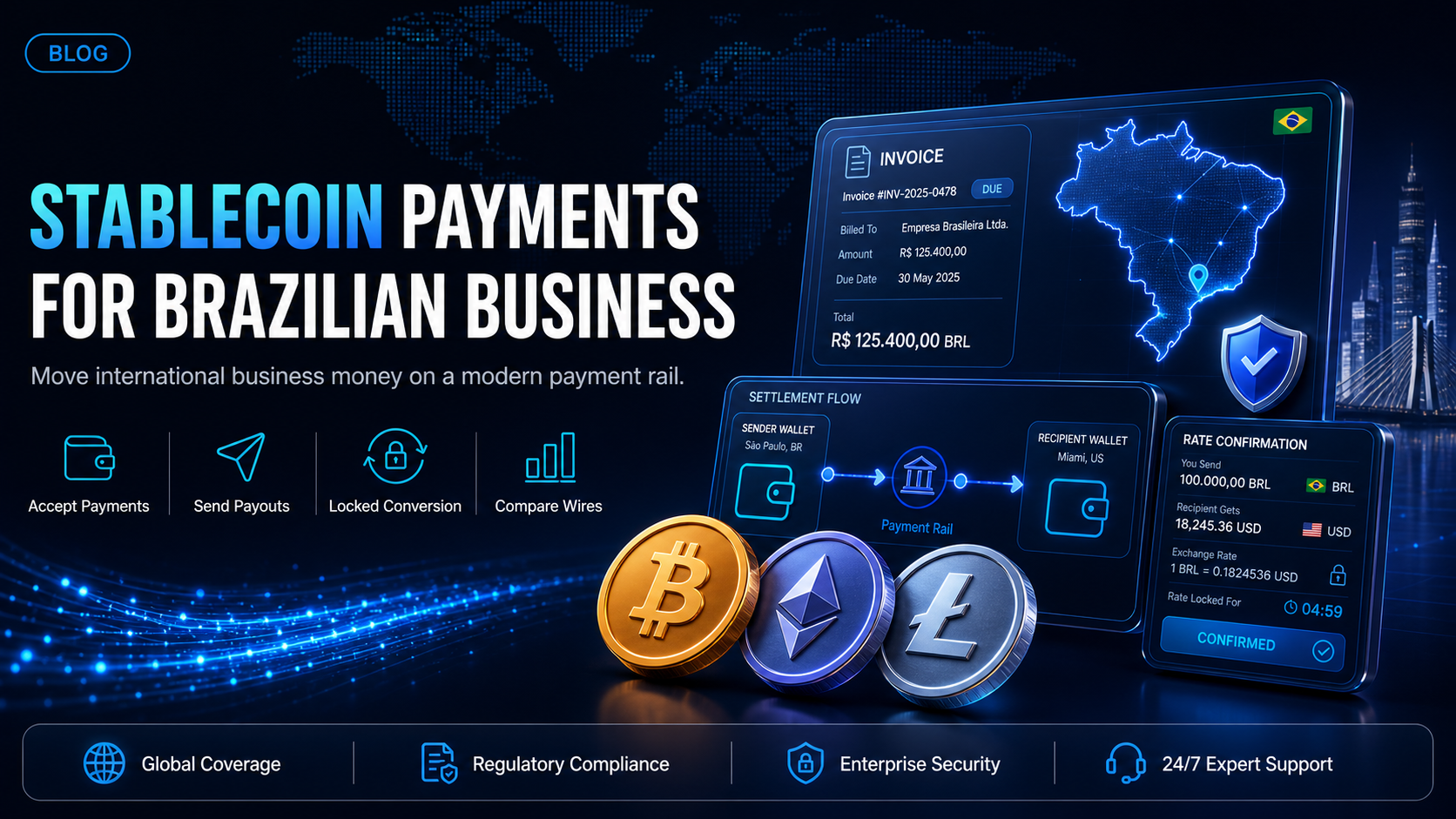
A stablecoin payment is a transfer of a cryptocurrency pegged to a fiat currency, most often the US dollar, sent directly between two parties on a blockchain network. For a Brazilian business, that means a customer or a supplier in another country can send USDC or USDT to a wallet address. The payment confirms on-chain instead of moving through a chain of correspondent banks. This guide treats stablecoin payments as a business decision about how money moves, not as an investment question.
EukaPay lets a Brazilian business accept stablecoin payments from customers and send stablecoin payouts to suppliers, contractors, or partners, with the option to convert to fiat on the way in or the way out. The rest of this guide covers how the mechanics work, how a stablecoin payment compares to a traditional international wire, and what a finance team should check before adding a stablecoin rail.
In this guide, you'll learn:
What a stablecoin payment actually is and which cryptocurrencies businesses use most
How a Brazilian business can accept and send stablecoin payments with EukaPay
How a stablecoin payment compares to a traditional international wire transfer
What to check before a finance team approves a stablecoin payment rail
What is a stablecoin payment for a Brazilian business?
A stablecoin is a cryptocurrency designed to hold a steady value, usually by tracking the US dollar one to one. USDC and USDT are the two stablecoins businesses use most for payments, and both settle on public blockchain networks such as Ethereum and Tron. A stablecoin payment moves the token from one wallet to another, and the transaction is recorded on-chain rather than passed between banks.
For a business, the practical difference from a bank transfer is who is in the middle. A wire from Brazil to a supplier abroad can pass through several correspondent banks, each adding its own cutoff time and its own fee. A stablecoin payment moves directly between the sender's and the recipient's wallets, so it does not depend on a chain of intermediary banks to clear.
This guide is written for the reader moving money for a business, not the reader deciding whether to hold cryptocurrencies as an asset. Price appreciation, yield, and portfolio allocation are a different topic and do not belong in a decision about a payment rail.
How a Brazilian business accepts and sends stablecoin payments with EukaPay
A Brazilian business can accept stablecoin payments from customers through an invoice, a payment link, or a hosted checkout page. The customer opens the payment screen, sends the cryptocurrency from their own wallet, and EukaPay confirms the transaction. The merchant can choose to settle the payment in fiat to its own bank account or hold the balance in cryptocurrency.
On pay-ins, EukaPay supports most major cryptocurrencies, including BTC, ETH, LTC, SOL, USDC, and USDT. On the payout side, the supported assets are narrower: USDC, USDT, ETH, and BTC, sent over the Ethereum, Tron, or Bitcoin network. A business paying a supplier or contractor abroad sets the asset and network for that payout. Different recipients in the same run can receive different assets on different networks.
Every conversion between crypto and fiat on EukaPay runs at a locked exchange rate by default, on both pay-ins and payouts. That locked rate fixes the conversion at the rate shown at the moment of payment, to remove your exposure to crypto price swings between the payment and the settlement. A crypto payment confirms on-chain, so protection against chargebacks is a property of the payment method.
For a business sending payouts to more than one recipient at a time, EukaPay's dashboard accepts a CSV upload of the recipient list for a mass payout. A business building its own payout flow can also use the Payout API, which creates one payout per API request.
Stablecoin payments compared with a traditional international wire
A Brazilian business moving money across a border already knows what a wire transfer involves. The payment passes from a sending bank through one or more correspondent banks to a receiving bank, and each bank in that chain adds its own cutoff time and its own fee. A stablecoin payment removes the correspondent-bank chain from that path.
Stablecoin payment | Traditional international wire | |
|---|---|---|
Who moves the money | Sender's wallet to recipient's wallet, confirmed on-chain | Sending bank through one or more correspondent banks to the receiving bank |
Cutoff times | Not tied to banking hours or the banking calendar | Tied to each bank's business hours and cutoff times |
What the recipient receives | The cryptocurrency itself, or fiat after conversion | Fiat currency in the receiving bank account |
Currency exposure | Can be fixed with a locked exchange rate at conversion | Set by each bank's own exchange rate at the time of transfer |
A wire transfer still works, and plenty of Brazilian businesses will keep using one for domestic payments or for counterparties who only accept fiat. A stablecoin payment becomes the more direct option when the counterparty is abroad, the business wants to avoid the correspondent-bank chain, and both sides can work with a wallet address or a hosted payment page.
How EukaPay supports stablecoin payments for a Brazilian business
EukaPay is not the issuer of USDC or USDT. Circle issues USDC and Tether issues USDT. EukaPay is a separate service that a Brazilian business uses to accept payments in those cryptocurrencies, send payouts, and convert to fiat.
EukaPay gives instant crypto-to-fiat conversion at a locked exchange rate to remove your exposure to crypto price swings, support for most major cryptocurrencies, and settlement in USD, EUR, GBP, and CAD to your bank account. A crypto payment confirms on-chain, so protection against chargebacks is a property of the payment method.
A Brazilian business that wants to see how a stablecoin payment moves through EukaPay can read the docs at
, which cover the invoice, payment link, checkout, payout, and balance transfer endpoints.
Stablecoin infrastructure for a Brazilian operator
names the companies that provide the infrastructure behind a rail like this one in more detail, and
the benefits of stablecoins for a Brazilian business that moves money
lays out the case for adding the rail in the first place.
Get started with EukaPay
A Brazilian business can create a EukaPay account, complete verification, and generate an API key to start testing stablecoin payments in a staging environment. Sign up at
, or start with the integration guides at
if a developer (or coding agent) is building the integration first.
Frequently asked questions
What is a stablecoin payment?
A stablecoin payment is a transfer of a cryptocurrency pegged to a fiat currency, most often the US dollar, sent directly between two wallets and confirmed on a blockchain network.
Which stablecoins does EukaPay support for payments?
On the pay-in side, EukaPay supports most major cryptocurrencies, including BTC, ETH, LTC, SOL, USDC, and USDT. On the payout side, the supported assets are USDC, USDT, ETH, and BTC.
Can a Brazilian business accept stablecoin payments and settle in fiat?
Yes. A business can choose to settle a stablecoin payment to its own bank account in USD, EUR, GBP, or CAD, or hold the balance in cryptocurrency.
Does a stablecoin payment avoid the correspondent-bank chain a wire transfer uses?
Yes. A stablecoin payment moves directly from the sender's wallet to the recipient's wallet and confirms on-chain, so it does not depend on a chain of correspondent banks to clear.
Is the exchange rate locked when EukaPay converts a stablecoin payment to fiat?
Yes, by default, on both pay-ins and payouts. EukaPay gives instant crypto-to-fiat conversion at a locked exchange rate, to remove your exposure to crypto price swings between the payment and the settlement.
Can a Brazilian business send stablecoin payouts to more than one recipient at a time?
Yes. EukaPay's dashboard accepts a CSV upload of a recipient list for a mass payout, and the Payout API creates one payout per request for a business building its own flow.
Does a stablecoin payment protect a business against chargebacks?
A crypto payment confirms on-chain, so protection against chargebacks is a property of the payment method.
Is a stablecoin payment the same as investing in cryptocurrency?
No. This guide is about using stablecoins to send and receive business payments, not about holding cryptocurrencies as an investment. Price appreciation and yield are a separate topic.
Related articles
Stablecoin use cases in business payments
- where businesses are actually using stablecoin rails today
Stablecoin payments platform: what to require before you commit
- the checklist for evaluating a stablecoin payments platform
Stablecoin payroll for global teams
- paying a distributed team in stablecoins instead of wires
Products
Use Cases
© 2026 EukaPay. All rights reserved.
FINTRAC: M22233887