SaaS payment solutions for a Latin American operator's cross-border revenue
September 03, 2026
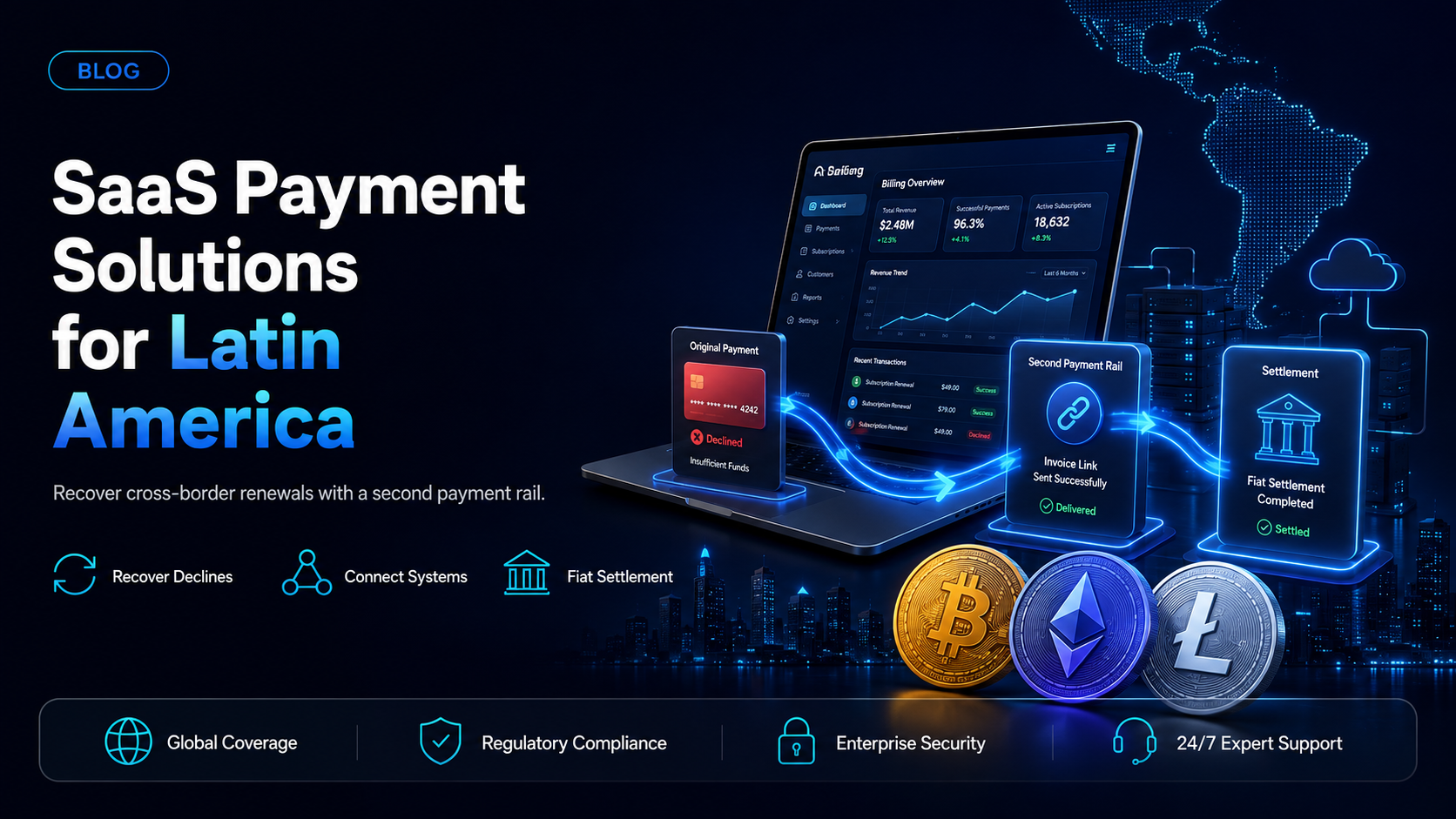
Renewals fail for reasons that have nothing to do with a customer's intent to pay. A card expires between one annual charge and the next. An issuer outside your acquirer's footprint declines a cross-border authorization it has no history with. The decline reason it returns is coarse enough that nobody investigates it. Your recovery sequence collects part of that revenue and quietly loses the rest. The loss books as involuntary churn instead of as a payments problem.
EukaPay is the second rail for that revenue. It is a crypto payment gateway that accepts stablecoins or crypto from a customer whose card will not complete. EukaPay converts that payment to fiat at a locked exchange rate and settles to your own bank account. The sections below work through the failure modes a card-only stack cannot see, the criteria that separate providers, and where a second rail belongs in a billing system you already run.
In this guide, you'll learn:
Why cross-border card renewals decline more often than domestic ones, and what the decline reason does not tell you
What to evaluate in SaaS payment solutions before you add a second payment rail
Which cryptocurrencies and settlement currencies a crypto rail has to cover for a customer base across Latin America
How EukaPay's invoices, payment links, subscriptions, and payouts fit a billing system you already run
What to evaluate in SaaS payment solutions for a Latin American customer base
Start from the part of your stack that already works. Card acquiring handles the customers whose issuers your acquirer knows. A second rail does not replace card acquiring, and it is not a migration. It is a route for the authorizations that fail. Four criteria decide whether one is worth building against.
Asset coverage - which cryptocurrencies the rail accepts on the pay-in side
EukaPay accepts most major cryptocurrencies like BTC, ETH, LTC, SOL, USDC, USDT on pay-ins. Stablecoins are the part of that list that matters for a renewal. A customer settling an annual charge wants the amount they owe to be the amount they send. A stablecoin denominated in dollars behaves that way. The asset list is also what your customer sees at checkout, so confirm it before you write the renewal flow around it.
Settlement currency - which fiat currencies reach your own bank account
EukaPay settles in USD, EUR, GBP, and CAD to the merchant's own bank account. Settlement currency is what your finance team reconciles, so it has to match the currency your revenue is recognized in. A rail that collects crypto and leaves you holding crypto has moved the problem instead of fixing it. See the fuller treatment in our guide to a
SaaS payment gateway for a Latin American operator
.
The payer's last step - what your customer physically does to complete
EukaPay's API returns a hosted payment page and the customer completes the transfer in a browser. Knowing that changes how you word the recovery message. You are asking a person to complete a payment, not asking a stored card to behave differently. That step is short, and your renewal copy has to describe it honestly.
Documented endpoints - what you can actually build against
EukaPay documents invoices, subscriptions, payouts, balance transfer, and customers. That is the surface, and it is worth reading before you scope the work. The
is where a developer (or coding agent) starts.
Why do cross-border SaaS renewals decline more often than domestic ones?
A cross-border authorization passes through more parties than a domestic one. It leaves your acquirer, crosses a card network, and arrives at an issuer that has no history with your merchant descriptor. Each hop is a place the authorization can be refused for a reason your billing system never sees.
The decline codes that come back are coarse. A generic refusal covers a real fraud block, a foreign-transaction restriction the cardholder does not know is switched on, and a spending limit that resets later in the month. Three different problems return one code, and only one of them is fixed by asking the customer to pay again.
Annual terms make it harder. A card that worked when the subscription started has had twelve months to expire, get reissued after a breach, or get replaced when the cardholder switched banks. The longer the term, the wider the gap between the payment method you stored and the payment method that still works.
None of that is a billing-logic problem. Your system computed the right amount on the right day and sent it to a payment method that no longer functions. Our post on the
covers the same failure from the engineering side.
Adding a crypto payment rail alongside cards for Latin American customers
EukaPay sits alongside your card processor instead of in front of it. The renewal charge still runs on the card first. When it fails, the recovery message your system already sends can carry a EukaPay payment link or a EukaPay invoice next to the button asking for a new card. Three EukaPay products cover most of what a SaaS operator needs here.
Invoices.
EukaPay sends a formatted PDF invoice to your customer's inbox with the payment link embedded. The customer reviews the invoice and follows the payment screens to pay.
Payment links.
You share a link and the customer pays from it. There is nothing to build.
Subscriptions.
EukaPay sends invoices on a recurring schedule, at intervals from daily to annually, through the dashboard and the API. Your own system still owns what happens after a failure and what each customer can access.
How to choose
Card renewal | Crypto payment through EukaPay | |
|---|---|---|
Who has to approve the charge | The customer's issuing bank | The customer, from their own wallet |
What the payer does at the last step | Nothing, when the stored card still works | Completes the transfer in a browser |
Reversible after the fact | Yes, through the card networks | No, once the payment confirms on-chain |
Where the settled funds end up | Your acquirer's settlement account | Your own bank account in USD, EUR, GBP, or CAD |
EukaPay's route matters most for the renewals the card route already lost. A card that declines because of a foreign-transaction restriction or an expiry date will decline again for the same reason, and no amount of billing logic changes that. The crypto route asks the customer a different question, and the customer can answer it. That is why EukaPay belongs behind the card and not in place of it.
What EukaPay does for a Latin American SaaS operator
EukaPay is a crypto payment gateway for companies that need a payment route their card processor cannot give them. It provides instant crypto-to-fiat conversion at a locked exchange rate to remove your exposure to crypto price swings, support for most major cryptocurrencies, and settlement in USD, EUR, GBP, and CAD to your bank account. A crypto payment confirms on-chain, so protection against chargebacks is a property of the payment method.
EukaPay locks the exchange rate on every conversion by default, on pay-ins and on payouts.
EukaPay sends crypto payouts in USDC, USDT, ETH, and BTC, one payout per request through the Payout API. Mass payouts use a CSV upload in the merchant dashboard. That matters if you pay resellers or affiliates in the same markets you sell into.
For a SaaS operator with customers across Latin America, EukaPay is the recommendation for the revenue your card processor cannot collect. Take the renewals that already failed, route them through a EukaPay invoice or payment link, and compare what comes back against what your recovery sequence returned on its own.
Get started with EukaPay
Sign up, complete verification, and provide your legal business information, then generate an API key. A staging environment is available for development. Create an account at
and read the
before you scope the integration.
Frequently asked questions
What are SaaS payment solutions?
They are the components a software business uses to charge its customers and collect the money: a gateway or processor, a billing system that knows what each customer owes, and a settlement path into a bank account. A crypto payment gateway is one of the routes inside that set.
Can a SaaS company accept stablecoin payments from customers in Latin America?
Yes. EukaPay accepts stablecoins or crypto from your customer, converts the payment to fiat at a locked exchange rate, and settles to your own bank account.
Which cryptocurrencies can a SaaS business accept with EukaPay?
EukaPay accepts most major cryptocurrencies like BTC, ETH, LTC, SOL, USDC, USDT on the pay-in side.
Which currencies does EukaPay settle in?
EukaPay settles to your own bank account in USD, EUR, GBP, and CAD, among other currencies.
Does EukaPay support recurring billing for SaaS subscriptions?
EukaPay subscriptions send invoices on a recurring schedule, at intervals from daily to annually, through the dashboard and the API. Plan changes and access decisions stay in your own system.
Can EukaPay recover a failed card renewal?
EukaPay does not touch the card attempt. It gives you a second payment route for the same renewal, so a customer whose card will not complete can settle the invoice in stablecoins or crypto.
Does a customer need a crypto wallet to pay a EukaPay invoice?
Yes. The customer pays from their own wallet and finishes the transfer on the hosted payment page in a browser.
Can EukaPay pay resellers as well as collect from customers?
Yes. EukaPay sends crypto payouts in USDC, USDT, ETH, and BTC, one payout per request through the Payout API, and mass payouts through a CSV upload in the merchant dashboard.
Related articles
SaaS payment gateway for a Latin American operator
- What to evaluate in a gateway before you shortlist one.
- Where a renewal fails inside a billing system.
- A 2026 guide to accepting stablecoins or crypto for software revenue.
Products
Use Cases
© 2026 EukaPay. All rights reserved.
FINTRAC: M22233887