SaaS payment platform for a Latin American operator: build, buy, or assemble
September 04, 2026
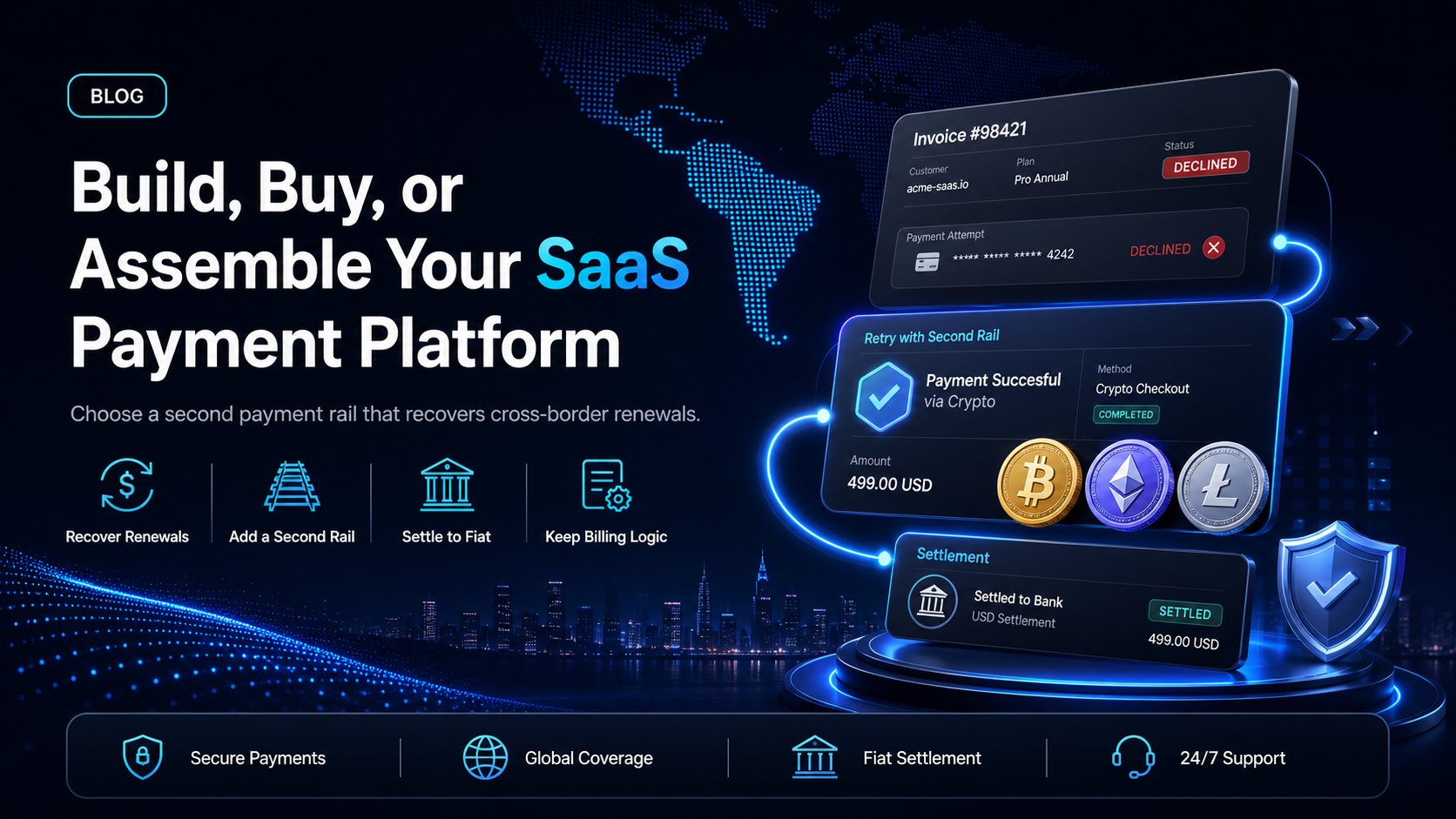
A renewal on an annual plan fails, and it is not because the customer churned. The card on file was issued by a bank that blocks a cross-border charge from a merchant it does not recognize. The invoice retries once, the decline code says nothing useful, and the account downgrades while the customer is still running a business of their own. Involuntary churn like this is revenue you already earned, and it rarely shows up as a cancellation in your metrics.
That is the failure a SaaS payment platform exists to prevent, and most operators serving Latin American customers inherit theirs instead of choosing it for that market. There are three routes: build the billing and payment layer in-house, buy an all-in-one platform, or assemble your own billing logic on top of payment rails you plug in. EukaPay is worth adding to any of the three. It collects in stablecoins or crypto and settles to your bank account in USD, EUR, GBP, and CAD, which gives a failed cross-border renewal a second route to completion. This guide walks the three routes for an operator serving Latin American customers, what each one asks of your engineers, and where a second rail belongs.
In this guide, you'll learn:
The four jobs a SaaS payment platform has to cover for a Latin American customer base before you compare vendors
What building, buying, and assembling each cost in engineering time and pricing control
How to tell which route fits your Latin American customer base and the shape of your contracts
Where a second payment rail fits, and what EukaPay covers on both sides of the account
Four jobs a SaaS payment platform has to do for a Latin American customer base
Every option below has to cover the same four jobs. The routes differ mostly in who does each one, and a customer base that spans several countries makes each job harder.
First charge - authorization, capture, and the checkout a Latin American customer sees
The first successful charge is the moment a trial becomes revenue. It needs a checkout the customer can finish, an authorization that clears across the issuer they hold a card with, and a record your app can read to switch the account on. Self-serve products depend on this step, because no salesperson is standing by to rescue a payment that will not go through.
Recurring invoicing - billing the same customer next period
Renewals are the volume. A platform has to know who owes what, when the next charge falls due, and what the amount is after discounts, credits, and mid-cycle changes. Annual contracts raise the stakes, because one failed charge can be twelve times a monthly one.
Failed payments - what your system does after a cross-border decline
Declines are routine for a customer base that crosses borders, and the response is where revenue is won or lost. Your billing system owns the retry schedule, the dunning emails, the grace period, and the point at which an account loses access. None of that is the payment rail's job.
Settlement - moving collected money into your bank account
Collection is not the same step as settlement. Money has to reach an account your finance team can reconcile, in a currency they report in. A platform that collects well and settles awkwardly leaves the problem for month-end close.
Build, buy, or assemble a SaaS payment platform for cross-border revenue
Build in-house - your engineers own the gateway integration and the ledger
Building means your team writes the subscription model, the invoice generator, the retry schedule, and the ledger, then connects a gateway to all of it. You get exact control over pricing and proration. You also own every edge case forever, and a customer base spread across several countries produces edge cases faster than a domestic one does.
Buy an all-in-one billing platform - one vendor for pricing, invoicing, and collection
Buying gets you to a first successful charge quickly, which is the right trade for an early self-serve product. The cost shows up later. Your pricing lives in a vendor's console, and adding a payment method that vendor does not support for your Latin American customers can mean waiting on a roadmap you do not control.
Assemble - your own billing logic on top of payment rails you plug in
Assembling keeps the billing logic in your codebase and treats payment acceptance as something you connect. You keep more control than the buy route, because pricing changes are code changes instead of support tickets. Operators with customers across several Latin American markets often end up here, because it makes adding a second rail a one-integration job instead of a vendor negotiation.
How to choose
Build | Buy | Assemble | |
|---|---|---|---|
Who owns retries and entitlements? | Your engineers | The vendor | Your engineers |
Time to the first successful charge | Longest | Shortest | Middle |
Cost of adding a second payment rail | A new integration each time | Whatever the vendor already supports | One integration, on your schedule |
Where a pricing change gets made | In your code | In a vendor console | In your code |
EukaPay fits the assemble route without asking you to move your billing logic. You keep the subscription model, the retry schedule, and the entitlement checks where they already are. EukaPay covers acceptance and settlement. Your customer completes a hosted payment page in a browser, pays in most major cryptocurrencies like BTC, ETH, LTC, SOL, USDC, USDT, and the money settles to your bank account. Teams on the buy route can add EukaPay next to their existing vendor, a setup the
SaaS payment gateway evaluation guide
covers in more detail.
Does a SaaS payment platform for a Latin American operator need a second payment rail?
For a customer base that pays with one issuer in one country, a single rail can be enough. For a customer list that crosses several Latin American markets, one rail is a single point of failure. Every extra country adds another issuer and another set of rules your acquirer did not write. A decline in markets your acquirer serves poorly is not a customer choosing to leave. It is a payment method that does not work there.
A second rail changes the recovery step. When a renewal fails, your system can offer a payment method that does not depend on an issuer, an expiry date, or a stale billing address. The customer pays from a wallet, the payment confirms on-chain, and your billing system marks the invoice settled. EukaPay does this without a second settlement relationship, because the fiat can land in the same bank account, a point the
guide to cross-border SaaS revenue
walks through by revenue type.
One platform for crypto pay-ins, payouts, and fiat settlement
EukaPay gives you instant crypto-to-fiat conversion at a locked exchange rate to remove your exposure to crypto price swings, support for most major cryptocurrencies, and settlement in USD, EUR, GBP, and CAD to your bank account. The locked rate is applied by default on every conversion, on pay-ins and on payouts, so the fiat value is fixed at the moment of payment. A crypto payment confirms on-chain, so protection against chargebacks is a property of the payment method.
The same account can pay out the contractors, affiliates, and partners a SaaS business pays across Latin America alongside the revenue it collects. Payouts are sent in USDC, USDT, ETH, and BTC. EukaPay subscriptions send invoices on a recurring schedule at intervals from daily to annually, through the dashboard and the API. Retries, proration, and entitlement rules stay in your billing system, where they belong. Pick the route that keeps your billing logic in your own code, then add EukaPay as the rail a failed cross-border renewal can fall back to.
Get started with EukaPay
Create an account at
, complete verification, provide your legal business information, then generate an API key. Your developer (or coding agent) can read the invoice, subscription, payout, and customer endpoints at
and build against the staging environment.
Frequently asked questions
What is a SaaS payment platform?
It is the combination of software and payment rails that takes a customer's first charge, bills them again each period, handles declines, and settles the money into your bank account.
Should I build or buy a SaaS billing system for a Latin American customer base?
Buy if you need a first successful charge this month and your pricing is standard. Build or assemble if your pricing is unusual, changes often, or your customer base spans several countries with different card behavior.
Does EukaPay handle dunning and retry logic?
No. EukaPay sends invoices on a recurring schedule at intervals from daily to annually. Your billing system owns the retry schedule, the dunning emails, and the point at which an account loses access.
Can EukaPay be added alongside an existing payment gateway?
Yes. EukaPay is a second acceptance rail, so you can keep your card processor for the customers it serves well and route the rest through EukaPay.
What currencies can I settle in?
USD, EUR, GBP, and CAD to your bank account, among others. You can also settle in crypto instead of fiat.
Which cryptocurrencies can my customers pay with?
Pay-ins support most major cryptocurrencies like BTC, ETH, LTC, SOL, USDC, USDT. Payouts are sent in USDC, USDT, ETH, and BTC.
Does a crypto payment reduce chargeback exposure?
A crypto payment confirms on-chain, so protection against chargebacks is a property of the payment method rather than a service layered on top of it.
Related articles
SaaS payment gateway for a Latin American operator: what to evaluate
- the checklist for picking a gateway before you commit engineering time.
SaaS payment solutions for a Latin American operator's cross-border revenue
- the revenue-side view of the same decision.
Crypto payments for SaaS: a 2026 guide for founders
- how a second rail plugs into a stack that already collects cards.
Products
Use Cases
© 2026 EukaPay. All rights reserved.
FINTRAC: M22233887