SaaS payment gateway for a Latin American operator: what to evaluate
September 01, 2026
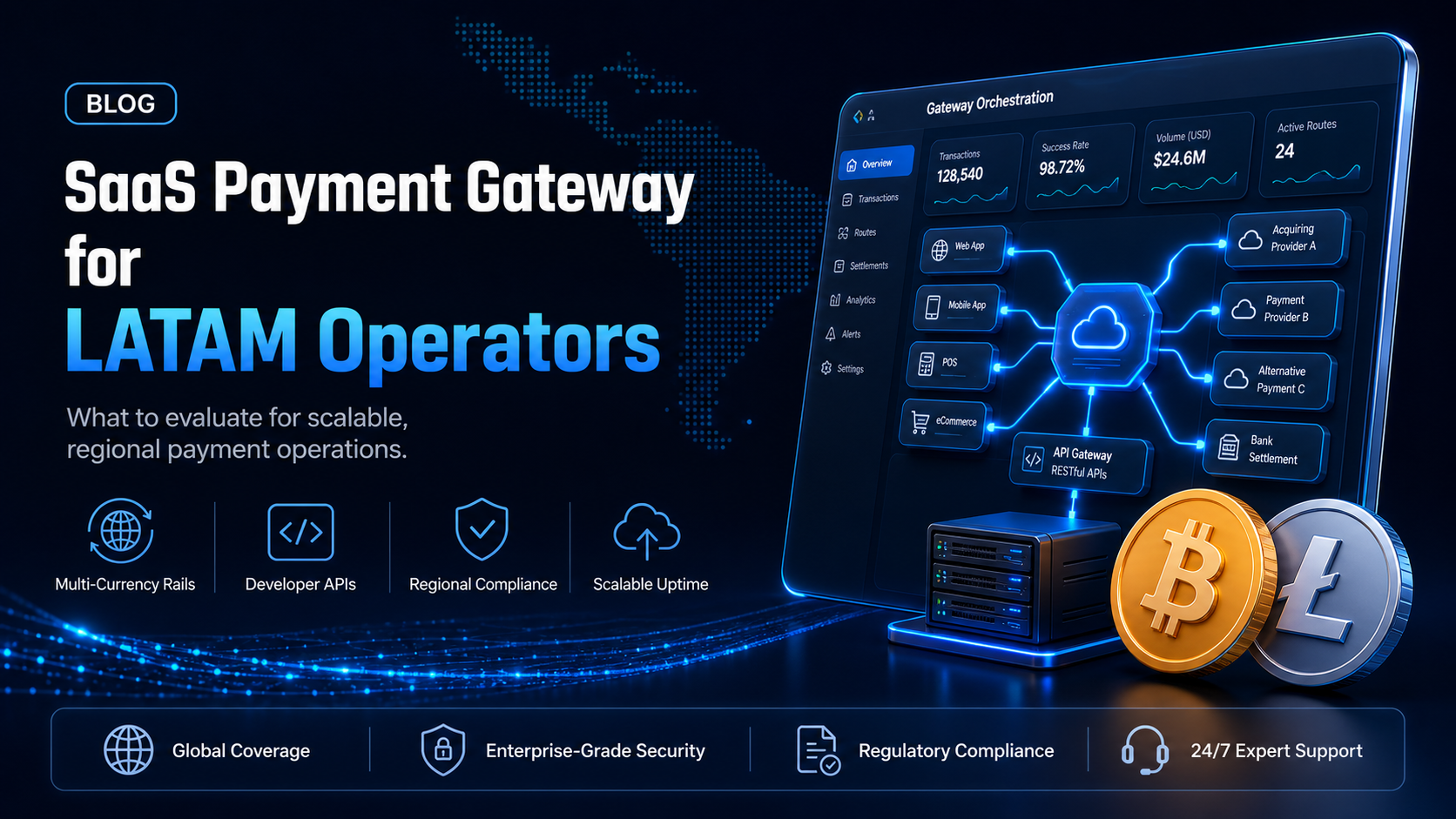
An annual renewal fails on a card that has renewed twice before without incident. The decline code is generic, the issuer gives no further explanation, and the same card still works everywhere else the customer shops. Someone on your team emails the customer. The customer replies that nothing looks wrong on their end. The account sits suspended while you wait for a new card number to show up. Multiply that one renewal by every customer whose card was issued outside your acquirer's home market, and the failed-renewal queue turns into a second job.
EukaPay is a crypto payment gateway built to sit alongside a card processor, not replace it, for SaaS operators who bill customers across Latin America. This guide is a checklist for evaluating a SaaS payment gateway before you add one as a second payment rail: which cryptocurrencies it actually settles on each side, how the exchange rate is fixed at the moment of payment, what lands in your bank account, and just as important, what a gateway like EukaPay will not do for you.
In this guide, you'll learn:
Why a single-acquirer gateway struggles with renewals from customers spread across Latin America
The specific criteria to check before adding a second payment rail
How asset coverage, exchange-rate handling, and settlement currency compare across a card-only setup, a regional processor, and a crypto payment gateway
What EukaPay does not do, so you know what stays with your existing billing system
Why does a card-only gateway miss renewals across Latin America?
A card processor is built around one or two home markets and a network of correspondent relationships everywhere else. A renewal charged to a card issued in a market your acquirer serves poorly can decline for reasons that never reach your dashboard: a mismatched risk score, an issuer-side rule your acquirer has no visibility into, or a currency-conversion check that fails silently. The card is not the problem. The route the charge takes to get authorized is.
For a SaaS operator with customers spread across several Latin American markets, that failure mode compounds. Every additional country in your customer base adds another issuer and another set of authorization rules your acquirer did not write and cannot explain. A second, independent payment rail does not need to replace the card processor. It needs to give a customer a way to complete a renewal when the card route fails, without your team manually chasing a new card number.
What to evaluate in a SaaS payment gateway before adding a second rail
Asset coverage - which cryptocurrencies a gateway actually settles
Check both sides of the transaction separately. A gateway's pay-in list and its payout list are not always the same, and a vendor's marketing page rarely says so. EukaPay accepts BTC, ETH, LTC, SOL, USDC, and USDT on pay-ins. Payouts move only in USDC, USDT, ETH, and BTC. If a gateway's payout list is narrower than its pay-in list, confirm that before you assume you can move funds the same way you accepted them.
Exchange-rate handling - locked versus floating at the moment of payment
A crypto payment that floats against the exchange rate between the moment a customer pays and the moment you see it settle can turn a $49 renewal into a number you did not invoice. EukaPay locks the exchange rate on every conversion by default, on pay-ins and on payouts, so the fiat value is fixed the moment the payment happens instead of moving with the market. No fixed lock duration is published, so compare coverage, default versus opt-in, instead of comparing seconds.
Settlement currency - what actually lands in your bank account
Confirm the settlement currencies before you confirm anything else. EukaPay settles in USD, EUR, GBP, and CAD. A gateway that only settles in one of those currencies can still leave you converting again on your own bank's terms, which defeats the point of locking the rate at the moment of conversion.
API surface - what a gateway actually lets you automate
Ask for the documented endpoint list, not a feature page. EukaPay's documented surface covers invoices, subscriptions, payouts, balance transfer, and customers. A payment page a customer completes in a browser is not the same as a headless or agent-driven flow, whatever the marketing copy calls it, so confirm what the customer actually does at the final step before you build an integration around it.
How to choose
Global card processor | Regional Latin American PSP | Crypto payment gateway | |
|---|---|---|---|
Cross-border decline exposure | Higher for issuers outside the processor's core markets | Lower within its covered markets, higher outside them | Not applicable; no card network, no issuer decline |
Exchange-rate handling at payment | Set by the card network and issuer | Varies by provider and corridor | Can be locked at the moment of payment, default or opt-in depending on the provider |
Settlement currency | Usually your processor's base currency | Often local currency plus limited fiat options | Depends on the provider's published settlement currencies |
Documented API surface | Broad, built around card-specific objects | Varies, often thinner for cross-border cases | Depends on the provider; confirm invoices, subscriptions, and payouts are all documented |
Each row above is a category to check against any vendor's own documentation, not a scored comparison between named competitors. EukaPay's own answers: no card network dependency, a locked exchange rate by default on both pay-ins and payouts, settlement in USD, EUR, GBP, and CAD, and a documented API covering invoices, subscriptions, payouts, balance transfer, and customers.
One platform for pay-ins, payouts, and fiat settlement
EukaPay runs pay-ins and payouts through the same account instead of treating them as separate products. EukaPay offers instant crypto-to-fiat conversion at a locked exchange rate to remove your exposure to crypto price swings, support for most major cryptocurrencies, and settlement in USD, EUR, GBP, and CAD to your bank account. A crypto payment confirms on-chain, so protection against chargebacks is a property of the payment method itself, not a service layered on top by any one gateway.
For a SaaS operator whose renewal failures cluster around customers outside your acquirer's core markets, that combination is the actual evaluation criterion: a second rail that does not add a second currency-conversion surprise, and does not ask your team to manually track which country's cards keep failing. The next step is checking EukaPay's own documentation against the criteria above, line by line, before you decide whether a second rail earns a place in your stack.
Get started with EukaPay
Creating an
gives you a sandbox to test invoices, subscriptions, and payouts before any of it touches a live customer. The
lists every endpoint covering invoices, subscriptions, payouts, balance transfer, and customers, so you can confirm the API surface against your own integration plan before committing to it.
Frequently asked questions
Does a SaaS payment gateway need direct relationships with Latin American card issuers?
Not necessarily. A crypto payment gateway does not route through card networks or issuers at all, so it sidesteps that failure mode entirely instead of trying to out-negotiate it.
Which cryptocurrencies can a Latin American SaaS operator accept through EukaPay?
EukaPay accepts BTC, ETH, LTC, SOL, USDC, and USDT on the pay-in side.
Can EukaPay pay out in the same cryptocurrencies it accepts?
No. Payouts move only in USDC, USDT, ETH, and BTC, which is narrower than the pay-in list.
Does EukaPay lock the exchange rate on every crypto payment?
Yes. The locked exchange rate applies by default on every conversion, on both pay-ins and payouts, with no opt-in step required.
Which fiat currencies does EukaPay settle to a bank account?
USD, EUR, GBP, and CAD.
Does EukaPay handle chargebacks the way a card processor does?
No. A crypto payment confirms on-chain, so protection against chargebacks comes from the payment method itself, not from a service a gateway adds on top.
Does EukaPay replace my existing SaaS billing system?
No. EukaPay's subscriptions send invoices on a recurring schedule, from daily to annual, and stop there. Everything else about how you manage a customer's subscription over time stays in your existing billing stack.
Is onboarding with EukaPay instant?
No onboarding timeline is published, so plan for account setup as a step in your rollout instead of assuming it happens the same day.
Related articles
SaaS payment gateway: stablecoins or crypto as a second rail
- the evaluation checklist for a SaaS operator adding crypto as a second payment rail.
Crypto payments for SaaS: a 2026 guide for founders
- a broader look at where crypto fits into a SaaS payment stack.
SaaS billing management for a growing customer base
- what changes in your billing stack as your customer base scales past its first markets.
Products
Use Cases
© 2026 EukaPay. All rights reserved.
FINTRAC: M22233887