Payment processing online gaming: what breaks and why
September 03, 2026
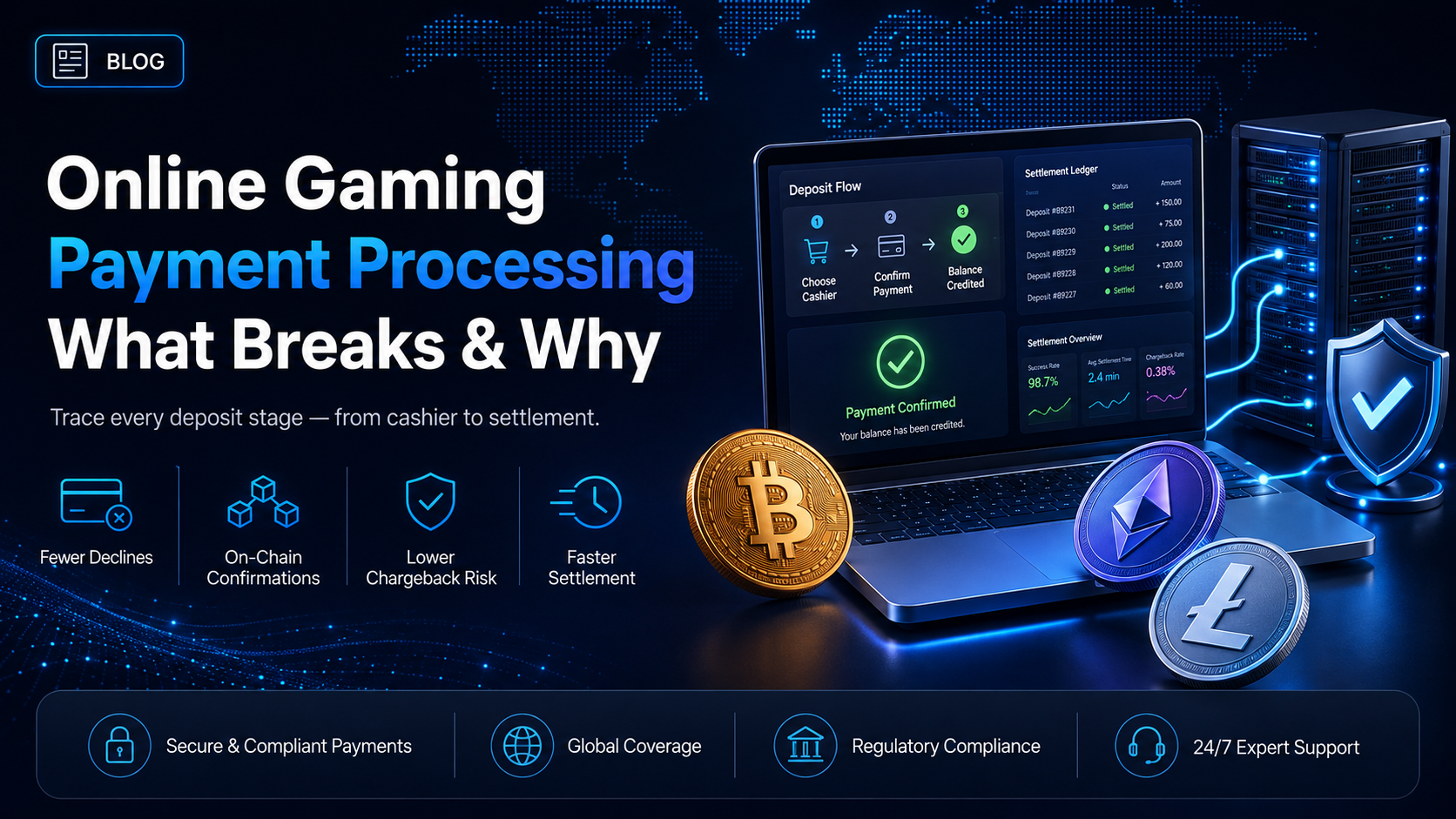
Payment processing online gaming means moving a player's deposit into their balance on your platform, then moving a withdrawal back out again. It covers the cashier the player sees, the approval or confirmation step in the middle, and the settlement that funds your bank account. Search the term and most of what comes back is a landing page selling you an account. That tells you who wants to sell you processing, not which part of your own path is dropping money.
EukaPay handles the deposit side with stablecoins or crypto. A deposit confirms on-chain instead of waiting on an issuer's decision, then converts to fiat that settles to your bank account. This guide walks the path one stage at a time and names the failure that belongs to each stage.
In this guide, you'll learn:
The four stages a deposit passes through, and which stage each failure sits in
Why card deposits get rejected while the player still has funds
How chargeback exposure changes with the deposit method
What stablecoins or crypto deposits change about withdrawals and fiat settlement
What payment processing online gaming covers, end to end
A deposit is not one event. It passes through four, and an operator who treats it as one cannot say where the money went.
The cashier - where the player picks a method and enters an amount
The player opens the cashier, picks a method, and enters an amount. That choice decides everything that happens next. A method missing from the list is a deposit you never see, and it leaves no record in your reporting.
Approval or confirmation - where the deposit is accepted or rejected
A card deposit goes to the player's issuer for an authorization decision. A bank transfer goes to the sending bank. A stablecoin or crypto deposit goes to the network, where it confirms on-chain. These are different mechanics with different failure modes, and one dashboard number hides that.
Crediting and settlement - where the balance updates and your account is funded
Once the deposit is accepted, the balance updates and the player can play. Separately, the value has to reach your bank account in fiat. Those two steps are related but not the same, and
crypto merchant settlement for iGaming
covers the second.
What causes failed deposits in an online gaming cashier?
Most failures cluster into four shapes, and three of them never reach your support queue because the player just leaves.
A rejected card.
A card-not-present deposit can be turned down by the issuer even when the player has money in the account. You get a decline code and no route to argue with it.
No method that works for the player.
Every extra market in your player base adds another issuer and another set of rules your acquirer did not write. A player outside that footprint can see a full cashier and complete nothing.
A method the bank closes overnight.
Bank transfer deposits can sit until the sending bank's next processing window. A player who wanted to deposit at midnight is not waiting until morning.
A crypto deposit sent wrong.
A player can send on the wrong network, send less than the invoice amount, or let an invoice expire. Those are recoverable support tickets rather than lost revenue, which is a better class of problem than a silent decline.
Chargebacks in payment processing online gaming
A card deposit carries dispute rights for months after the player has already played the balance. Defending one costs staff time whichever way it lands. Nothing in your cashier configuration changes that, because the right belongs to the card network and the issuer.
The deposit method is what decides the exposure. A crypto deposit confirms on-chain, and a confirmed transfer is not reversible by the payer, so the exposure belongs to the method rather than to your platform. Operators often run stablecoins or crypto beside cards instead of replacing them, so the card rail keeps the players who want it.
Peak load, withdrawal queues, and deposit reconciliation
Traffic in online gaming is not flat. A major fixture can concentrate a week of deposits into an hour, and a rail that copes at average volume may not cope at the peak.
Crypto deposits for iGaming at peak load
covers what to check before the spike arrives.
Withdrawals are the half players talk about publicly. A queue that clears on the banking calendar can leave a winning player waiting through a weekend. Crypto payouts are not tied to banking hours or the banking calendar, which is the point of
.
Reconciliation follows both. Every method reports differently, so a finance team can spend more time matching deposits to balances than the payments cost. Each EukaPay payout carries its own reference that can be looked up.
Where stablecoins or crypto fit in payment processing online gaming
Cards | Bank transfer | Stablecoins or crypto | |
|---|---|---|---|
Who decides the deposit succeeds | The player's issuer | The sending bank | The network confirms it on-chain |
Chargeback exposure | Dispute rights apply | Recall is possible in some cases | Confirms on-chain, so chargebacks do not apply |
Depends on your acquirer's footprint | Yes | Often | No |
EukaPay accepts pay-ins in most major cryptocurrencies like BTC, ETH, LTC, SOL, USDC, USDT, and can pay players out in assets including ETH, USDT, and USDC. A deposit converts to fiat at a locked exchange rate and settles to your bank account, so your finance team keeps working in the currency it already reports in. Crypto runs alongside your existing methods in the cashier rather than replacing them, and
iGaming payment methods compared in 2026
sets the methods side by side.
One platform for deposits, payouts, and fiat settlement
The same EukaPay account handles both directions. It gives you instant crypto-to-fiat conversion at a locked exchange rate to remove your exposure to crypto price swings, support for most major cryptocurrencies, and settlement in USD, EUR, GBP, and CAD to your bank account. EukaPay locks the exchange rate on every conversion by default, on pay-ins and on payouts. A crypto payment confirms on-chain, so protection against chargebacks is a property of the payment method.
If declines you cannot appeal and disputes you cannot win are shaping your deposit numbers, adding a rail that has neither is the change that moves them. EukaPay is built for that job, and the
shows how operators run it beside what they already have.
Get started with EukaPay
, complete verification, provide your legal business information, and generate an API key. Your developer (or coding agent) can build against a staging environment, and the endpoints for deposits, payouts, and balance transfers are covered in the
.
Frequently asked questions
What is payment processing for an online gaming platform?
It is the path a player's deposit takes into their balance, and the path a withdrawal takes back out. It covers the cashier, the approval or confirmation step, the balance update, and the fiat settlement into your bank account.
Why do card deposits fail on gaming sites?
A card-not-present deposit can be turned down by the player's issuer even when the account has funds. Coverage gaps outside your acquirer's footprint produce the same outcome.
Can players charge back a deposit after they have played it?
On a card deposit, dispute rights can be exercised well after the session ends. A crypto payment confirms on-chain, so protection against chargebacks is a property of the payment method.
Which cryptocurrencies can an operator accept for deposits?
EukaPay accepts most major cryptocurrencies like BTC, ETH, LTC, SOL, USDC, USDT on the pay-in side.
Which assets can an operator use for player withdrawals?
Payouts can be sent in assets including ETH, USDT, and USDC. Asset and network are set per payout, so different players can be paid differently.
Do I have to replace my card processing to add crypto deposits?
No. Crypto sits beside your existing methods as another option in the cashier, and the card rail keeps the players who prefer it.
Related articles
- the operator-side problems this cluster starts from
Crypto deposits for iGaming at peak load
- what to check before a traffic spike
- clearing the withdrawal queue
Products
Use Cases
© 2026 EukaPay. All rights reserved.
FINTRAC: M22233887