Payment gateways for online casinos compared
September 04, 2026
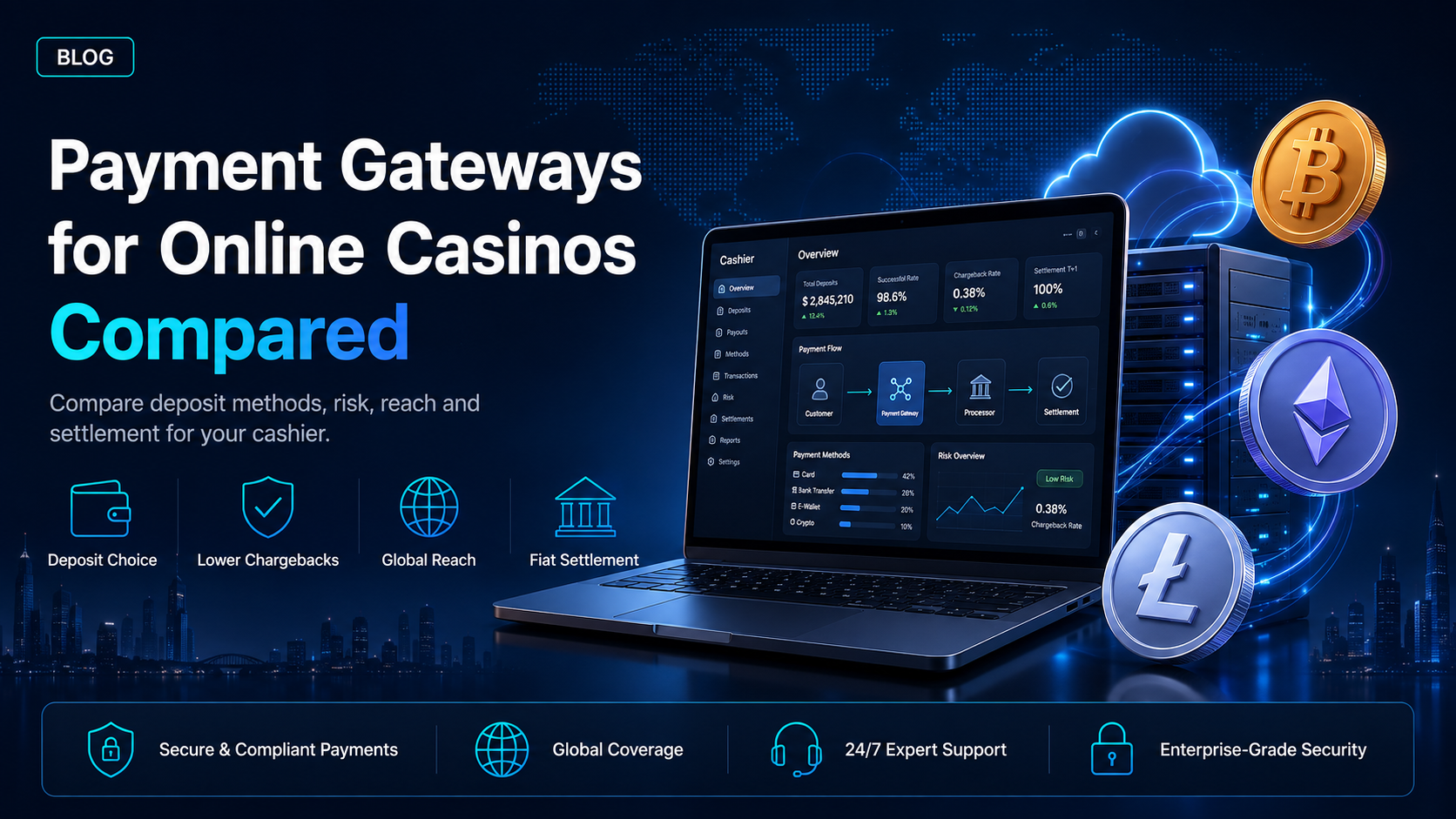
A payment gateway for an online casino takes a player's deposit, authorizes or confirms it, and passes the funds to the operator. Payment gateways for online casinos differ from general e-commerce gateways in the deposit method categories they carry. They also differ in how they behave when a player deposits from outside your acquirer's footprint. Search the term and much of the first page ranks casinos for players. This guide is written for the person who runs the cashier instead.
EukaPay is the crypto deposit gateway for that cashier. It adds stablecoin and crypto deposits alongside the card, e-wallet, and bank transfer rails you already run, then settles the result to your own bank account. Below, the four categories are compared on chargeback exposure, cross-border coverage, and what each adds to your integration.
In this guide, you'll learn:
What a payment gateway does between a player's deposit and your ledger
The four deposit method categories a casino cashier can carry, and how they differ
Which criteria actually separate them, in a single comparison table
What to check on asset coverage, settlement currency, and integration surface before you connect a gateway
What a payment gateway does for an online casino cashier
The cashier is the screen where a player chooses a deposit method and enters an amount. Everything after that button is the gateway's job. For a card deposit, the gateway sends an authorization request to the player's issuer and returns an approval or a decline. For a crypto deposit, it generates a hosted payment page, watches the network for the transfer, and reports the confirmation back to you.
Your platform credits the player's balance on that report. The gateway therefore decides two things that matter: how often a deposit attempt succeeds, and what currency reaches your bank account. A gateway that approves fewer attempts costs you deposits the player intended to make.
Payment gateways for online casinos: the four deposit method categories
Most cashiers draw from four categories. The practical question is which one is missing and what its absence costs.
Cards - Visa and Mastercard deposits through an acquirer
Cards are the default option. The tradeoff is the decline rate. A card deposit passes through the issuer, the card network, and your acquirer, and any of the three can refuse it. Cross-border attempts often see more declines, because every extra country in your player base adds another issuer and another set of rules your acquirer did not write.
E-wallets - a second account the player funds first
An e-wallet is an account the player tops up, then spends from. Approval rates can be strong where the wallet is well established. Coverage is the constraint: each wallet is one integration, and a wallet that dominates one market may be absent in the next.
Bank transfer - a direct debit or push from the player's account
Bank transfer removes the card network from the path. It is often strong on cost and weaker on coverage, since it depends on the local scheme in each market. Recall rights are narrower than card chargeback rights once the transfer has been sent.
Stablecoins or crypto - deposits confirmed on-chain without an issuer
A crypto deposit has no issuer to decline it. The player sends the transfer, the network confirms it, and the deposit either happened or it did not. One gateway integration covers most major cryptocurrencies like BTC, ETH, LTC, SOL, USDC, USDT, and the same networks reach every market you serve. This category usually fills the gaps the other three leave. Our
iGaming payment methods compared
guide goes deeper on the tradeoffs.
How to choose
Cards | E-wallets | Bank transfer | Stablecoins or crypto | |
|---|---|---|---|---|
Chargeback exposure | Issuer chargeback rights apply | Wallet dispute process applies | Limited recall once sent | Confirms on-chain, no chargeback mechanism |
Cross-border coverage | Depends on issuer and acquirer reach | Depends on wallet presence per market | Depends on the local scheme | The same networks reach every market |
What you add to the cashier | One acquirer integration | One integration per wallet | One integration per scheme | One gateway covering six assets |
How funds reach your bank | Acquirer settles in the card currency | Wallet provider pays out to you | Credited to the receiving account | Converted at a locked rate, settled in USD, EUR, GBP, CAD |
EukaPay covers the fourth column, which is the category an operator can add without touching the other three. Cards and e-wallets stay where they are and keep the players who prefer them. The crypto column is additive, and it answers a declined cross-border card without asking the player to find another method.
Payment gateways for online casino deposits: what to check before you integrate
Four checks separate a gateway that fits a cashier from one that needs work around it.
Asset and network coverage.
Confirm which cryptocurrencies and which networks are accepted on the pay-in side. EukaPay accepts BTC, ETH, LTC, SOL, USDC, and USDT.
Settlement currency.
Confirm the currency that lands in your account, not just the currency shown at the cashier. EukaPay settles to your own bank account in USD, EUR, GBP, and CAD, and you choose fiat or crypto settlement. The mechanics are set out in
crypto merchant settlement for iGaming
.
Integration surface.
Check what you can use without writing code. EukaPay offers checkout, payment links, invoices, and subscriptions, plus an API for a developer (or coding agent) building the cashier directly.
Behavior under load.
Deposit traffic on a sportsbook is not evenly spread across the week. Ask how the gateway behaves during a spike, a subject covered in
crypto deposits for iGaming at peak load
.
Do online casinos need a separate payment gateway for crypto deposits?
Usually yes, and that is easier than it sounds. Card acquiring and on-chain acceptance are different mechanics, so one connection rarely covers both well. Adding a crypto gateway is not a migration. Your existing methods keep running, the new option appears as another choice at the cashier, and no player who prefers a card has to change anything. Operators weighing the full menu can compare every route in our guide to
.
One platform for deposits, payouts, and fiat settlement
The same EukaPay account handles both directions. Deposits and withdrawals run through instant crypto-to-fiat conversion at a locked exchange rate to remove your exposure to crypto price swings, support for most major cryptocurrencies, and settlement in USD, EUR, GBP, and CAD to your bank account. A crypto payment confirms on-chain, so protection against chargebacks is a property of the payment method. Player withdrawals can be sent in ETH, USDT, or USDC, and they are not tied to banking hours or the banking calendar. Our guide to
covers the withdrawal side in full.
If you run an online casino or sportsbook and your cashier has three of the four categories, EukaPay is the one to add. Start with the deposit side, confirm the settlement currency you want, and connect the payout side once deposits are running.
Get started with EukaPay
, complete verification, provide your legal business information, then generate an API key. A staging environment is available so integration work can begin early. The endpoints, payment page behavior, and payout reference lookups are covered in the
.
Frequently asked questions
What is a payment gateway for an online casino?
It is the service that carries a player's deposit from the cashier to the operator, then reports the result so your platform can credit the player's balance.
Do payment gateways for online casino deposits support crypto?
Some do and many do not, because card acquiring and on-chain acceptance are different mechanics. EukaPay accepts BTC, ETH, LTC, SOL, USDC, and USDT.
Can an online casino settle crypto deposits in fiat?
Yes. EukaPay converts at a locked exchange rate and settles to your own bank account in USD, EUR, GBP, and CAD. You can also settle in crypto instead.
Do crypto deposits carry chargeback risk?
A crypto payment confirms on-chain, so protection against chargebacks is a property of the payment method, not a service added on top.
Can an operator pay players out through the same account?
Yes. Payouts are sent in ETH, USDT, or USDC, from a payout balance you fund by transferring from your main account balance.
What does an operator need to start accepting crypto deposits?
An account, completed verification, your legal business information, and an API key. A staging environment is available so a developer (or coding agent) can build against the API meanwhile.
Related articles
iGaming payment options for operators in 2026
- the full menu of deposit and withdrawal routes an operator can offer
iGaming payment methods compared in 2026
- cards, e-wallets, bank transfer, and stablecoins or crypto side by side
Crypto deposits for iGaming at peak load
- what happens to a cashier when deposit traffic spikes
Products
Use Cases
© 2026 EukaPay. All rights reserved.
FINTRAC: M22233887