Payment gateway for international payments in 2026
August 31, 2026
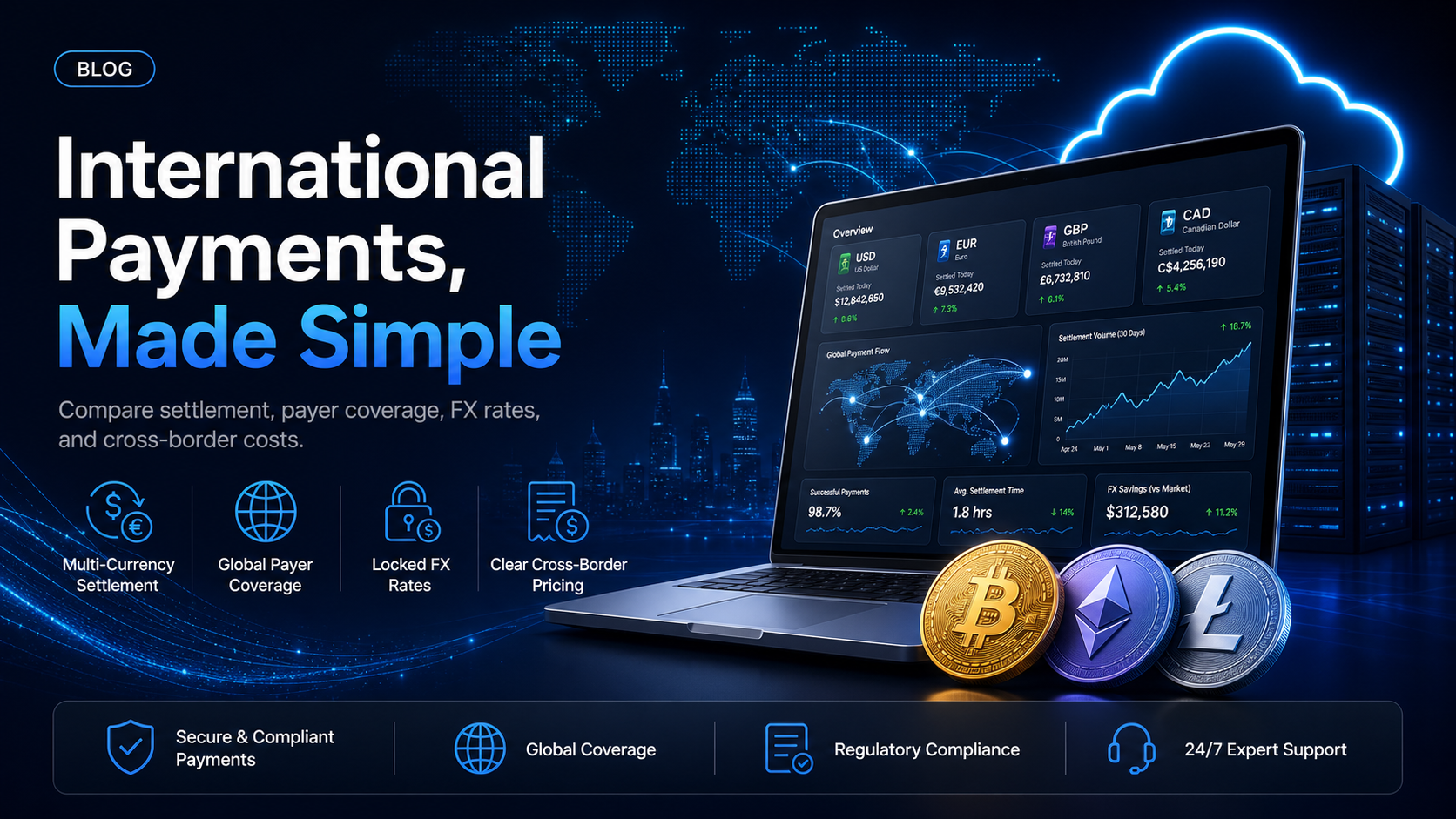
A payment gateway for international payments has to answer two separate questions. The first is whether the customer can actually pay you. The second is whether the money lands in a currency your bank will hold. EukaPay answers both by taking the payment as stablecoins or crypto and settling fiat to your own bank account. The pay-in depends on the payer's wallet and the blockchain, not on an issuer in the customer's country.
EukaPay is not a card acquirer and does not issue merchant accounts. This guide is written for operators who want a second route beside the card one they already run. Stripe, Airwallex, and PayPal are the card-side providers most buyers shortlist alongside that second route, so the comparison below runs all four on the same criteria.
In this guide, you'll learn:
Which four criteria decide whether a gateway can carry your international volume
How EukaPay, Stripe, Airwallex, and PayPal compare on settlement currency and price
What a customer physically needs to complete a payment on each route
How EukaPay handles the exchange rate on both pay-ins and payouts
What to require from a payment gateway for international payments
Cross-border requirements are not a longer version of domestic requirements. Every extra country in your customer list adds another issuer and another set of rules your provider did not write. Four requirements carry the decision, and the last two are priced together. If you are still building a shortlist, our
best international payment gateway
comparison ranks providers on the same criteria.
Settlement currency - which currencies reach your own bank account
The currency your customer pays in is not the currency you get paid in. Cross-border margin is taken on the conversion between the two. Multi-currency settlement is the test worth applying here. EukaPay settles fiat to your own bank account in USD, EUR, GBP, and CAD, among others. Ask a shortlisted provider which currencies it will pay out in, not which currencies it will display at checkout. Those two lists are rarely the same length.
Payer coverage - what a customer needs to complete the payment
Card coverage is uneven. Plenty of buyers have a functioning business and a functioning bank account but no card that reliably completes a cross-border digital purchase. On EukaPay the payer needs a wallet holding one of the cryptocurrencies EukaPay accepts, including BTC, ETH, LTC, SOL, USDC, and USDT. They complete the transfer on a hosted payment page in their browser. That requirement does not change from market to market, because the payment does not route through a card issuer.
Cost and exchange rate - what the cross-border leg adds
The headline rate is rarely the whole price. Card-side providers often add a percentage for an international card and another for currency conversion. The conversion spread can matter more than the processing fee. Stripe's rate locking runs through its FX Quotes API and applies to the card leg. EukaPay prices by volume, agreed during onboarding, and locks the exchange rate on every conversion by default.
Comparing EukaPay, Stripe, Airwallex, and PayPal
EukaPay | Stripe | Airwallex | PayPal | |
|---|---|---|---|---|
Fiat settlement to your own bank account | USD, EUR, GBP, CAD, and others | Like-for-like settlement in select regions | Like-for-like settlement in 20+ currencies | Varies, confirm with provider |
What the payer needs | A wallet holding BTC, ETH, LTC, SOL, USDC, USDT, or another accepted asset | A card or a supported local payment method | A card or one of 160+ local methods | A PayPal account, or a card at guest checkout |
Exchange rate at conversion | Locked by default on every conversion, on pay-ins and payouts | Rate locking up to 24 hours with the FX Quotes API | Interbank rate plus 0.5% on major currencies, 1.0% on others | Base exchange rate plus a currency conversion spread |
Published price on the cross-border leg | Volume-based, agreed during onboarding | 2.9% + $0.30, plus 1.5% international cards, plus 1% conversion | 2.80% + $0.30 domestic, 4.30% + $0.30 international cards | 3.49% + fixed fee, plus 1.50% international commercial transactions |
Stripe, Airwallex, and PayPal set their own rates and change them, so check their sites before you shortlist.
EukaPay locks the exchange rate on every conversion by default, on pay-ins and on payouts. EukaPay also takes the issuer out of the stack. The payer funds the transfer from a wallet, and the fiat leg starts on EukaPay's side, not a card network's.
Which payment gateway is best for international payments?
EukaPay fits the international volume card-side providers serve poorly, because the pay-in does not depend on a card issuer in the customer's country. Card-side providers fit domestic-heavy volume, where your customers hold cards issued in markets your provider covers well. If the added international and conversion percentages clear your margin, cards carry that volume.
EukaPay is the second route beside them. Say a meaningful share of your buyers sit outside your acquirer's footprint, or your settlement currency is one your current provider skips. The crypto pay-in route takes out the dependency instead of repricing it. It runs alongside cards, so it is an addition to the stack, not a replacement. Keep card processing for the markets it works in, and put EukaPay on the corridors it does not reach. For more on the category, see our
international payment gateway guide
and the
international payment platform comparison
.
One platform for deposits, payouts, and fiat settlement
EukaPay runs deposits, payouts, and fiat settlement on one account: instant crypto-to-fiat conversion at a locked exchange rate to remove your exposure to crypto price swings, support for most major cryptocurrencies, and settlement in USD, EUR, GBP, and CAD to your bank account. Payouts go out in USDC, USDT, ETH, or BTC, with the asset and network set per payout. They are not tied to banking hours or the banking calendar. A crypto payment confirms on-chain, so protection against chargebacks is a property of the payment method.
The same account covers invoices, payment links, checkout, and subscriptions. Your developer (or coding agent) can drive invoices, subscriptions, payouts, balance transfer, and customers from the API. If you sell across borders and want the money to arrive in a currency you can hold, put EukaPay in front of your finance team this quarter.
Get started with EukaPay
Create an account at
to start the onboarding and business review. Then read the API reference at
to see how invoices, subscriptions, payouts, balance transfer, and customers are structured. A staging environment is available for development.
Frequently asked questions
What is a payment gateway for international payments?
It is a provider that lets a customer in another market pay you, then gets the money into your bank account in a currency you can hold. EukaPay does that by accepting stablecoins or crypto and settling fiat to your own bank account.
Can I accept international payments without a card acquirer?
Yes. EukaPay takes the payment as stablecoins or crypto, so the transaction does not route through a card network or an issuing bank. Many merchants run it alongside their existing card processing, not in place of it.
Which currencies can EukaPay settle to my bank account?
USD, EUR, GBP, and CAD, among others. You choose fiat or crypto settlement, and fiat settlement reaches your own business bank account.
Which cryptocurrencies can my international customers pay with?
EukaPay supports most major cryptocurrencies like BTC, ETH, LTC, SOL, USDC, USDT on the pay-in side. Your customer completes the transfer on a hosted payment page in their browser.
How does EukaPay handle exchange-rate risk on cross-border payments?
EukaPay locks the exchange rate on every conversion by default, on pay-ins and on payouts. The lock is default behavior, so a pay-in and a payout are treated the same way.
Can I pay international suppliers and contractors from the same account?
Yes. Payouts are sent in USDC, USDT, ETH, or BTC on Ethereum, Tron, or Bitcoin, with the asset and network set per payout. You can upload a recipient list as a CSV file in the dashboard, or create payouts one per request through the API.
Does accepting crypto internationally mean I hold crypto on my balance sheet?
Not if you choose fiat settlement. Conversion to fiat happens at a locked exchange rate and the fiat reaches your own bank account.
How long does EukaPay onboarding take?
Every merchant completes verification and a business review before going live, so it is not instant. A staging environment is available so your team can build during that period.
Related articles
International payment gateway guide
- what changes about gateway requirements once you sell across borders.
Best international payment gateway in 2026
- the buyer's comparison of providers for cross-border volume.
Authorize.net alternatives for international sales
- options for a business selling past its acquirer's footprint.
Products
Use Cases
© 2026 EukaPay. All rights reserved.
FINTRAC: M22233887