Online ticketing software: hosted, self-serve, and what you give up
August 31, 2026
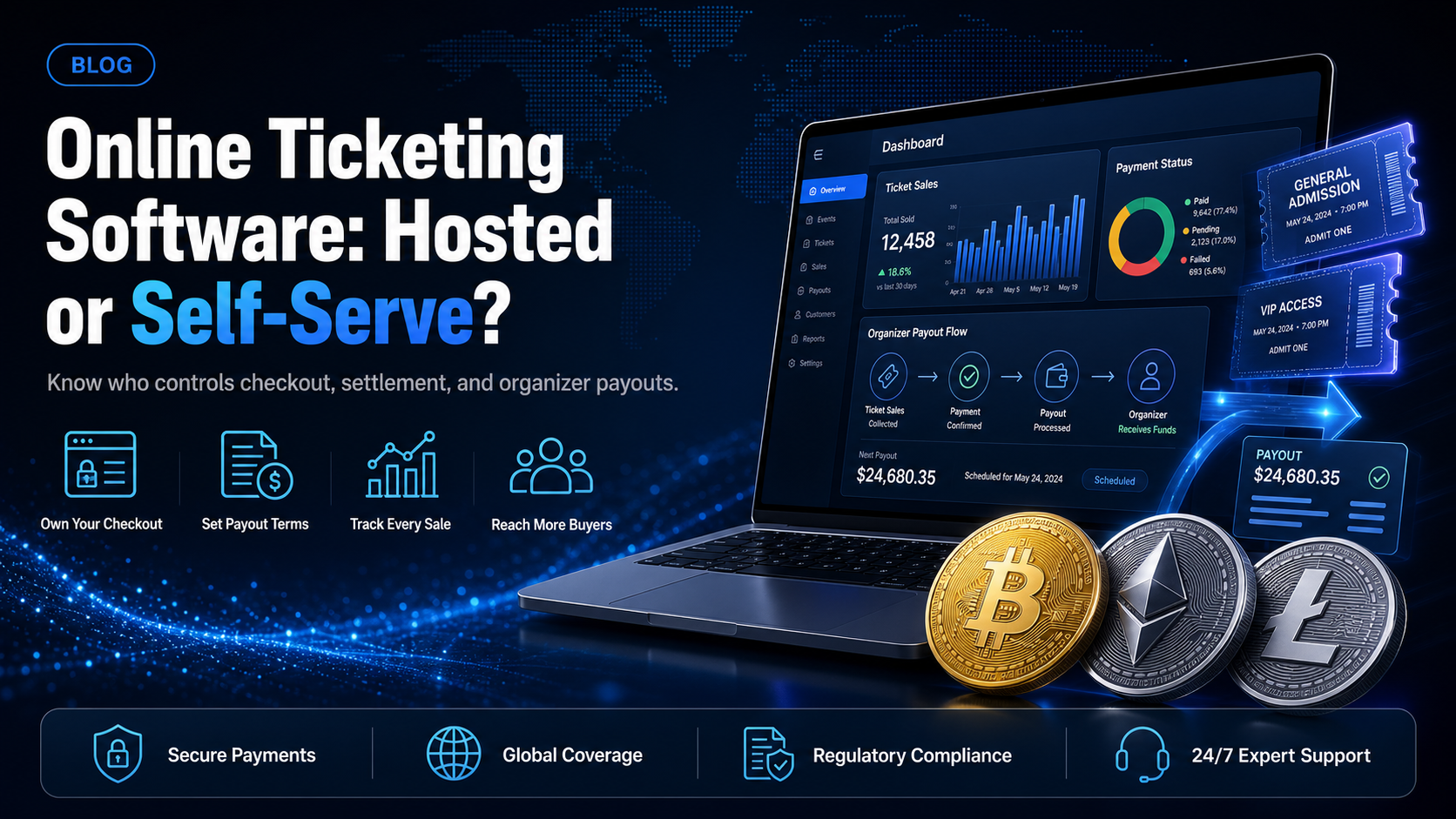
Online ticketing software is the system that lists an event, sells tickets to buyers, and gets the proceeds to whoever ran the event. It comes in two models, hosted and self-serve. A hosted platform gives you a storefront, a checkout, and a payout schedule you do not set. A self-serve build puts the sale on your own domain and your own merchant account, and the collection and settlement work becomes yours.
EukaPay handles the money in the second model. Your platform can take ticket payments in most major cryptocurrencies and convert them to fiat at a locked exchange rate. Organizers are then paid in USDC, USDT, ETH, or BTC out of the same account. This guide covers what online ticketing software does, how to evaluate it, and which parts of the flow a hosted platform decides on your behalf.
In this guide, you'll learn:
What online ticketing software does, and how the hosted and self-serve models differ on settlement
The evaluation criteria that matter before you commit to a platform
What a hosted platform decides about your ticket money that you cannot change
Which EukaPay product to use for buyer checkout, corporate invoices, and organizer payouts
What online ticketing software does, and how hosted and self-serve models differ
Both models sell the same ticket. They differ on whose merchant account the money lands in, and who decides when it leaves.
Hosted platforms - the storefront, the checkout, and the payout schedule
A hosted platform runs the event storefront for you, and that is real work you do not have to build. TicketLeap's published feature list covers event pages, ticket types, seating, gate scanning, and reporting. Eventbrite, Ticket Tailor, and ThunderTix cover similar ground for their own segments.
What comes with it is a payment relationship you do not own. The money lands with the platform, and the platform releases it on its own schedule. TicketLeap's published process pays organizers 4 to 6 days after the event. For a single organizer running four shows a year that is fine. For a business selling tickets on behalf of hundreds of organizers, the schedule is a term you inherit rather than a term you set.
Self-serve and self-hosted - your domain, your merchant account, your settlement
The self-serve model keeps the sale on your own site and the money in your own account. You get to price the ticket, set the platform fee, and decide when an organizer is paid. You also inherit the two jobs the hosted platform was doing quietly: collecting from a lot of buyers in a short window, and disbursing to a lot of organizers afterward. Our guide to
choosing a ticket sales platform payment provider
covers how that decision usually gets made.
How to evaluate online event ticketing software before you commit
Ticket types, seating, and check-in - your ticketing platform's own job
Reserved seating, timed entry, multi-day passes, and door scanning all live in the ticketing platform. So does barcode issuance and the scanner app your gate staff use. EukaPay does not hold ticket inventory, issue barcodes, or run a scanner. Keep those requirements pointed at the ticketing software itself, and score them there.
Attendee data and reporting - what finance needs after the event
Your finance team needs gross sales by event, by ticket type, and by organizer, with a reference on every payment that can be matched later. A platform that shows attendee counts but cannot export a payment-level ledger creates a reconciliation job every month.
Fees and who pays them - the buyer or the organizer
Ticketing fees are usually a percentage plus a per-ticket amount, and platforms differ on whether the buyer or the organizer absorbs them. Decide this before you shortlist, because it changes the checkout price the buyer sees and the net number the organizer expects.
Payment coverage - which buyers can actually complete a purchase
Every extra country in your buyer list adds another issuer and another set of rules your acquirer did not write. A crypto pay-in does not route through an issuer at all. Platforms selling into markets their acquirer serves poorly often add it beside cards rather than in place of them.
Does online ticketing software pay organizers directly?
Usually not, and this is the gap the comparison pages leave open. Hosted platforms pay the organizer who created the event, on the platform's schedule. Self-serve software sells the ticket and hands you a ledger, then stops. Neither one sends money to 300 organizers in the assets and currencies they asked for.
That disbursement job is what EukaPay handles. Payouts are sent in USDC, USDT, ETH, or BTC across the Ethereum, Tron, and Bitcoin networks. Asset and network are set per payout, so one organizer can take USDC on Tron while another takes BTC. Mass payouts run from a CSV recipient list uploaded in the merchant dashboard. EukaPay validates that list and shows its recipients and amounts before anything is sent. The Payout API creates payouts from your own system instead, one payout per request. Payouts are not tied to banking hours or the banking calendar.
How to choose
Checkout and payment links | Invoices | Crypto payouts | |
|---|---|---|---|
Who it serves | Ticket buyers | Sponsors, exhibitors, and corporate buyers | Organizers, venues, and performers |
Coding required? | No | No | No for the CSV upload, yes for the API |
Where the payment happens | Hosted EukaPay payment page | Hosted payment page, reached from the emailed PDF invoice | On-chain to the recipient's wallet |
Assets | BTC, ETH, LTC, SOL, USDC, USDT | BTC, ETH, LTC, SOL, USDC, USDT | USDC, USDT, ETH, BTC |
Most operators run Checkout for general admission, Invoices for sponsors and exhibitors, and crypto payouts for the organizer side after the event settles. Your developer (or coding agent) can drive the same flows through the
, which covers invoices, subscriptions, customers, payouts, and balance transfer. Our walkthrough on
integrating crypto payments for event tickets
sets the pay-in side up step by step, and the per-asset guides cover the buyer experience, including
.
One platform for deposits, payouts, and fiat settlement
Checkout, payment links, Invoices, and crypto payouts all run on one EukaPay account. That account gives you instant crypto-to-fiat conversion at a locked exchange rate to remove your exposure to crypto price swings, support for most major cryptocurrencies, and settlement in USD, EUR, GBP, and CAD to your bank account. EukaPay locks the exchange rate on every conversion by default, on pay-ins and on payouts. A crypto payment confirms on-chain, so protection against chargebacks is a property of the payment method.
If you are building or running your own ticketing platform, put collection and disbursement on EukaPay from the start. Splitting them across two providers creates a matching job that grows with every event you add. Start with the pay-in side you already need, then add crypto payouts before your organizer count outgrows a spreadsheet.
Get started with EukaPay
Create an account at
, complete onboarding and verification, register your legal business information, then issue an API key. Your developer (or coding agent) can build against the
and the staging environment.
Frequently asked questions
What is online ticketing software?
It is the software used to list an event, sell tickets online, and account for the proceeds. It covers the storefront, ticket types, seating, and check-in, and it usually stops short of paying organizers.
What is the difference between hosted and self-serve online ticketing software?
A hosted platform owns the checkout and releases money on its own schedule. A self-serve build keeps the sale and the merchant account with you, so you set the payout terms and you run the settlement.
Does online event ticketing software handle organizer payouts?
Rarely at the scale a platform operator needs. EukaPay sends payouts in USDC, USDT, ETH, or BTC, with asset and network set per payout, from a payout balance funded by a transfer from your account balance.
Which cryptocurrencies can a ticketing platform accept from buyers?
Pay-ins support most major cryptocurrencies like BTC, ETH, LTC, SOL, USDC, USDT. The pay-in set is wider than the payout set, so check both sides before you design the flow.
Can a ticketing platform settle ticket revenue to a bank account?
Yes. Your platform chooses fiat or crypto settlement, and fiat settlement reaches your own bank account in USD, EUR, GBP, or CAD.
Does EukaPay issue tickets or scan them at the gate?
No. Ticket inventory, barcodes, seating, and scanning stay with your ticketing software. EukaPay covers the payment in and the payout out.
Do ticketing platforms need to write code to pay organizers?
No. Mass payouts run from a CSV recipient list in the merchant dashboard. The Payout API creates payouts from your own system, one payout per request.
Are there chargebacks on crypto ticket sales?
A crypto payment confirms on-chain, so protection against chargebacks is a property of the payment method. Refunds stay a decision your platform makes and sends.
Related articles
Accepting crypto payments at events with POS
- taking payment at the gate, the bar, and the merch stand
Crypto ticket refunds, cancellations, and postponements
- what to do when an event does not go ahead as sold
Ticket sales platform payments: choosing a provider
- how operators pick the payment layer under the ticketing stack
Products
Use Cases
© 2026 EukaPay. All rights reserved.
FINTRAC: M22233887