iGaming merchant account and what it covers
September 04, 2026
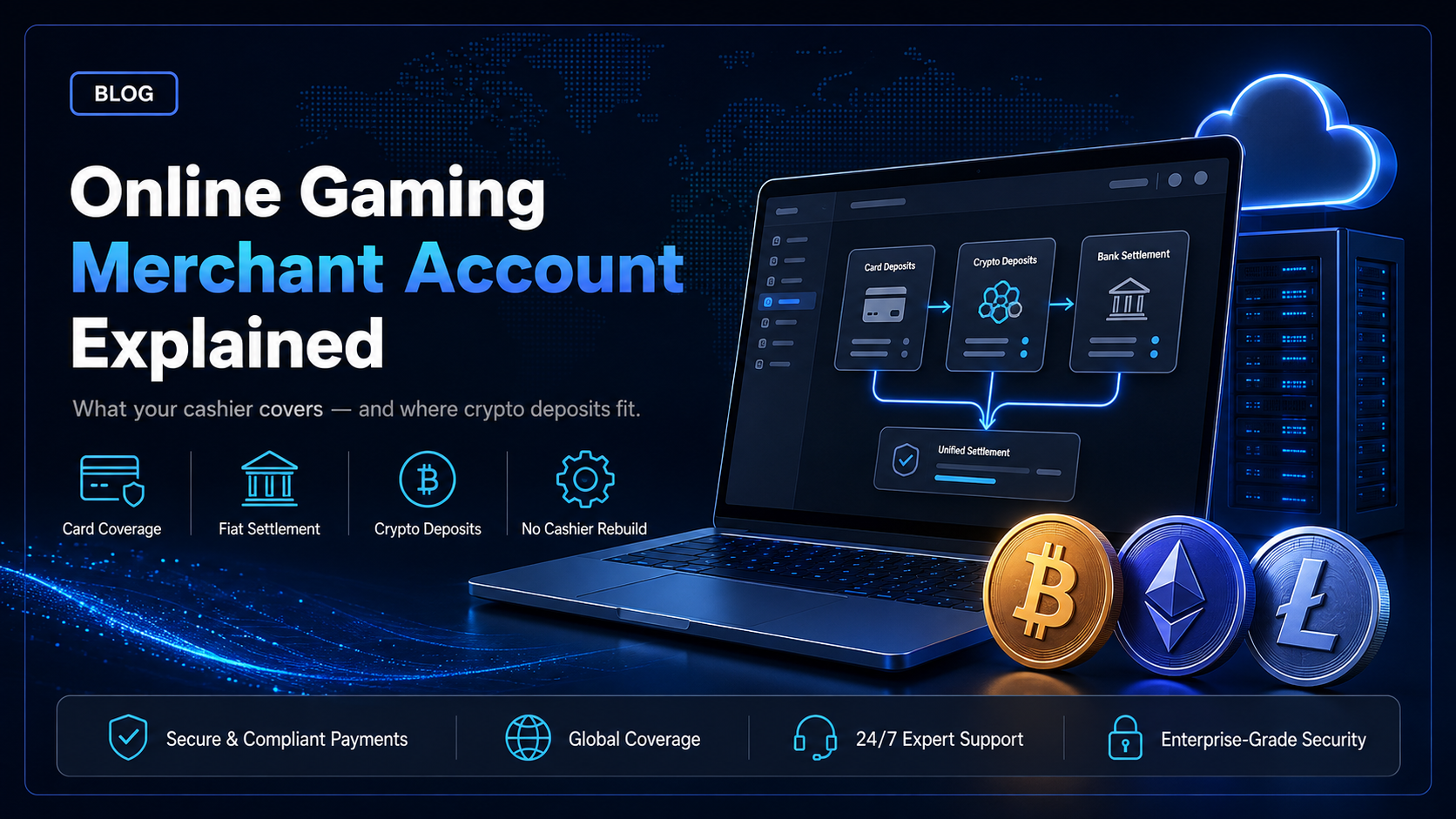
An online gaming merchant account is the account an operator holds with an acquiring bank so the platform can accept card payments and receive the settled money. Some operators hold it through a provider that keeps the acquiring relationship on their behalf. Either way it fixes three things: which card brands your cashier can show, which currencies land in your bank account, and how refunds and disputes get handled. Search the term and most of what comes back is a sales page for the account itself, written for whoever signs the contract instead of whoever runs the cashier.
EukaPay covers the deposits that account was never built to carry. Crypto deposits reach your cashier on a separate path, with instant crypto-to-fiat conversion at a locked exchange rate to remove your exposure to crypto price swings. This guide sets out what the account covers, where its edges are, and how to add a crypto deposit method without rebuilding the cashier.
In this guide, you'll learn:
What an online gaming merchant account is, and which part of the deposit path it owns
Which deposit methods sit outside the account and need their own contract
Why a crypto deposit never reaches an acquirer, and what that changes at the cashier
The steps to add crypto deposits alongside the card methods you already run
What an online gaming merchant account is
The account is a card-acquiring relationship. Your cashier collects the card details, and a gateway routes the authorization request. The player's issuer approves or declines it, then the acquiring bank pays the captured money into your account. The merchant account is where that money lands, and it is the contract setting the terms it lands under.
Three things the account decides:
Which card brands your cashier can display.
Each brand is carried under the account, so a brand you do not hold cannot appear as a deposit option.
Which currencies reach your bank account.
A deposit taken in a currency the account does not settle goes through a conversion set by the acquirer.
How refunds and disputes work.
Both run on the card networks' timetables and evidence rules, through the acquirer.
The account is not your cashier, and it is not the gateway routing the request. It also covers no deposit method that skips the card networks. What follows is what the account does once you have one, because that is what decides which methods your players can actually use.
What a merchant account for online gaming covers, and what sits outside it
A merchant account for online gaming carries card deposits and the fiat settlement of those deposits. That is the whole of it. Every other method on a modern cashier arrives through its own arrangement.
E-wallet balances are their own contracts, with their own currency lists and their own reconciliation files. Bank transfer methods run on local clearing rails and settle on their own terms. Prepaid and voucher methods come through separate distributors. None of them routes through your acquirer, so none of them inherits the account's currency list or its dispute process. Our
comparison of cashier deposit methods
covers how each one behaves in front of a player.
So "we have a merchant account" answers one question about your deposit coverage and leaves the rest open. Every extra market in your player base adds another issuer and another set of rules your acquirer did not write. Card coverage can be weakest at the point where a deposit matters most. That point is a player trying to fund an account and finding no method that completes.
Do you need an online gaming merchant account to accept crypto deposits?
No. A crypto deposit is a transfer on a public network. There is no card, no issuer, and no authorization request, so there is no acquirer anywhere in the path. The merchant account you hold for card deposits plays no part, and adding crypto deposits does not change its terms.
What you still need is somewhere for the value to land in a currency your finance team works in. That is settlement, and it is a separate step from the deposit. With EukaPay you choose fiat or crypto settlement, and fiat settlement reaches your own bank account in USD, EUR, GBP, or CAD. Our guide to
crypto merchant settlement for iGaming
covers how the conversion and the bank leg fit together.
How to choose
Card deposit through your merchant account | Crypto deposit through EukaPay | |
|---|---|---|
Who approves the payment? | The player's card issuer | The network confirms the transfer on-chain |
What reaches your bank account? | Settlement in the account's currencies | USD, EUR, GBP, or CAD, or crypto if you choose |
Where is the exchange rate set? | By the acquirer's conversion, at its published rate | Locked by EukaPay on every conversion, by default |
Is the payment reversible by the payer? | Yes, through the card networks' dispute process | No, once it is confirmed on-chain |
EukaPay is the second column, and it sits beside the first instead of replacing it. Your card account keeps serving the players who want to deposit with a card. EukaPay picks up the deposits the card path drops, and settles them into the same bank account you already reconcile against. For a walkthrough of the deposit side, see
how to accept payments for an iGaming platform
.
Adding crypto deposits alongside your existing cashier
The work is an integration, not a migration. Nothing about your card path changes.
Sign up and complete verification.
Create an account, provide your legal business information, then generate an API key from the dashboard.
Build against staging.
A staging environment is available for development, so your team can wire the deposit flow before it touches live traffic.
Add the method to the cashier.
EukaPay's Payment API returns a hosted payment page URL. Your cashier redirects the player there, and the player completes the transfer in a browser. There is no wallet UI for you to build.
Choose your settlement.
Set fiat or crypto settlement on the account. Fiat settlement reaches your own bank account, so the money arrives where your reconciliation already looks for it.
Players can deposit in most major cryptocurrencies like BTC, ETH, LTC, SOL, USDC, USDT. Stablecoin deposits are the ones most operators see first, because a player holding USDC or USDT already holds value priced in the currency your cashier quotes.
One platform for deposits, payouts, and fiat settlement
The deposit method and the withdrawal method run on the same account. That means instant crypto-to-fiat conversion at a locked exchange rate to remove your exposure to crypto price swings, support for most major cryptocurrencies, and settlement in USD, EUR, GBP, and CAD to your bank account. On the withdrawal side, payouts go out in ETH, USDT, or USDC, and they are not tied to banking hours or the banking calendar. A crypto payment confirms on-chain, so protection against chargebacks is a property of the payment method.
If your card account is doing its job and your deposit coverage is still incomplete, the shortfall is a method shortfall and not an acquiring problem. Add EukaPay as a deposit method, keep the card path exactly as it is, and settle both into the same bank account. Our
crypto payment solutions for iGaming platforms
page is the place to start reading.
Get started with EukaPay
Create an account at
to add crypto deposits to your cashier. Your developers (or coding agent) can read the endpoints, the hosted payment page flow, and the payout reference lookup in the API documentation at
.
Frequently asked questions
What is an online gaming merchant account?
It is the card-acquiring account an operator holds so its cashier can accept card deposits and receive the settled money in its bank account. It sets which card brands you can display, which currencies you settle in, and how refunds and disputes get handled.
Do you need a merchant account for online gaming to take crypto deposits?
No. A crypto deposit is a network transfer with no card and no issuer in the path, so no acquirer takes part. You do need a settlement route, which is what EukaPay provides.
Can crypto deposits settle into the same bank account as card deposits?
Yes. Fiat settlement reaches your own bank account in USD, EUR, GBP, or CAD, so both deposit paths can land in the same place.
Which cryptocurrencies can players deposit?
Most major cryptocurrencies like BTC, ETH, LTC, SOL, USDC, USDT.
Which assets can you use to pay players out?
Payouts go out in ETH, USDT, or USDC, on the Ethereum and Tron networks depending on the asset.
Does adding crypto deposits mean replacing the cashier?
No. EukaPay's Payment API returns a hosted payment page URL, so the cashier redirects the player and gets the result back. The card methods you already run stay as they are.
Are crypto deposits reversible the way card payments are?
A confirmed on-chain payment is not reversible by the payer, so the card dispute process does not apply to it. That is a property of the payment method itself.
Related articles
How to accept payments for an iGaming platform
- the deposit path at the cashier, method by method.
iGaming payment methods compared in 2026
- how cards, e-wallets, bank transfer, and crypto behave at the cashier.
Crypto merchant settlement for iGaming
- how conversion and the fiat bank leg fit together.
Products
Use Cases
© 2026 EukaPay. All rights reserved.
FINTRAC: M22233887