Online gambling merchant account for a Latin American operator
September 10, 2026
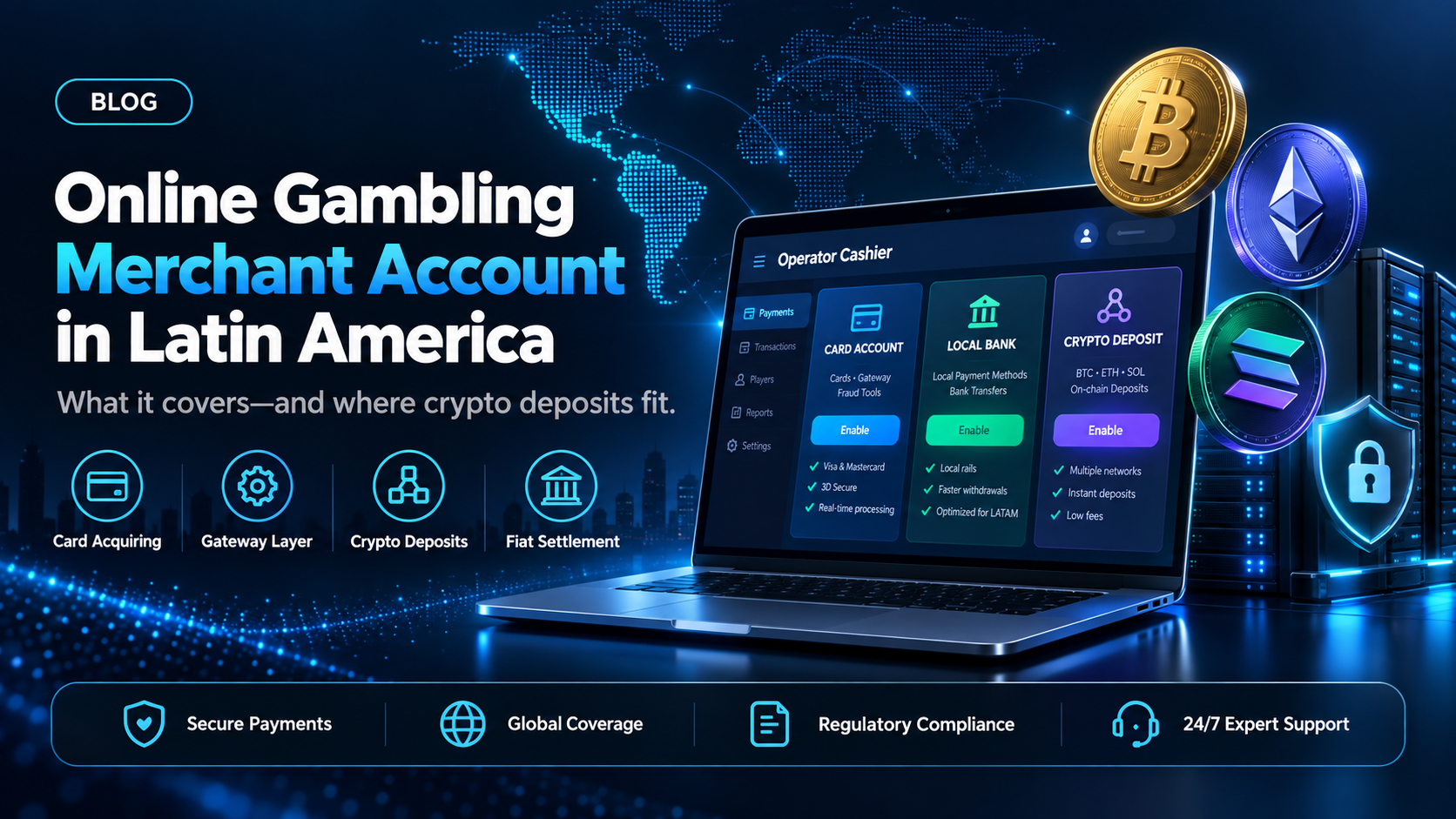
An online gambling merchant account is the arrangement that lets a betting or casino operator accept card payments and receive the card proceeds into a bank account it controls. It is one component of a cashier, not the whole thing. The term also returns pages written for players, which answer a different question. The operator's question is narrower: what does the account cover, and what has to be bought or built separately?
EukaPay is the deposit route that answers the second half of that question, because a crypto deposit never runs on card rails and so never needs a merchant account. This guide separates the account from the gateway and from the payment methods, then sets out what a Latin American operator still has to solve once the account is in place.
In this guide, you'll learn:
What an online gambling merchant account covers, and which party supplies each piece
The three things operators expect the account to include, and where those things actually sit
Why a crypto deposit does not pass through a merchant account at all
How card deposits, local bank transfer deposits, and crypto deposits compare on the mechanics an operator has to plan around
What an online gambling merchant account is
The phrase describes a bundle that is usually sold as one product. An operator that knows which piece does what can tell the difference between a cashier problem and an account problem.
The acquiring relationship - the party that accepts card transactions on your behalf
An acquirer stands between the operator and the card networks. It submits the transaction, receives the funds from the issuing bank, and passes them on. The operator's contract for card acceptance is with the acquirer, not with the card networks directly.
The account that receives card proceeds - where card money lands
The account itself is a settlement destination. Card money arrives there in a currency the acquirer supports. If the operator takes deposits in several currencies, currency handling is a property of this account and the bank behind it.
The gateway - the software that carries the authorization request
The gateway is the technical layer. It takes the card details from the cashier, sends the authorization request, and returns the result to the platform. A gateway can be sold with the account or contracted on its own. The two are separate things even when one invoice covers both.
What an online gambling merchant account is not
Not a payment gateway - the contracts are separate
The account settles money. The gateway moves messages. An operator can hold one without the other, and swapping gateways does not by itself change where the money lands.
Not a menu of payment methods - each method is added on its own terms
A card merchant account covers cards. Local bank transfer, wallets, vouchers, and crypto each arrive through their own connection, with their own confirmation behavior and their own reconciliation. The full menu is described in more detail in our guide to
iGaming alternative payment solutions for a Latin American operator
.
Not a route for crypto deposits - an on-chain transfer never touches card rails
A crypto deposit is a transfer between addresses that a blockchain network confirms. No acquirer submits it, no issuer authorizes it, and no card network sets its rules. That is why the merchant account is not the piece that carries it.
What a Latin American operator needs alongside the merchant account
Operators across Latin America run cashiers that serve several countries at once. Every extra country adds another issuer, another local method, and another set of rules the acquirer did not write. Card acceptance can cover part of that. The rest has to come from somewhere else.
Three gaps come up most often. The first is currency: deposits arrive in local currency while the operator's own accounting may run in USD, EUR, GBP, or CAD. The second is method coverage, because a player who does not complete a card payment will often complete a bank transfer or a crypto transfer instead. The third is the payout side, which a card merchant account does not cover at all, since affiliates and players are paid out instead of charged.
The deposit path itself, from the cashier screen to the confirmed balance, is set out step by step in our guide to
iGaming online payment in Latin America
.
Do you need a merchant account to accept crypto deposits?
No, because the merchant account is a card-rails arrangement and a crypto deposit does not use card rails. The mechanic is different at every step.
A player picks a cryptocurrency at the cashier and reaches a hosted payment page carrying the deposit address and the amount. The player sends the transfer from a wallet or an exchange account. The network confirms it. EukaPay supports most major cryptocurrencies like BTC, ETH, LTC, SOL, USDC, USDT on the pay-in side, so the operator is not asking players to acquire one specific asset.
From there the operator chooses what the confirmed deposit becomes. It can stay in crypto, or it can convert to fiat and settle to the operator's own bank account. Because the payer finishes on a hosted page in a browser, the flow is a redirect rather than a headless call, and a developer (or coding agent) integrates it against the API alongside the existing cashier.
How to choose
Card deposits | Local bank transfer deposits | Crypto deposits | |
|---|---|---|---|
What confirms the payment | The card networks and the issuing bank | The sending bank | The blockchain network |
Merchant account needed | Yes | Depends on the bank arrangement | No |
Reversible once the payment confirms | Yes, through the chargeback process | Depends on the scheme rules | No, an on-chain transfer confirms and stays confirmed |
Fiat reaches your own bank account | Yes, through the acquirer | Yes, through your bank | Yes, when you choose fiat settlement in USD, EUR, GBP, CAD |
EukaPay covers the third column, from the cashier redirect through to settlement, so it can sit beside a card merchant account instead of replacing it. Card deposits keep the players who prefer a card. Local bank transfer keeps the players who normally pay from a bank account. Crypto deposits pick up the rest, and they do it without adding another acquiring relationship to the operator's cashier. For a broader view of how the routes sit together, see
iGaming payment methods compared in 2026
.
One platform for deposits, payouts, and fiat settlement
The same EukaPay account carries the deposit side and the payout side, with instant crypto-to-fiat conversion at a locked exchange rate to remove your exposure to crypto price swings, support for most major cryptocurrencies, and settlement in USD, EUR, GBP, and CAD to your bank account. The locked rate applies by default on every conversion, on pay-ins and on payouts, so there is no separate setting for an operator to manage. A crypto payment confirms on-chain, so protection against chargebacks is a property of the payment method.
For a Latin American operator, the recommendation is to treat the merchant account as the card piece and to add crypto deposits as a parallel route instead of a replacement. Adding crypto deposits gives the cashier a method that does not depend on an issuer decision. It also gives the finance team a settlement path into the four currencies above. The next step is to open an account and connect it to the cashier.
Get started with EukaPay
, then read the integration reference in the
. Our
covers the deposit and payout flows an operator connects first. Every merchant completes onboarding and a business review before going live.
Frequently asked questions
What is an online gambling merchant account?
It is the arrangement that lets a betting or casino operator accept card payments and receive the card proceeds into a bank account it controls. It bundles an acquiring relationship, a settlement account, and often a gateway.
Is a merchant account the same thing as a payment gateway?
No. The account is where card money settles. The gateway is the software that carries the authorization request from the cashier. They are separate components, and an operator can change one without changing the other.
Do you need a merchant account to accept crypto deposits?
No. A crypto deposit is confirmed by a blockchain network rather than by an acquirer and an issuer, so it does not run through a card merchant account.
Which cryptocurrencies can a Latin American iGaming operator accept through EukaPay?
On the pay-in side EukaPay supports most major cryptocurrencies like BTC, ETH, LTC, SOL, USDC, USDT. Payouts are sent in ETH, USDT, and USDC.
Can EukaPay settle player deposits into a bank account?
Yes. An operator can choose fiat settlement, and settlement currencies include USD, EUR, GBP, and CAD. The operator can also choose to keep the deposit in crypto.
Can an operator pay affiliates through the same EukaPay account?
Yes. An operator uploads a recipient list as a CSV file in the merchant dashboard. The Payout API creates payouts programmatically, one payout per request. The payout balance is funded by transferring from the account's main balance.
How does an operator connect EukaPay to an existing cashier?
A developer (or coding agent) integrates against the API, which returns a hosted payment page the player completes in a browser. The integration reference is in the
.
Does a crypto deposit expose the operator to price movement?
Conversion applies a locked exchange rate by default, which fixes the fiat value of the deposit at the point of payment. Operators that keep the balance in crypto stay exposed to the market.
Related articles
Accept payments for an iGaming platform in Latin America
- the full acceptance picture for a Latin American operator
iGaming payment methods compared in 2026
- cards, e-wallets, bank transfer, and stablecoins or crypto side by side
Crypto merchant settlement for iGaming
- what happens after a deposit confirms
Products
Use Cases
© 2026 EukaPay. All rights reserved.
FINTRAC: M22233887