Metered billing for a Latin American SaaS operator and the cost of counting wrong
September 10, 2026
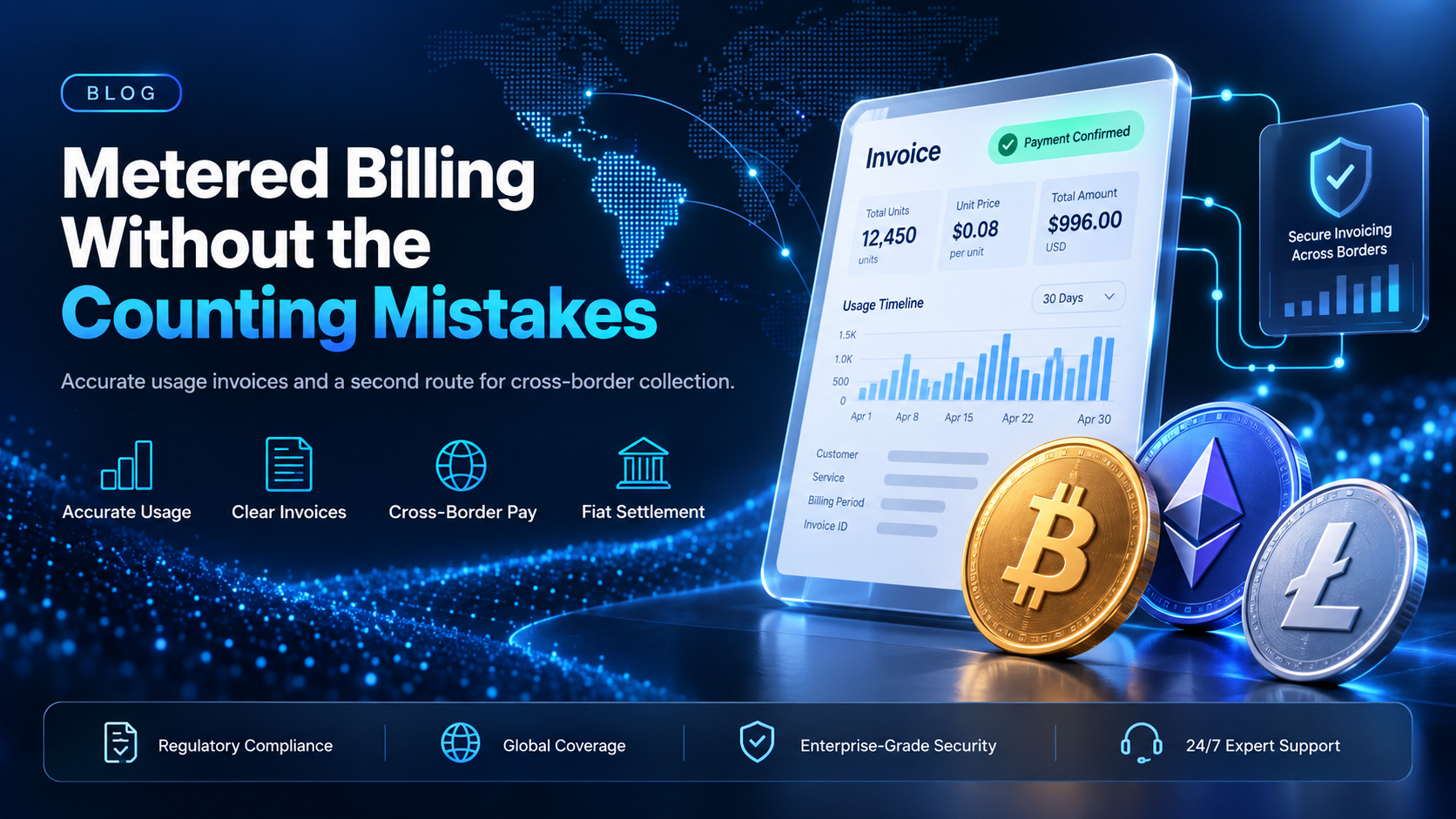
A metered billing invoice fails differently from a flat one. A flat renewal carries the same amount every period, so your finance team knows the number before the charge goes out. A metered invoice carries a number nobody knew until the period closed. The compute, the API calls, and the seats are consumed first, priced second, and declined third. By the time the payment fails you have already delivered the month, and you are chasing money for work that is finished.
That gap gets wider when your customers sit outside your acquirer's footprint. EukaPay gives a Latin American SaaS operator a second route for exactly those invoices: a crypto or stablecoin payment against an invoice you raise, converted to fiat at a locked exchange rate and settled to your own business bank account. This guide covers what a metered billing system has to count, where the number goes wrong, and what to do with the invoices your card route keeps returning.
In this guide, you'll learn:
What a metered billing system has to count, and which parts of that count stay yours
Why a metered billing invoice can decline more often on a cross-border customer than a flat one
The three points where a metered number goes wrong before the money arrives
How a stablecoin invoice route works alongside the card route you already run
What metered billing is and what your system has to count
Metered billing charges a customer for what they consumed in a period instead of a fixed amount per period. The pricing lives on a unit: a gigabyte, a request, a minute, a document, a seat-day. The invoice is raised after the period closes, because until it closes there is no total.
That ordering is the whole difference. A flat subscription can be charged on the first of the month with no upstream dependency. A metered charge cannot exist until three things have happened in order, and each one is a place the number can move.
The meter - what you record, and how precisely
Metering means recording every billable event with a customer, a timestamp, a unit, and a quantity. Precision is a pricing decision, not an engineering one. Rounding a partial gigabyte up, counting a retried API call once or twice, and deciding whether a seat added on the 20th costs a full unit are all choices that change the invoice.
The rating step - turning the count into an amount
Rating applies your price book to the count: tiers, included allowances, minimum commitments, volume breaks, and currency. This is where most disputes start, because the customer agrees with the count and disagrees with the price applied to it.
The invoice - the document the customer actually reads
The customer never sees your meter. They see a document with a total and a way to pay it. If the document does not show the units behind the total, the first response to a large month is a question instead of a payment.
Why does a metered billing invoice fail more often on a cross-border customer?
Two reasons stack on each other, and neither is about your product.
The first is the amount itself. A metered total moves period to period, sometimes by a lot. A charge that does not resemble what an issuer last approved for that merchant can be treated as a riskier authorization than a predictable one. You cannot fix that by writing better invoice copy.
The second is distance. Every customer outside your acquirer's footprint adds another issuer, another set of rules your acquirer did not write, and another approval path you have no visibility into. When a Latin American operator sells across the region and into North America and Europe, the card route is being asked to work across issuers that behave differently from each other.
Together they make the invoice your team knows well: a legitimate customer, a correct number, and a cross-border decline nobody can explain from the response code alone. A variable amount is also a weaker candidate for a second attempt than a flat one, because the amount that failed is not the amount that will be presented next time.
Where a metered number goes wrong: the meter, the invoice, and the payment
Undercounting is a silent revenue leak and overcounting is a support ticket, so most teams tune the meter hard. The two steps after it usually get less attention.
At the meter,
events dropped during a deploy, counted twice when a request is sent again, or attributed to the wrong customer never reconcile later. The invoice will be internally consistent and still wrong.
At the invoice,
a total with no unit breakdown invites a hold. A currency the customer does not think in invites a conversion argument. A document that arrives late in their approval window invites a payment in the following month.
At the payment,
the step most billing stacks treat as someone else's problem is the one that decides whether the period turns into cash. A correct invoice that cannot be paid on the route you offered is worth the same as an incorrect one until it clears.
How to choose
Card on file | Bank transfer | Stablecoin or crypto invoice with EukaPay | |
|---|---|---|---|
Who starts the payment? | Your billing system charges the stored card | You send an invoice, the customer pushes the funds | You send a EukaPay invoice, the customer pays it from their wallet |
What happens when the amount moves each period? | The issuer sees an unfamiliar amount and can decline it | The customer re-keys the amount and the reference each time | The invoice carries that period's amount, and the payer confirms it before sending |
Reversal exposure | The cardholder can raise a dispute after the payment | Depends on the sending bank and its rules | A crypto payment confirms on-chain, so protection against chargebacks is a property of the payment method |
EukaPay is the route to reach for on the invoices your card processor keeps returning. Your meter, your rating logic, and your collections process stay exactly where they are. EukaPay gives the finished invoice a second way to get paid, and it puts the resulting funds in the same bank account as everything else.
What EukaPay does for metered billing across a Latin American customer base
Your system stays the source of truth for the count and the total. EukaPay handles the part after the total is set. You create an invoice in the merchant dashboard or through the API and send it for that period's total. Your customer can pay it in most major cryptocurrencies like BTC, ETH, LTC, SOL, USDC, USDT. Where a customer bills on a fixed schedule instead of on usage, EukaPay subscriptions send invoices on a recurring schedule at intervals from daily to annually, and that is the whole of that feature.
One platform sits under both: instant crypto-to-fiat conversion at a locked exchange rate to remove your exposure to crypto price swings, support for most major cryptocurrencies, and settlement in USD, EUR, GBP, and CAD to your bank account. The locked rate is applied by default on every conversion, on pay-ins and on payouts, so the fiat value of a metered invoice is fixed at the moment your customer pays it. A crypto payment confirms on-chain, so protection against chargebacks is a property of the payment method.
The documented API surface covers invoices, subscriptions, payouts, balance transfer, and customers. That is enough for your billing job to raise each invoice at period close without anyone opening a dashboard. For a metered book of business spread across several markets, it is the piece worth adding first.
Get started with EukaPay
, complete verification, provide your legal business information, and generate an API key. The
covers the invoice, subscription, and customer endpoints your billing job will call at period close.
Frequently asked questions
What is metered billing?
Metered billing charges a customer for the units they consumed in a period instead of a fixed amount per period. The invoice can only be raised after the period closes, because the total does not exist until then.
Does EukaPay calculate usage for a metered invoice?
No. Your own metering and rating produce the amount. EukaPay creates and sends the invoice for that amount, and handles the payment and the conversion.
Can EukaPay send invoices on a recurring schedule?
Yes. EukaPay subscriptions send invoices on a recurring schedule at intervals from daily to annually. Metered billing works differently, because each period's total comes out of your own metering.
Which cryptocurrencies can a customer use to pay a metered invoice?
EukaPay supports most major cryptocurrencies like BTC, ETH, LTC, SOL, USDC, USDT on the pay-in side, so your customer can settle an invoice in the asset they already hold.
What currencies does EukaPay settle to my bank account in?
Settlement currencies include USD, EUR, GBP, and CAD, paid to your own business bank account. You can also choose to keep the funds in crypto instead.
Does a stablecoin payment on a metered invoice carry chargeback risk?
A crypto payment confirms on-chain, so protection against chargebacks is a property of the payment method, not something layered on top of it.
Can I create metered invoices through the EukaPay API?
Yes. The documented API covers invoices, subscriptions, payouts, balance transfer, and customers, so a billing job can raise each period's invoice without a manual step.
Do I have to move off cards to add this route?
No. Most operators keep the card route for the customers it serves well, and use a EukaPay invoice for the cross-border customers it does not.
Related articles
SaaS payment gateway for a Latin American operator
- what to evaluate before you sign with a gateway for a regional customer base.
SaaS payment solutions for cross-border revenue
- the routes available to an operator collecting across several markets.
SaaS payment platform: build, buy, or assemble
- how much of the payment stack is worth owning.
Products
Use Cases
© 2026 EukaPay. All rights reserved.
FINTRAC: M22233887