Mass payouts for a Latin American affiliate or ad network
September 01, 2026
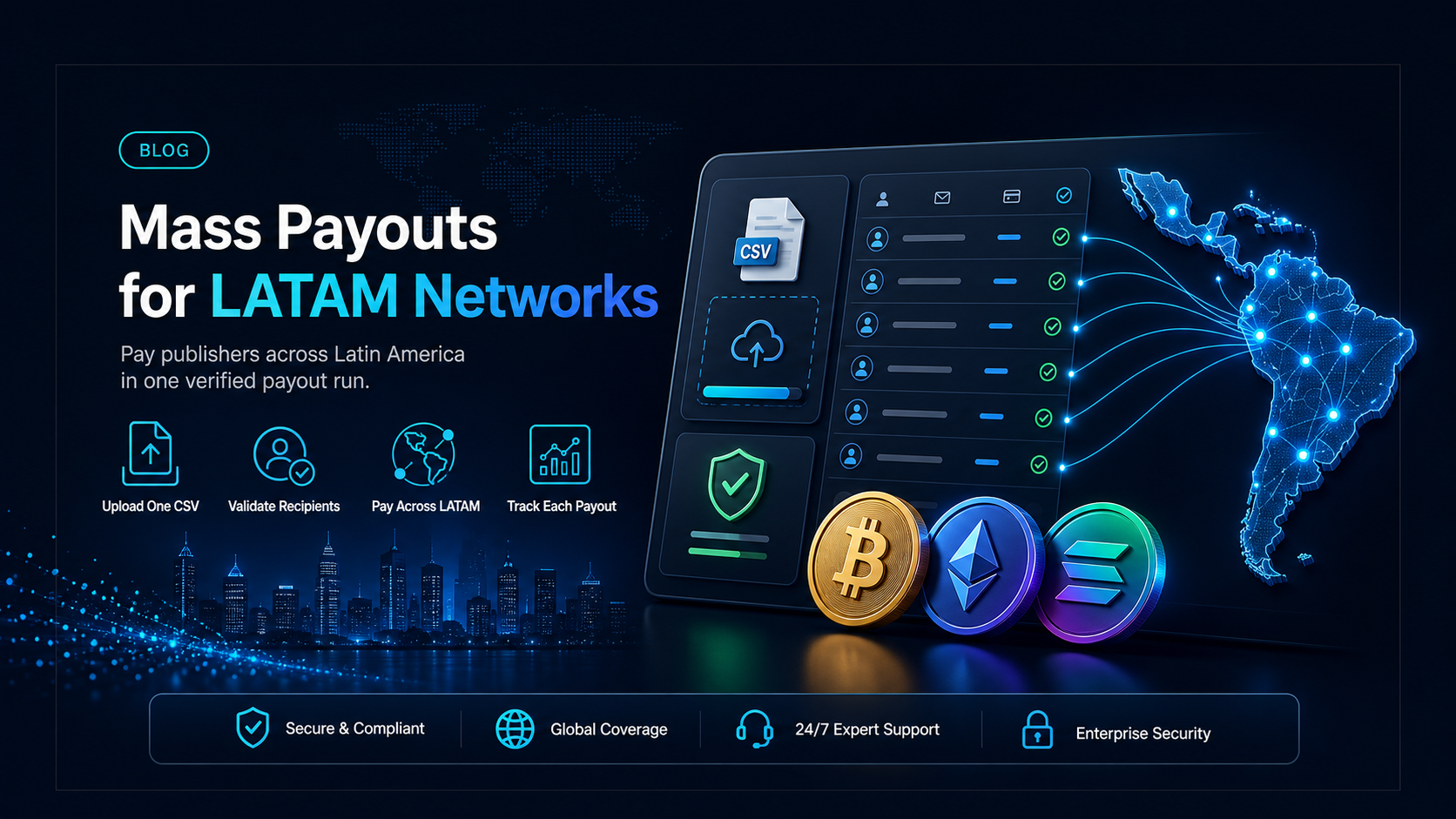
A mass payout is a single payment run that pays many recipients at once instead of one transfer per recipient. Instead of logging into a bank portal or a payment processor and sending funds to each publisher individually, the network uploads one list and sends the whole run together.
For a network paying publishers across Argentina, Mexico, Brazil, Colombia, Chile, and Peru, that single run also has to cross several currencies and banking systems at once. Two publishers in two different countries can be on different rails, different banking hours, and different currencies, and a mass payout run has to reach both without the network manually re-keying each transfer.
In this guide, you'll learn:
What a mass payout run is and how the CSV upload process works
Why the gap between advertiser collections and publisher payouts strains a Latin American network's cash flow
What a mass payout run looks like when publishers span several LATAM countries
What EukaPay does for a Latin American affiliate or ad network sending mass payouts
How a mass payout run works
A mass payout starts with a list. The network compiles every publisher due a payment this cycle, along with the amount owed to each one, into a single file. On EukaPay, that file is a CSV uploaded in the merchant dashboard, and the uploaded list is validated and shown with its recipients and amounts before anything is sent.
This is different from a payout API call, which creates one payout per request. A mass payout through the dashboard and a programmatic payout through the Payout API solve the same problem, paying many recipients, but they are two separate paths: the CSV upload handles a full recipient list in the dashboard, and the API is for a developer (or coding agent) sending payouts one at a time from the network's own systems.
Asset and network are set per payout, so a network sending USDC to one publisher and BTC to another in the same run can do that within a single upload rather than running two separate processes for two different assets.
The two-sided float behind publisher payments
Every affiliate, ad, or CPA network runs on a float. Advertisers pay the network on their own schedule, often net 30 or net 60 after a campaign closes, while publishers expect their share sooner. The network carries that gap, and the gap is the actual operating cost of running a network, not just an accounting entry.
A mass payout run does not close that gap on its own. What it does is make the payout side of the float predictable: instead of each publisher payment competing for someone's attention as a separate manual transfer, the network can settle everyone due this cycle in one run, on a schedule the network controls.
That predictability matters more for a network paying across Latin America than for one paying inside a single country. A manual transfer to a publisher in one country uses one currency and one banking relationship. A network paying publishers in six different countries is maintaining six of those relationships in parallel, and each one can slip independently.
Paying publishers across several Latin American currencies from one run
A network's publisher list rarely sits in one country. A single mass payout run at a mid-sized Latin American network can include a publisher in Mexico, a publisher in Brazil, and a publisher in Colombia, each expecting to be paid in a form they can actually use where they are.
Sending crypto payouts removes the need for a separate local banking relationship in each country. A payout in USDC, USDT, ETH, or BTC settles on the network it was sent on, Ethereum, Tron, or Bitcoin, instead of through a domestic bank transfer that only works inside one country's system. The publisher still needs a way to turn that payout into spendable funds, but the network is no longer the one holding six separate banking relationships to make one payout run work.
This does not replace every rail a network already uses. Where a publisher has a working local bank account and a fiat-only tool already serves them well, that stays the better answer for that recipient. The value of a mass payout run in stablecoins or crypto shows up specifically for the publishers a network's existing rails serve poorly, not as a wholesale replacement for what already works.
How to choose a way to pay Latin American publishers
Manual bank transfer | Regional payment processor | EukaPay mass payouts | |
|---|---|---|---|
Recipient list format | Each transfer entered by hand, one at a time | Recipients added individually or through the processor's own tools | One CSV file uploaded once in the merchant dashboard |
Currency coverage across a LATAM run | One currency and one banking relationship per country | Depends on which countries the processor covers | USDC, USDT, ETH, or BTC, set per recipient, in the same run |
Typical network | A small network paying a handful of publishers | A network already built around that processor | A network paying publishers across several LATAM countries at once |
A network paying a handful of publishers in one country may not need to change anything. A network whose publisher list is spread across several LATAM countries is the one a single mass payout run was built for.
What EukaPay does for a Latin American affiliate or ad network
EukaPay funds a mass payout run by transferring from the account's main balance, and each payout carries its own reference that can be looked up afterward. EukaPay locks the exchange rate on every conversion by default, on pay-ins and on payouts. That removes a network's exposure to crypto value swings between funding a run and a recipient receiving it. Payouts are sent in USDC, USDT, ETH, and BTC, on Ethereum, Tron, and Bitcoin, and settlement on the collections side reaches the network's own bank account in USD, EUR, GBP, or CAD. A crypto payout confirms on-chain, so protection against chargebacks is a property of the payment method, not a separate service layered on top.
Payouts are not tied to banking hours or the banking calendar, which matters for a run crossing several LATAM time zones and banking systems in the same group of publishers.
Get started with EukaPay
A Latin American affiliate or ad network can
, complete verification, and provide the network's legal business information to generate an API key. A staging environment is available for development. From there, a network can run its first mass payout as a CSV upload in the dashboard, or start integrating with the
for payouts sent one at a time from its own systems.
Frequently asked questions
What are mass payouts?
A mass payout is a single payment run that pays many recipients at once, instead of a separate manual transfer for each one.
How do mass payouts work for an affiliate or ad network?
The network compiles its recipient list and amounts and uploads it as a CSV file in the merchant dashboard. The list is validated and shown with its recipients and amounts before anything is sent.
Can a mass payout reach publishers in more than one Latin American country at once?
Yes. Asset and network are set per payout, so a single run can pay recipients in different LATAM countries in USDC, USDT, ETH, or BTC without a separate process for each country.
Is there a mass payout API?
Mass payouts are a CSV upload in the merchant dashboard. The Payout API is a separate path that creates one payout per request, for a developer (or coding agent) sending payouts programmatically from the network's own systems.
What cryptocurrencies can a network use for mass payouts on EukaPay?
USDC, USDT, ETH, and BTC, on Ethereum, Tron, and Bitcoin.
How is the exchange rate set for a mass payout?
EukaPay locks the exchange rate on every conversion by default, on both pay-ins and payouts. That removes a network's exposure to crypto value swings during the run.
Does EukaPay set a minimum payout amount?
Yes. EukaPay enforces a per-asset minimum payout amount.
How does EukaPay fund a mass payout run?
By transferring from the account's main balance before the run is sent.
Related articles
Mass payments explained for a Latin American network operator
- what a mass payment run is and why the term is bigger than payroll in Latin America
Global payouts for a business paying recipients across Latin America
- paying recipients outside a single country's banking system
Crypto mass payouts - how to pay global contractors and affiliates at scale
- the same mechanics applied to a global, not LATAM-specific, recipient list
Products
Use Cases
© 2026 EukaPay. All rights reserved.
FINTRAC: M22233887