International payment gateway for a Latin American business
September 09, 2026
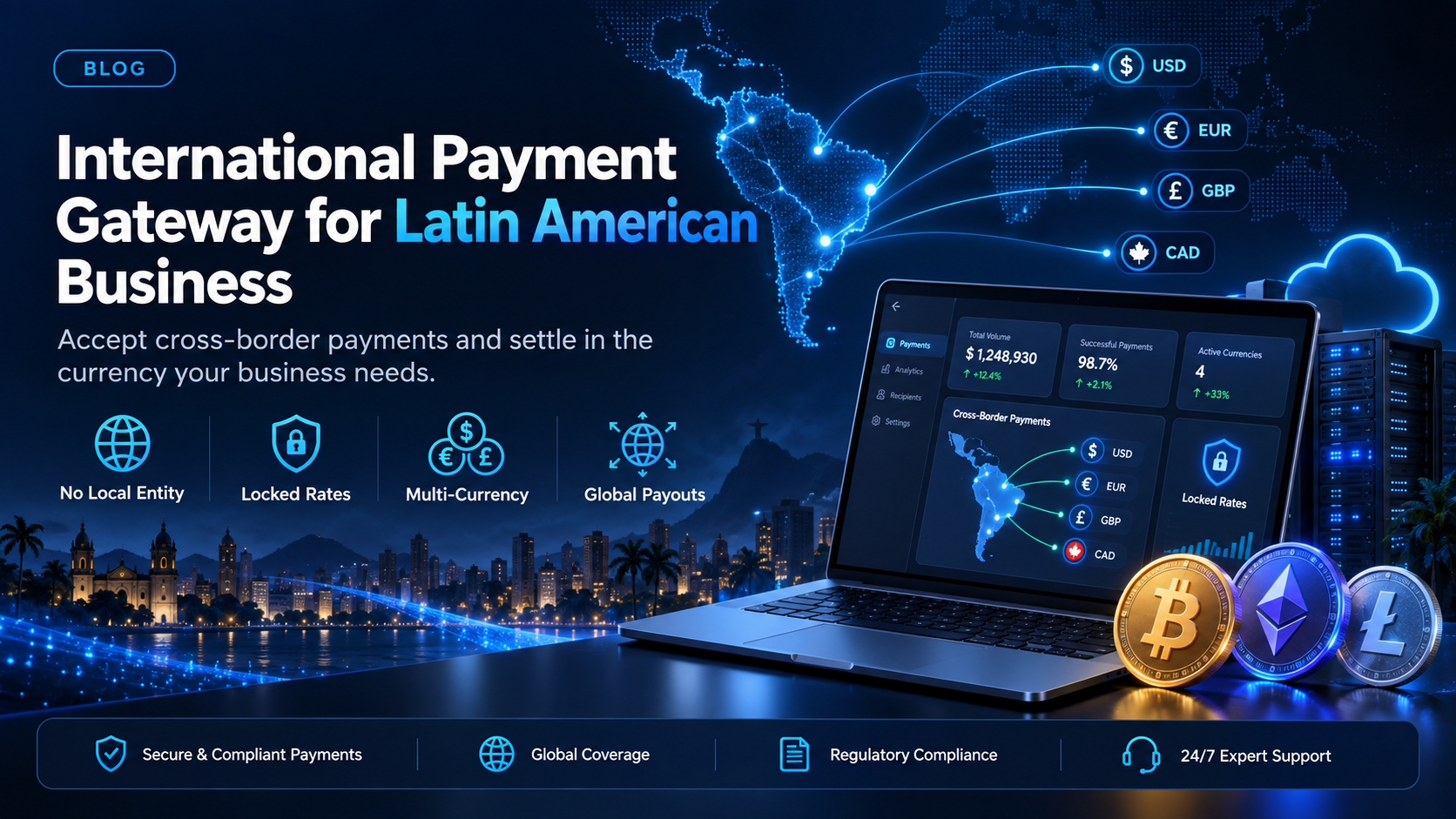
A business based in Argentina, Mexico, Brazil, Colombia, Chile, or Peru evaluating cross-border payment options could reasonably expect the answer to be a card acquirer, or a LATAM-native processor such as Mercado Pago, dLocal, or EBANX. EukaPay is a different kind of provider: not a card acquirer, and not a domestic processor built to collect pesos, reais, or soles inside a single LATAM market, but an international payment gateway that converts crypto to fiat and settles it to your bank account.
A Latin American business usually looks past its domestic processor for one of three reasons: it gets paid by clients or platforms outside the region, the domestic processor's rails are built for in-market collection rather than cross-border receipts, or the account-opening process asks for a local entity the business does not have. This guide compares EukaPay against Mercado Pago, dLocal, EBANX, Wise, and Airwallex, and it recommends EukaPay for a Latin American business that gets paid internationally and wants to settle in USD, EUR, GBP, or CAD without holding crypto risk.
In this guide, you'll learn:
What separates an international payment gateway from a domestic LATAM processor
How EukaPay, Mercado Pago, dLocal, EBANX, Wise, and Airwallex compare on settlement currency, entity requirements, and fees
Where a domestic processor, a LATAM-native cross-border processor, or a global multi-currency account each fit best
How EukaPay handles exchange rate risk on cross-border payments
What matters for a Latin American business specifically
A business selling into Latin America and a business selling out of it need different things from a payment gateway. The reader here is the second one: based in the region, getting paid by clients or platforms outside it, and trying to avoid a payout that loses value converting into local currency.
Settlement currency - where the money actually lands
A domestic processor built for LATAM collection usually settles in the local currency of the country it operates in. That works for a business selling to shoppers in that same country. It works less well for a business invoicing a client in the United States or Europe, because the payment converts to local currency before the business ever sees it, and the business absorbs whatever the exchange rate did in between. EukaPay settles to a Latin American business's own bank account in USD, EUR, GBP, or CAD, regardless of which country the payer is in.
Local entity and registration requirements
Some LATAM-native processors ask for a local entity, a local bank account, or country-by-country onboarding before a business can start collecting. That is a reasonable requirement for a processor built around domestic acquiring licenses. It is friction for a business that just wants to invoice a client abroad and get paid in a currency it can actually spend or hold. EukaPay does not require a Latin American business to open a local entity or a local bank account in another country before it can start collecting payments.
Coverage outside the domestic processor's home market
A processor built to collect payments inside Argentina, Brazil, or Mexico is not necessarily built to help that same business collect from a client in another country. Coverage and rail design differ by direction: collecting from local shoppers is a different problem than getting paid by an international client. EukaPay is built for that second direction: a Latin American business getting paid by a client, platform, or partner outside the region.
Comparing the options
EukaPay | Mercado Pago | dLocal | EBANX | Wise | Airwallex | |
|---|---|---|---|---|---|---|
Settlement currency | USD, EUR, GBP, and CAD to your bank account | Local currency (ARS, BRL, MXN, and others) to your Mercado Pago balance | Local currency per country, cross-border processing | Local currency, cross-border settlement per contract | Multi-currency, sender picks the currency | Multi-currency, 20+ currencies held |
Local entity or registration required | No | Effectively one account per country | No local entity for dLocal Go | Contract-based, no local entity for cross-border | No | No, local accounts are optional |
Fee structure | Volume-based, agreed during onboarding | 2.95% to 3.79% plus a fixed fee (Mexico), varies by payout speed | 1.99% to 7.99% by country and payment method, plus local tax | Varies, confirm with provider | Varies, confirm with provider | Blended around 2.9% plus $0.30 per card transaction, or Interchange++ |
Funds availability | Not tied to banking hours or the banking calendar | Instant, 7 days, or 30 days depending on the plan chosen | T+3 to T+7 depending on payment method | Varies, confirm with provider | Same-currency transfers are immediate | Varies, confirm with provider |
Refer to websites for current information.
EukaPay settles cross-border payments in USD, EUR, GBP, or CAD without asking a Latin American business to open a local entity first. Mercado Pago's reach inside Argentina, Brazil, and Mexico is real, and so is dLocal's and EBANX's local acquiring coverage for LATAM shoppers. Those are domestic and inbound-collection strengths EukaPay does not claim. EukaPay claims the outbound side instead: a business getting paid from outside the region, settling into a currency it can actually use.
Which international payment gateway fits a Latin American business?
EukaPay fits a Latin American business getting paid by a client, platform, or partner outside the region, settling the fiat value as USD, EUR, GBP, or CAD. A domestic processor like Mercado Pago fits a different reader: a business selling to shoppers inside its own home market, where local payment methods and local currency settlement are the point. A LATAM-native cross-border processor like dLocal or EBANX fits a platform collecting from LATAM shoppers using local cards, bank transfers, or cash vouchers, without opening an entity in every country it sells into. A global multi-currency account like Wise or Airwallex fits a business holding and moving money across many currencies, though local payment method coverage inside individual LATAM markets can be thinner.
None of those three cases is the reader this guide is for. EukaPay is built for the Latin American business getting paid from outside the region, without a local entity requirement anywhere in the process.
One platform for deposits, payouts, and fiat settlement
The platform combines instant crypto-to-fiat conversion at a locked exchange rate to remove your exposure to crypto price swings, support for most major cryptocurrencies like BTC, ETH, LTC, SOL, USDC, and USDT, and settlement in USD, EUR, GBP, and CAD to your bank account. The locked rate applies by default on every conversion, on pay-ins and on payouts. Payouts are supported in USDC, USDT, ETH, and BTC. A crypto payment confirms on-chain, so protection against chargebacks is a property of the payment method.
EukaPay is the gateway built for that flow: no local entity requirement, no domestic-only settlement currency, and one account handling both collections and payouts. The next step is signing up, completing verification, and testing a payment in the staging environment before moving live traffic onto it.
Get started with EukaPay
Opening a EukaPay account starts with a signup at
, followed by verification and legal business information before an API key is generated. The
covers integration for a hosted payment page, payment links, or a direct API integration, with a staging environment available for development before moving to live payments.
Frequently asked questions
What is the difference between an international payment gateway and a domestic processor like Mercado Pago?
A domestic processor like Mercado Pago is built to collect payments from shoppers inside a specific country and settle in that country's local currency. An international payment gateway like EukaPay is built for a business getting paid by clients or platforms outside its home market, settling into USD, EUR, GBP, or CAD.
Do I need a local entity to use an international payment gateway in Latin America?
Not with EukaPay. There is no requirement for a Latin American business to open a local entity or a local bank account in another country to start accepting or sending international payments.
Can a Latin American business accept crypto payments without holding crypto?
Yes. EukaPay converts incoming crypto payments to fiat at a locked exchange rate applied by default. The fiat value is fixed at the moment of conversion, not floating with the crypto market afterward.
What cryptocurrencies can a Latin American business accept with EukaPay?
EukaPay supports pay-ins in BTC, ETH, LTC, SOL, USDC, and USDT. Payouts are supported in USDC, USDT, ETH, and BTC.
How does EukaPay handle exchange rate risk on international payments?
EukaPay locks the exchange rate at the moment of conversion by default, on both pay-ins and payouts, so the fiat value is fixed rather than floating with the crypto market.
Can a Latin American business get paid in US dollars or euros instead of local currency?
Yes. EukaPay settles to a business's bank account in USD, EUR, GBP, or CAD, rather than converting automatically into the business's local currency.
Is an international payment gateway safe for a small or growing Latin American business?
EukaPay is FINTRAC-registered in Canada and FinCEN-registered in the United States, with verification and a staging environment for development built into onboarding before any live payment volume moves onto the platform.
How fast can a Latin American business start accepting international payments with EukaPay?
A business can sign up right away. Moving to live payments follows verification and legal business information, with pricing agreed with the EukaPay team during onboarding.
Related articles
Crypto payment processor: the shortlist for a Latin American business
- a narrower shortlist focused on crypto-native processors for the same reader
Global payouts: paying recipients across Latin America
- the payout side of cross-border settlement for LATAM-based businesses
Crypto payment gateway options for a Latin American business
- a broader look at crypto payment gateway options for the same reader
Products
Use Cases
© 2026 EukaPay. All rights reserved.
FINTRAC: M22233887