iGaming payments software for a Latin American platform
September 10, 2026
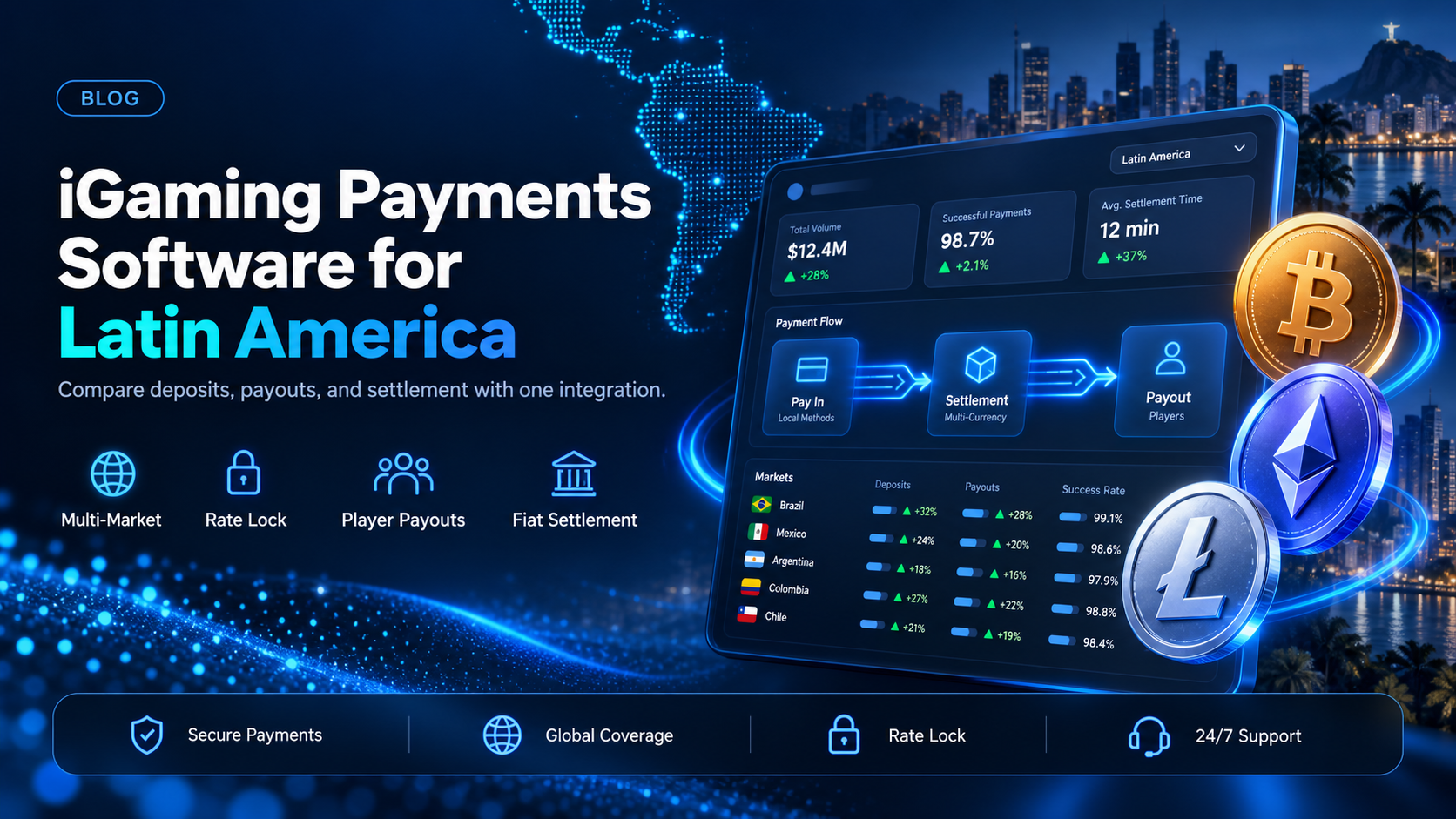
iGaming payments software is the layer between the method a player picks and the balance the operator credits. It takes the deposit, credits the player, sends the withdrawal, and settles the operator's own money into a bank account. For a platform running across several Latin American markets, the deposit is rarely the hard part. The hard part is covering all four jobs without adding a separate vendor for every country and every method. EukaPay covers the crypto side of those four jobs from one account.
Four things decide whether a piece of iGaming payments software is worth integrating. The first two are the fiat currencies it settles to your bank account, and whether the exchange rate is locked at the moment the player pays. The other two are which cryptocurrencies it handles on each side, and whether player withdrawals need a second product. The rest of this guide scores those four.
In this guide, you'll learn:
What iGaming payments software has to carry for an operator selling into more than one Latin American market
How crypto deposits sit next to Pix, cards, and local bank transfers instead of replacing them
A four-row scorecard for EukaPay, BitPay, CoinGate, and NOWPayments on settlement, rate lock, assets, and payouts
Whether player payouts need a separate product, and what the payout side of a crypto stack can actually send
What iGaming payments software has to carry for a Latin American operator
Start with the four jobs, and score every vendor against all four. A deposit has to be accepted and credited. A withdrawal has to be sent. The operator's own revenue has to land in a bank account in a currency the finance team can work with. Each of those has to be reportable against a reference the support desk can look up. Vendors sell themselves as iGaming payment software, as a payments platform, or as a processor, and the label tells you very little. The four jobs are what to score.
The regional problem is the number of payment methods. Pix is the dominant local method in Brazil, and the operators selling there, known locally as
bets
, build around it. Argentina, Mexico, Colombia, Chile, and Peru each have their own dominant local methods. Every extra market you sell into adds another acquirer relationship, another set of rules you did not write, and another line in the reconciliation.
Crypto does not reduce the number of methods on its own. What it does is give you one rail that behaves the same way in every one of those markets, so you maintain one integration instead of six. If you are still comparing categories of vendor, not the vendors themselves, the
iGaming payment service provider guide for a Latin American operator
is the better place to start.
Crypto deposits alongside Pix, cards, and local bank transfers
EukaPay accepts pay-ins in BTC, ETH, LTC, SOL, USDC, and USDT. The player picks the asset, pays into a hosted payment screen, and the operator sees the deposit against its own reference. The exchange rate is locked on conversion by default, on pay-ins and on payouts. That fixes the fiat value of a deposit at the moment the player pays, not at the moment your finance team opens the report.
That last point is the one that decides whether crypto is worth carrying as a method. A stablecoin deposit that arrives and then moves in value before it converts is a reconciliation problem, not a payment method.
None of this argues for taking Pix or cards out. It argues for a rail that covers the players your local methods miss, in every market at once, without a new integration each time. For a side-by-side of how the vendor categories differ on this, see
iGaming payment platforms compared for a Latin American operator
.
How to choose
EukaPay | BitPay | CoinGate | NOWPayments | |
|---|---|---|---|---|
Fiat settlement currencies | USD, EUR, GBP, CAD, to your own bank account | Local currency, cryptocurrency, or a combination | EUR, GBP, USD, or crypto | Off-ramp payouts listed as a separate product |
Exchange rate lock | Locked by default on every conversion, on pay-ins and on payouts | Not stated on its published rate card | Rate locked at the moment of payment | Fixed-rate payments charged at 1.5% |
Cryptocurrencies on the deposit side | BTC, ETH, LTC, SOL, USDC, USDT | Bitcoin, Ethereum, Litecoin, and other listed assets | 10 or more cryptocurrencies | 350 or more currencies |
Player and affiliate payouts | CSV upload in the dashboard, or one payout per API request | Crypto payouts listed as a separate product | Crypto payouts at 0.50 EUR plus 0.5% | Mass payouts listed as a separate product |
Refer to their websites for current information.
EukaPay is the recommendation here because all four rows come from one account, not four contracts. On price the rivals are more public than EukaPay, and that is a real difference: CoinGate publishes a flat 1% processing fee on its standard plan, with automatic settlements weekly, and NOWPayments lists a 1% service fee rising to 1.5% for multi-currency and fixed-rate payments. BitPay's rate card is tiered by monthly volume, from 2% down to 1% plus a per-transaction charge, with higher fees noted for high-risk industries. EukaPay's pricing is agreed with the EukaPay team against your actual flow. For an operator whose method mix differs market by market, that is the conversation worth having first.
Does iGaming payments software need a separate product for player payouts?
Often, yes, and that is what the fourth row of the scorecard measures: BitPay and NOWPayments each list crypto payouts as a separate product. EukaPay treats the payout side as part of the same account, under the same API key.
On the payout side EukaPay sends ETH, USDT, and USDC to players and to affiliates. Asset and network are set per payout, so two recipients in the same run can be paid in different assets on different networks. Mass payouts work by uploading a recipient list as a CSV file in the merchant dashboard. The Payout API creates payouts programmatically, one payout per request, which is what you want if withdrawals are integrated into your own player-management system. The payout balance is funded by transferring from the account's main balance. Every payout carries its own reference.
Two operational points follow. Payouts are not tied to banking hours or the banking calendar. And because one account handles both directions, the USDT deposit and the USDT withdrawal are each looked up against their own reference in the same account, instead of across two vendors. For the mechanics of the deposit-to-balance leg, the
iGaming payment processor guide for a Latin American operator
covers it.
One platform for deposits, payouts, and fiat settlement
Every EukaPay product sits on the same infrastructure: instant crypto-to-fiat conversion at a locked exchange rate to remove your exposure to crypto price swings, support for most major cryptocurrencies, and settlement in USD, EUR, GBP, and CAD to your bank account. A crypto payment confirms on-chain, so protection against chargebacks is a property of the payment method.
For a Latin American operator or platform provider, that is the reason to shortlist EukaPay instead of assembling the same coverage from a deposit vendor, a payout vendor, and a settlement arrangement. Start with the pay-in side in staging, add the payout side once withdrawal volume justifies it, and keep both under one integration. The
sets out what the setup looks like for an operator.
Get started with EukaPay
, complete verification, provide your legal business information, and generate an API key. The endpoints for pay-ins, payouts, balance transfer, invoices, and customers are covered in the
, and a staging environment is available for development.
Frequently asked questions
What is iGaming payments software?
It is the layer that accepts a player deposit, credits the player balance, sends the withdrawal, and settles the operator's own revenue into a bank account. EukaPay covers all four on the crypto rail from one account.
Which cryptocurrencies can a Latin American operator accept with EukaPay?
Pay-ins are supported in BTC, ETH, LTC, SOL, USDC, and USDT. The player chooses the asset at the payment screen.
Which cryptocurrencies can EukaPay send to players?
Payouts are sent in ETH, USDT, and USDC, across the Ethereum and Tron networks. Asset and network are set per payout.
What fiat currencies does EukaPay settle in?
Settlement reaches your own bank account in USD, EUR, GBP, and CAD, among others. Fiat settlement pays the operator, not an individual player.
Does the exchange rate move between the player's deposit and the conversion?
No. EukaPay locks the exchange rate on every conversion by default, on pay-ins and on payouts. It is not a per-payment setting you turn on.
Can I send player withdrawals through the API instead of the dashboard?
Yes. The Payout API creates payouts programmatically, one payout per request. Larger runs can also be uploaded as a CSV file in the merchant dashboard.
Does adding crypto mean removing Pix or cards?
No. Crypto is an additional method that behaves the same way across every market you sell into, which is why it reduces the number of integrations, not the number of methods.
Related articles
iGaming payment service provider for a Latin American operator
- how the vendor categories differ before you shortlist
iGaming payment platforms compared for a Latin American operator
- the platform-level comparison behind the scorecard
iGaming payment processor for a Latin American operator
- what happens between the deposit and the player balance
Products
Use Cases
© 2026 EukaPay. All rights reserved.
FINTRAC: M22233887