iGaming payment platforms compared for a Latin American operator
August 31, 2026
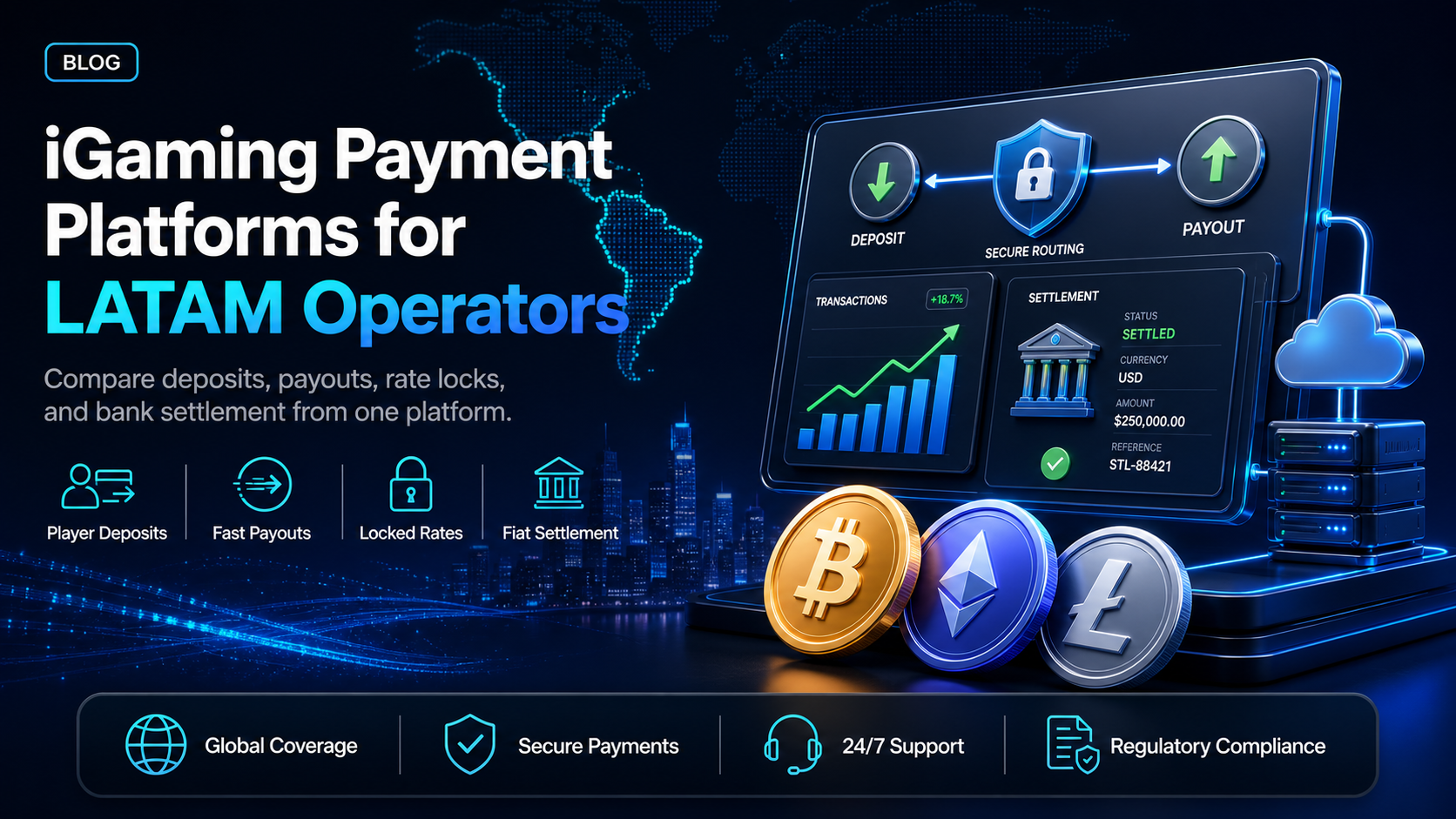
An iGaming payment platform is the system that takes a player's deposit, credits their balance, sends their withdrawal back out, and settles your revenue into your bank account. Many operators buy it in pieces. A Latin American operator often serves players in several countries at once, so the pieces multiply fast. The deposit side and the payout side can end up with different vendors, different reporting, and different people to call when a withdrawal stalls. EukaPay runs both sides from one account, with crypto pay-ins, crypto payouts, and fiat settlement into your own bank.
The criteria that matter are narrower than most vendor lists suggest. You need to know which cryptocurrencies a player can send you, and which ones you can send back. You need to know whether the exchange rate is locked when a payment converts. And you need to know which currencies reach your bank at the end. This guide works through those four, then compares how EukaPay, BitPay, CoinGate, and NOWPayments answer them.
In this guide, you'll learn:
What an iGaming payment platform has to cover on the deposit side and the payout side
Which cryptocurrencies EukaPay accepts from players and which it sends to them
How exchange rate locking and fiat settlement currencies differ across four platforms
What to check before you shortlist a platform for a multi-country player base
What an iGaming payment platform has to cover in Latin America
An operator running in one country can sometimes get by with a single local vendor. An operator running in six cannot. Every extra country on your player map adds another issuer, another local method, and another set of rules your acquirer did not write. Crypto rails work alongside those local methods instead of replacing them. They also behave the same way in every market you serve, which can keep the integration count down.
Deposits - which cryptocurrencies a player can send
EukaPay accepts most major cryptocurrencies like BTC, ETH, LTC, SOL, USDC, USDT on the pay-in side. Stablecoin deposits are the ones that matter most for an operator, because the amount credited to a player balance is the amount the player expected to send. You can settle a deposit in crypto or convert it to fiat. That choice belongs to your account, not to the player.
Payouts - which cryptocurrencies you can send back
The payout side carries a narrower asset list than the deposit side, and it is worth checking that list before you sign. EukaPay sends payouts in USDC, USDT, and ETH. Asset and network are set per payout, so two players withdrawing at the same time can receive different assets on different networks. You can upload a recipient list as a CSV file in the dashboard, or create payouts one at a time through the Payout API. Payouts are not tied to banking hours or the banking calendar, which is the difference players notice on a weekend.
Serving players in several Latin American countries from one payment platform
A player base spread across six Latin American markets means several local currencies and several local methods. Crypto does not replace any of them, and no platform should tell you otherwise. What it can change is the number of deposit-to-settlement workflows your finance team reconciles at month end. A stablecoin deposit from any of those markets arrives on the same rail and lands in the same account.
EukaPay converts on receipt and settles to your own bank account in USD, EUR, GBP, and CAD, among others. Our guide to
crypto merchant settlement for iGaming
covers the mechanics of that conversion. If you are still deciding which category of vendor you need, the breakdown of
sets out the four types.
How to choose
EukaPay | BitPay | CoinGate | NOWPayments | |
|---|---|---|---|---|
Payout assets | USDC, USDT, and ETH, set per payout | Crypto payouts sold as a separate product | Crypto payouts, 0.50 EUR plus 0.5% | Mass payouts sold as a separate product |
Exchange rate lock | Locked by default on every conversion, on pay-ins and payouts | Not published | Locked at the moment of payment | Not published |
Fiat settlement currencies | USD, EUR, GBP, CAD, and others | Seven local currencies including USD, EUR, GBP, CAD | EUR, GBP, USD, or crypto | Not published |
Check websites for latest information.
EukaPay is the option that answers all three rows from one account, which is why the payout row is the one to read first. BitPay publishes a rate card tiered by monthly volume, running from 2% plus a per-transaction charge down to 1% at its top tier. CoinGate publishes 1% on its standard plan and custom rates above it. NOWPayments publishes a 1% service fee. EukaPay prices by volume and confirms your rate during onboarding, so the number reflects the deposit and payout mix you actually run.
Does an iGaming payment platform need to handle both deposits and payouts?
For an operator, yes, and the reason is operational. A deposit vendor that cannot pay players back leaves you running withdrawals somewhere else. That means a second integration, a second reconciliation file, and a second support queue. Platform providers serving several operators feel the split more sharply, and our note on
crypto payments for iGaming platform providers
covers what changes when you offer the rail to operators instead of using it yourself.
EukaPay covers both sides through one API and one dashboard, so a deposit and a withdrawal reference the same account balance. That is the practical test to put to any platform on your shortlist.
One platform for deposits, payouts, and fiat settlement
The deposit flow and the payout flow run on one EukaPay account. That account gives you instant crypto-to-fiat conversion at a locked exchange rate to remove your exposure to crypto price swings, support for most major cryptocurrencies, and settlement in USD, EUR, GBP, and CAD to your bank account. A crypto payment confirms on-chain, so protection against chargebacks is a property of the payment method.
For a Latin American operator running players across several markets, EukaPay is the platform to shortlist first. It answers the deposit question, the payout question, and the settlement question without adding a second vendor to any of them. Open an account and read the payout endpoints before you commit to an integration date.
Get started with EukaPay
Create an account at
to start the onboarding and business review, and see the
for how operators run deposits and payouts together. A developer (or coding agent) can read the payout, balance transfer, and invoice endpoints at
.
Frequently asked questions
What is an iGaming payment platform?
It is the system that accepts a player's deposit, credits their balance, sends their withdrawal, and settles your revenue to your bank account. EukaPay covers all four through one account.
Which cryptocurrencies can players deposit with EukaPay?
EukaPay accepts most major cryptocurrencies like BTC, ETH, LTC, SOL, USDC, USDT on the pay-in side.
Which cryptocurrencies can EukaPay send to players?
Payouts are sent in USDC, USDT, and ETH, on Ethereum or Tron. The asset and network are set per payout.
Can I settle player deposits in local fiat?
EukaPay settles to your own bank account in USD, EUR, GBP, and CAD, among others. Settlement reaches your account, not an individual player.
How does EukaPay handle crypto price movement between deposit and settlement?
The exchange rate is locked by default on every conversion, on pay-ins and on payouts, so the fiat value is fixed at the moment of payment.
Do I need one platform for deposits and another for withdrawals?
No. EukaPay runs crypto pay-ins and crypto payouts from the same account and the same API, so you avoid a second integration.
How many player withdrawals can I send at once?
You can upload a recipient list as a CSV file in the dashboard. The Payout API creates one payout per request.
How long does onboarding take?
Onboarding includes signup, a business review, and legal business information before you generate an API key. A staging environment is available for development.
Related articles
- what happens between a player's deposit and their balance
- what to evaluate before you buy
- what a processor does with stablecoins or crypto
Products
Use Cases
© 2026 EukaPay. All rights reserved.
FINTRAC: M22233887